
IT vs Software Engineering Navigating Your 2026 Career Choice
· 26 min read

Why ‘IT vs Software Engineering’ still matters in 2026
It’s 2026, and you might still hear people use "IT" and "software engineering" as if they mean the same thing. But actually, these two fields are quite different. This mix-up can make it hard for people to pick the right career path or for companies to hire the right person.

If you’re looking into computer information systems jobs or dreaming of a software development job, understanding these differences is super important.
Knowing what makes "it vs software engineering" different helps you choose your education, build a strong computer engineering resume, and find the job that truly fits your skills and goals. For example, a software engineer often designs and builds new software applications from the ground up, using programming languages to create new systems 2026. Companies often look for these skills when filling software development jobs. On the other hand, IT professionals usually focus on keeping computer systems, networks, and existing software running smoothly for users. They are the ones who make sure everything works day-to-day.
This article will help clear up this common confusion. We will look at the real differences between IT and software engineering. We will explore what the job market looks like for each field in 2026 and talk about the specific skills you need for both. We will also give you a clear plan to help you decide which path is best for you, whether you are just starting out or thinking about a career change. Understanding these roles can even help you see where systems engineering jobs fit into the big picture.
Want to stay sharp on all the latest tech and AI trends that shape these fields?
Get clear daily AI updates from The AI Newsletter Worth Reading.
Defining the Fields: What ‘IT’ and ‘Software Engineering’ Typically Mean
As we look at "it vs software engineering," it’s clear these two areas have different main goals.
Think of it this way: one group mostly handles keeping the lights on for computer systems, and the other group mostly builds the actual light bulbs.
The Role of Information Technology (IT)
Information Technology, or IT, is all about making sure computer systems, networks, and existing software work well every day. People in IT are like the helpful support team for a company’s technology. Their main job is to keep things running smoothly, fix problems, and make sure everyone can use their computers and programs without trouble.
This often includes tasks like:
- Setting up and managing computer networks
- Making sure data is safe and secure
- Helping users with their technical issues (this is often called IT support)
- Maintaining servers and other computer hardware
- Managing existing software applications
In 2026, many computer information systems jobs focus on these tasks. If you’re looking at an IT Certification Roadmap for 2026, you’ll often see paths for IT support and network administration.
The World of Software Engineering
Software engineering, on the other hand, is about creating new software and making big changes to existing ones. Software engineers are like the architects and builders of the digital world. They design, write, and test the code that makes applications, operating systems, and other software work. Their work is a core part of any software development job.
Key tasks for software engineers include:
- Planning how a new software program will work
- Writing computer code using different programming languages
- Testing software to find and fix mistakes
- Improving software over time to add new features or make it run better
- Designing whole software systems from scratch
A software engineer focuses on the full journey of a software product, from an idea to a finished, working program. They often create new systems and software to make things more efficient, as explained by the National Occupational Classification (NOC) 2021 Version 1.0. If you are thinking about a career in this field, learning more about a guide to software engineering degrees for your 2026 tech career can be a great first step.
Where IT and Software Engineering Overlap
While IT and software engineering have different main jobs, they do work together a lot. Sometimes, the lines between them can get blurry, especially in certain job roles. For example, some jobs need skills from both sides:
- DevOps: This stands for Development Operations. DevOps people help software developers and IT operations teams work better together. They make sure new software can be built, tested, and put into use quickly and smoothly.
- Platform Engineering: These engineers build and manage the tools and systems that software developers use to create their products. They help make sure developers have the best environment to work in.
- Site Reliability Engineering (SRE): SREs are engineers who use software engineering methods to help IT operations run more reliably. They write code to automate tasks that IT teams usually do, making systems more stable and efficient.
These roles show that while the core tasks for "it vs software engineering" are different, both are very important for any company that uses technology. They often work hand-in-hand to build and maintain the digital tools we rely on every day.
Want to stay sharp on all the latest tech and AI trends that shape these fields?
Get clear daily AI updates from The AI Newsletter Worth Reading.
Education, certifications, and early-career paths for each track
Now that we know what IT and software engineering are, let’s talk about how people get started in these exciting fields.
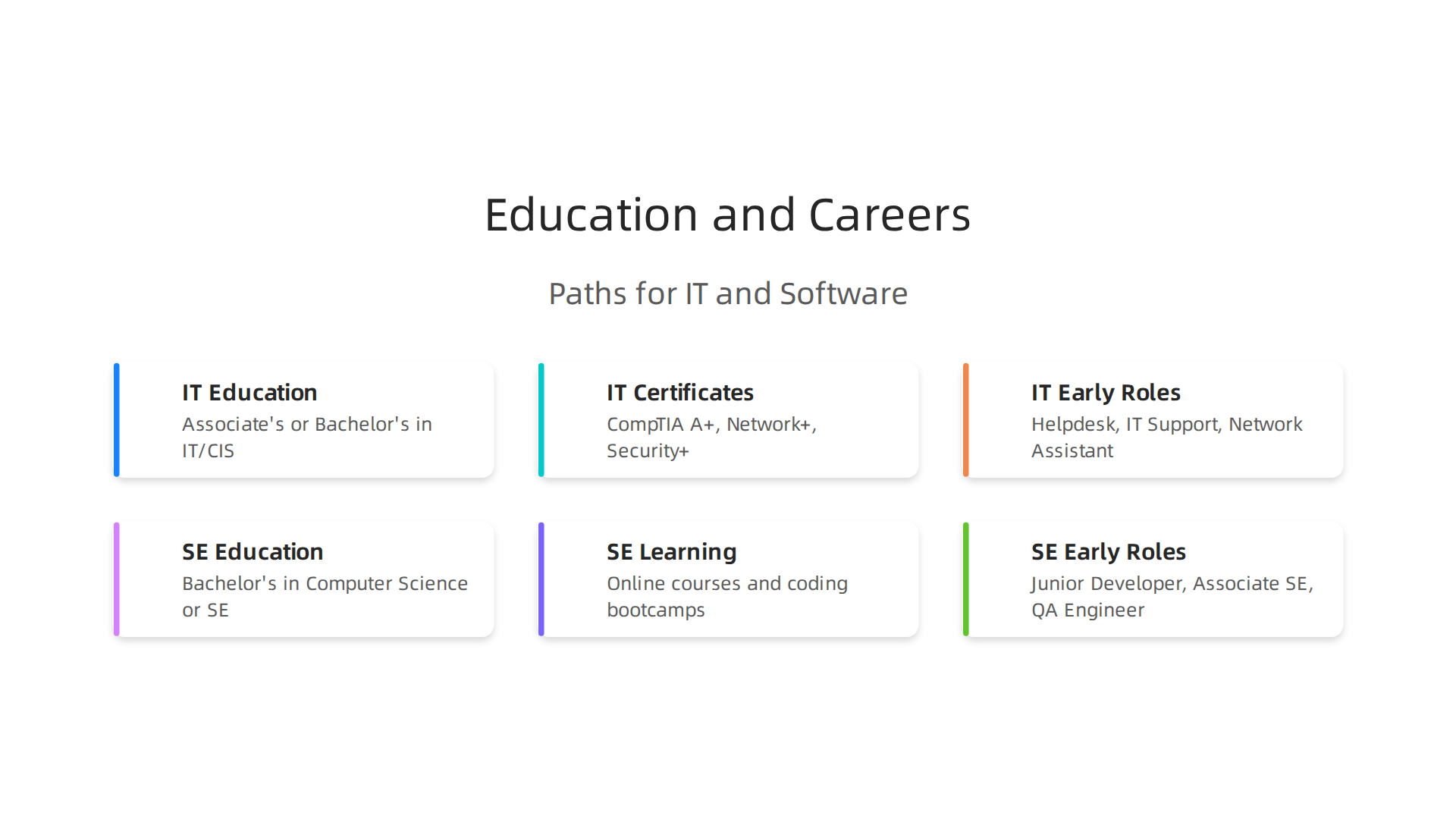
The paths are quite different, and understanding them can help you choose the right one for you. This distinction is key when thinking about "it vs software engineering" for your future.
Learning and Certificates for IT
Many people get into IT through different routes. Some go to college for a two-year associate’s degree or a four-year bachelor’s degree in things like Information Technology or Computer Information Systems. But actually, many IT pros start with special certificates that show they have certain skills.
These IT certifications are very important. They prove you know how to do specific tasks, like fixing computers or setting up networks. For 2026, some popular starting certificates include CompTIA A+ for basic computer skills, CompTIA Network+ for network basics, and CompTIA Security+ for keeping systems safe. These can help you land your first computer information systems jobs.
When you’re just starting in IT, you might find yourself in roles like:
- Helpdesk Technician: You answer calls and emails to help people with their computer problems.
- IT Support Specialist: You help users in person, fixing their software or hardware issues.
- Network Administrator Assistant: You help keep the computer network running smoothly.
These early jobs are all about solving problems for users and maintaining existing systems. You’ll learn a lot on the job about how a company’s technology works day-to-day.
Learning and Certificates for Software Engineering
Becoming a software engineer usually means going to college for a four-year degree. A Bachelor’s in Computer Science or Software Engineering is very common. These degrees teach you how to think like a programmer, how to design complex systems, and how to write good code. If you’re deciding between these degrees, it’s worth learning about computer science vs software engineering degree options.
However, you can also learn software engineering skills through online courses or special bootcamps that teach you coding quickly. While there are some specialized certifications for programming languages or cloud platforms, they are usually seen as extra skills rather than the main way to get hired. The key here is showing you can build things.
Early-career software engineering roles often look like this:
- Junior Developer: You write and test parts of new software under the guidance of more experienced engineers.
- Associate Software Engineer: Similar to a junior developer, you contribute to building software features.
- Quality Assurance (QA) Engineer: You test software to find bugs and make sure it works as expected.
For anyone looking to start their software development job journey, these roles are crucial for gaining real-world coding experience. A strong junior software engineer 2026 skills roadmap often involves working on projects, learning different programming languages, and improving problem-solving skills. These paths clearly highlight the different starting points in the world of "it vs software engineering."
After understanding the starting points and early roles, it’s time to look at the important skills you’ll need. Both IT and software engineering need special technical know-how and also good "people skills."
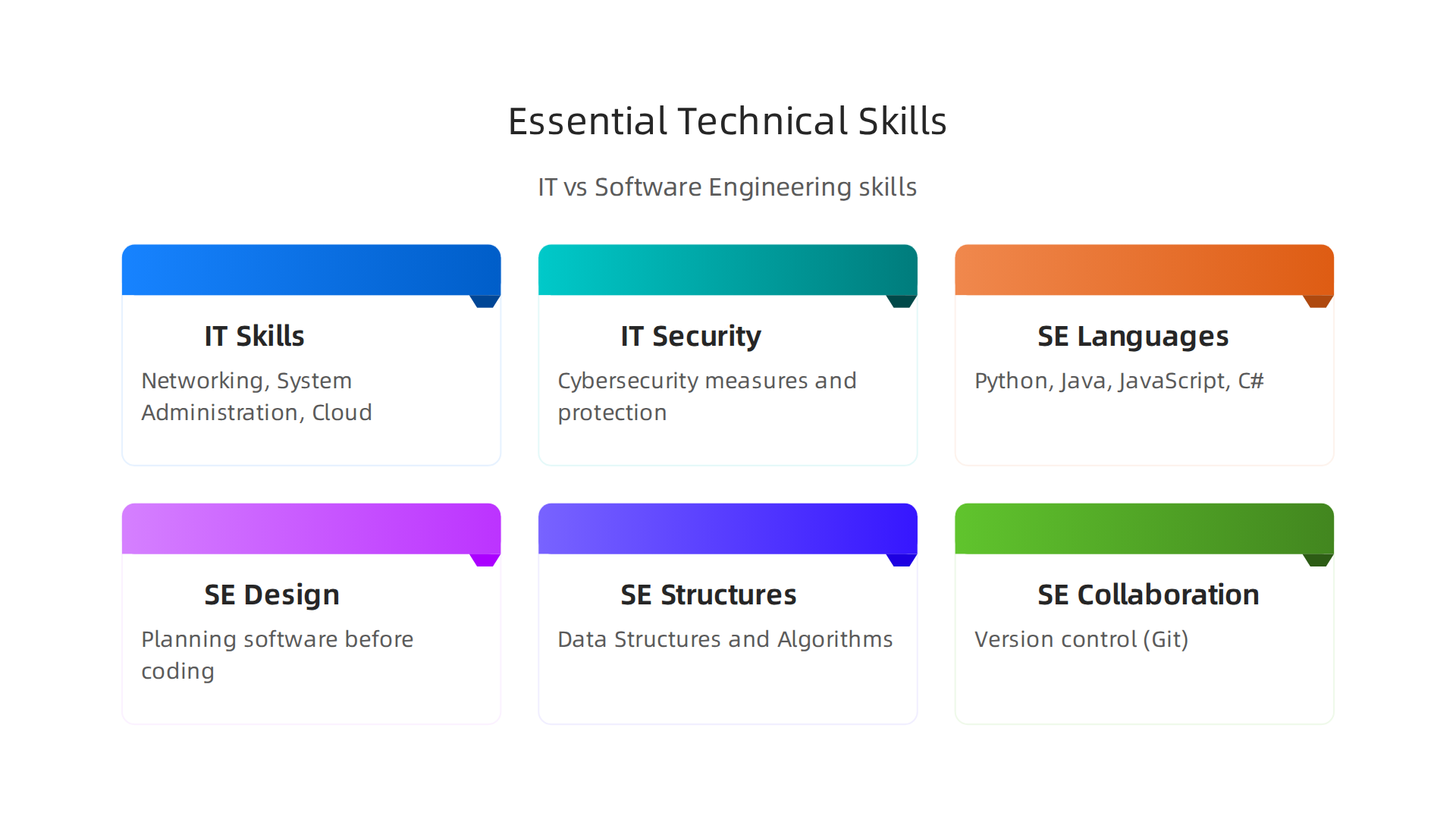
The differences in these skills truly show the gap in "it vs software engineering."
Technical Skills for IT
IT workers are like the doctors and mechanics for computer systems. They need to know how to keep things running smoothly. Here are some key technical skills for IT:
- Networking: This is about how computers talk to each other. IT pros need to know how to set up, secure, and fix network connections. Think of Wi-Fi, internet, and all the wires that connect devices.
- System Administration: This means managing servers, computers, and other devices. It’s about making sure software is installed correctly, users can log in, and everything is safe.
- Cloud Computing: Many businesses use online services like Amazon Web Services (AWS) or Microsoft Azure. Knowing how these cloud systems work is very important for today’s enterprise IT services.
- Cybersecurity: Keeping systems safe from hackers and viruses is a big part of IT. This skill involves setting up firewalls and making sure data is protected.
These skills are vital for anyone looking into computer information systems jobs and making sure a company’s tech stays healthy.
Technical Skills for Software Engineering
Software engineers are like architects and builders. They create the programs and apps we use every day. Their technical skills focus more on making new things:
- Programming Languages: They must know one or more programming languages very well. Popular ones include Python, Java, JavaScript, and C#. Learning to master programming language fundamentals is a must.
- Software Design: This is about planning how a program will work before writing any code. It involves thinking about how different parts of the software will fit together and interact.
- Data Structures and Algorithms: These are special ways to store and organize information, and rules for solving problems with that information. They help make software fast and efficient.
- Version Control: Tools like Git help engineers work together on code without messing up each other’s work. It’s like a save history for all the changes made to a program.
Today, understanding AI for software development is also becoming a key technical skill, as AI tools help engineers write and test code faster.
Soft Skills for Both Paths
No matter if you choose IT or software engineering, some "people skills" are super important. These are often called soft skills:
- Troubleshooting and Problem-Solving: Both fields are all about fixing problems. You need to be able to think clearly and find solutions.
- Communication: You’ll often need to explain complex technical things to people who don’t understand tech. Good communication helps teams work better and helps users get the help they need.
- Teamwork: Most projects in tech involve working with others. Being a good team player is key to success.

- Continuous Learning: Technology changes very quickly. To stay good at your job, you must always be ready to learn new tools and ideas. Experts agree that human skills like a strong work ethic, along with new AI skills, are very important for the tech jobs in 2026 2026Q2. This ongoing learning helps you define developer levels as you grow in your career.
Being able to show these soft skills on your computer engineering resume is just as important as your technical abilities. The tech industry in 2026 values workers who can adapt and learn.
For example, artificial intelligence is changing many tech jobs. Staying updated on these new trends is crucial. Did you know that AI is expected to create many new IT jobs in 2026? 2026 State of Tech Talent Report It means you need to keep learning! Get clear daily AI updates from The AI Newsletter Worth Reading.
Building on the skills we just talked about, let’s see how those skills turn into actual jobs and career paths. Both "it vs software engineering" offer many chances to grow. Knowing the typical roles helps you plan your future in tech.
Typical Roles, Titles, and Career Progression Ladders
In the tech world, your job title often changes as you learn more and take on bigger tasks.

Let’s look at common paths for IT and software engineering professionals in 2026.
IT Career Progression
In IT, you often start by helping people directly with their computer problems.
- Entry-Level: A common start is a Help Desk Technician or Junior System Administrator. In these roles, you fix smaller issues and learn how to manage computer systems.
- Mid-Level: As you gain more experience, you might become a full System Administrator, managing servers and user accounts for a company. Other mid-level jobs include Network Administrator, focusing on how computers connect, or a Cybersecurity Analyst, protecting systems from online threats. A very popular newer role is Cloud Engineer, managing services on big online platforms. Getting from an entry to a senior IT role can take 5-8 years, with mid-level roles often requiring 2-5 years of experience, according to the IT Career Roadmap 2026: Entry-Level to Senior Roles. These roles are key for computer information systems jobs that keep businesses running smoothly.
- Senior-Level: Higher up, you could become an IT Manager, leading a team of IT specialists, or a Solutions Architect, designing large and complex IT systems. Some even become an IT Director, guiding all technology decisions for a company.
Software Engineering Career Progression
For software engineering, your path starts with learning to code and create programs.
- Entry-Level: You might begin as a Junior Software Developer or Associate Software Engineer. Here, you write code for small parts of bigger programs, usually with help from senior team members. If you’re looking into this path, understanding the junior software engineer 2026 skills hiring career roadmap is a great first step.
- Mid-Level: Next, you become a Software Engineer or a specialized developer. This could mean being a Front-End Developer (building what users see), a Back-End Developer (building the hidden logic), or a Database Developer (managing how data is stored). Many roles like these are considered part of the broader category of Software engineers and designers. For example, software engineers are crucial for designing and testing new applications Occupation 273333 Software Engineer. Moving from a junior to a mid-level role often takes 1 to 2 years, and then another 2 to 4 years to reach a senior position How to Get Promoted as a Software Engineer (2026).
- Senior-Level: After gaining solid experience, you can become a Senior Software Engineer, taking on bigger projects and guiding junior team members. From there, you might move into a Tech Lead role, where you guide a small team of developers, or a Software Architect, designing the overall structure of large systems. You could even become a Principal Engineer, influencing technical strategy across many different teams, as shown in the Mapping the Developer Career Ladder. Many companies, like Dropbox, have clear career paths from Software Engineer to Principal Software Engineer in their Dropbox’s engineering career framework. These are all important jobs in the world of software development job.
Crossover Opportunities and Pivoting
Sometimes, people begin their careers in one area and then move to another. For example, an experienced System Administrator with good scripting skills might learn more programming and move into a DevOps Engineer role. DevOps is a special area that mixes IT operations and software development to make delivering software faster and smoother.
Similarly, a software engineer who enjoys solving problems with computer infrastructure could pivot into a Site Reliability Engineer (SRE) role. This job involves using software engineering skills to improve IT operations. These types of crossover roles show that the lines between "it vs software engineering" can sometimes blur, especially as you gain more experience. Being able to show a broad skill set on your computer engineering resume can open up these kinds of opportunities, including some interesting systems engineering jobs that combine both worlds.
The key is to keep learning new things and find what you enjoy most in the fast-changing world of technology.
Now that we’ve looked at the different jobs and career paths, let’s talk about how much these roles pay and how much they are in demand. Understanding salary, demand, and market trends helps you see how employers value each track in 2026.
Salary, Demand, and Market Trends (How Employers Value Each Track)
Thinking about money is a big part of choosing a career. In the tech world of 2026, pay and demand for jobs in IT and software engineering can change a lot. It depends on where you live, what kind of company you work for, and even how big that company is.
The overall tech job market in 2026 is growing. For example, the information sector is expected to grow quite fast between 2024 and 2034, helping to add many jobs across the economy, according to the Bureau of Labor Statistics projections Industry and occupational employment projections overview. The overall tech workforce is also expected to reach almost 9.8 million workers in 2026, creating hundreds of thousands of new jobs. However, hiring can be very specific, and the rise of AI is making some changes in the kinds of skills needed in the workforce. The 2026 US Tech Labor Market report from Forrester points to selective hiring and questions about AI’s impact.
Where Demand Varies
Demand for both IT and software engineering jobs is not the same everywhere.
- Geography: Big tech hubs like cities in California or New York often have more job openings, but also more people looking for those jobs. Smaller cities might have fewer jobs but also less competition. The need for tech talent also varies by country.
- Industry: Some industries, like healthcare, finance, or government, always need strong IT support to keep their systems safe and running. Other industries, like gaming or social media, lean heavily on software engineers to build new products. The 2026 Tech Jobs Report shows growth in areas like healthcare and enterprise systems.
- Company Size: Large companies might have many specialized IT and software engineering teams, offering many different roles. Smaller startups might need people who can do a bit of everything, wearing many hats.
What Employers Look For
Employers look for a mix of skills when hiring for IT vs software engineering roles:
- Technical Skills: For software engineers, strong coding skills in popular languages are a must. For IT professionals, knowing how to manage networks, servers, or cybersecurity tools is key. Both roles need people who can solve problems.
- Human Skills: Beyond technical know-how, employers highly value soft skills. These include being professional, having a good work ethic, and being able to work well in a team. The Experis US Tech Talent Outlook Q2 2026 report highlights the importance of these human skills, along with critical AI capabilities.
- Specialization and Experience: As you grow in your career, becoming an expert in a specific area, like cloud computing or artificial intelligence, can make you more valuable. Companies are increasingly looking for skills in areas like data analytics, cybersecurity, and software development, as noted in the State of the Tech Workforce 2026 by CompTIA. Continuous learning is vital to stay current with modern software development trends, including how to integrate new tools and practices, especially as AI advances. If you are looking to improve your skills, consider taking a choosing the best software development course for 2026.
Understanding Salary Numbers
When you see big salary numbers, it’s important to remember they don’t tell the whole story.
- Seniority Matters: An entry-level software engineer will earn much less than a senior software engineer or a principal engineer. For example, a junior software engineer might earn around $80,000 to $115,000, while a senior engineer could make $160,000 to $225,000 or more in the US, depending on the company and location, as seen in the Block Software Engineer Career Ladder.
- Region and Cost of Living: A high salary in a city with a very high cost of living might not go as far as a slightly lower salary in a more affordable area.
- Specialization and AI: Roles with specialized skills, especially in fast-growing areas like AI or cybersecurity, tend to command higher salaries. The impact of AI is also changing salaries in the tech market, as mentioned in the Tech Job Market 2026: Layoffs, AI Salaries, and Hiring Data report.
- Company Benefits: Besides salary, look at the full package. Things like health insurance, retirement plans, paid time off, and stock options add a lot to your total earnings.
The choice between IT vs software engineering often comes down to your passion. Do you love building new things and creating code, or do you enjoy making sure systems run smoothly and people can do their work? Both paths offer great rewards, but knowing these market trends helps you make a smart choice for your future. Staying informed about how AI for Software Development affects jobs is also crucial for either track.
The way we work in both IT and software engineering is changing a lot because of AI and automation. These new tools are not just fancy add-ons; they are reshaping what people do every day in these jobs. It’s not about machines taking over, but about how machines help us do our jobs better. Actually, AI is set to reshape more jobs than it replaces, changing what tasks we focus on AI Will Reshape More Jobs Than It Replaces.
How AI Helps Software Engineers
For people who build software, AI is becoming a helpful friend.
- AI-Assisted Coding: Tools powered by AI can help write code faster, fix small mistakes, and even suggest new ways to build parts of a program. This means software engineers spend less time typing out simple lines of code. Instead, they can focus more on the bigger picture, like designing how different parts of a system work together. Many organizations are already using AI in their development work, with almost 97% of software development organizations actively using or evaluating AI in 2026 AI Reaches 97% of Software Development Organizations.
- Faster Work: AI agents are making things quicker in many parts of software development, like creating code, doing research, testing, and planning The 2026 State of AI Agents Report. This means a software development job changes from just writing code to guiding AI tools and making sure they do what’s needed.
- New Skills Needed: If you want to be a software engineer in 2026, you’ll need to learn how to talk to AI. This is called "prompt engineering," where you give clear instructions to AI so it gives you the best results. You also need to understand how to design whole systems with AI in mind, not just write small pieces of code. Learning how to best use AI coding assistants in 2026 is a key skill.
How AI Helps IT Professionals
For those in IT, AI and automation are also changing things a lot.
- Observability Automation: This means using AI to watch computer systems, networks, and applications all the time. If something goes wrong, the AI can often spot it quickly, sometimes even before humans notice. This helps IT teams fix problems faster or even stop them from happening.
- AIOps: This is when AI helps with IT operations. It takes care of many routine tasks that IT pros used to do, like checking system health or doing small repairs. This frees up IT staff to work on more complex issues and plan for the future. Many IT workers say AI makes their work faster and helps them spend less time on repeated tasks 2026 AI Maturity Report.
- Shifting Roles: Four out of five IT professionals see their roles changing as AI becomes more common in their work New SolarWinds Report Shows 4 in 5 IT Pros See Shift in Role as AI Permeates Workflows. For people in computer information systems jobs or systems engineering jobs, this means learning how to manage these new AI tools and systems. It also means focusing on skills like automation scripting and understanding how AI can predict and prevent problems. By 2030, a quarter of IT operations work might be handled by AI AI ops tools will create console sprawl and break IT more often. This shows a clear shift towards proactive, AI-driven operations Gartner Report: Predicts 2026 — AI Agents Will Transform IT Infrastructure Operations.
Key Skills for the Future
No matter if you choose IT vs software engineering, some skills will be very important.
- Prompt Engineering: Learning how to give good instructions to AI is key. This helps AI tools understand what you need them to do, whether it’s writing code or troubleshooting a network issue. You can learn more about Google prompt engineering to get started.
- Automation Scripting: Being able to write small programs that tell AI and other tools to do tasks automatically will be super helpful.
- System Design for AI: Understanding how to build and manage systems where AI plays a big part. This includes making sure AI works well and is safe. This means learning about context engineering to design dependable AI systems.
- Continuous Learning: The world of tech moves fast. Staying updated on new AI tools and methods is a must for any computer engineering resume or career path.

If you are interested in learning more about how to stay on top of AI trends, make sure to get clear daily AI updates from The AI Newsletter Worth Reading.
AI and automation are not just changing jobs; they are making them more interesting. They take away the boring, repetitive tasks and let people focus on problem-solving and creating new things. For anyone looking at an it vs software engineering career, understanding AI’s role is crucial for success in 2026 and beyond.
It’s clear that AI is changing both IT and software engineering, making it more important than ever to pick the right path for you. So, how do you decide between an it vs software engineering career? It comes down to looking at a few key things about yourself and the job world.
A Practical Decision Framework: How to Choose Between IT and Software Engineering
Making a big career choice like this needs careful thought. Here’s a simple checklist to help you decide which path, IT or software engineering, might be better for you in 2026.
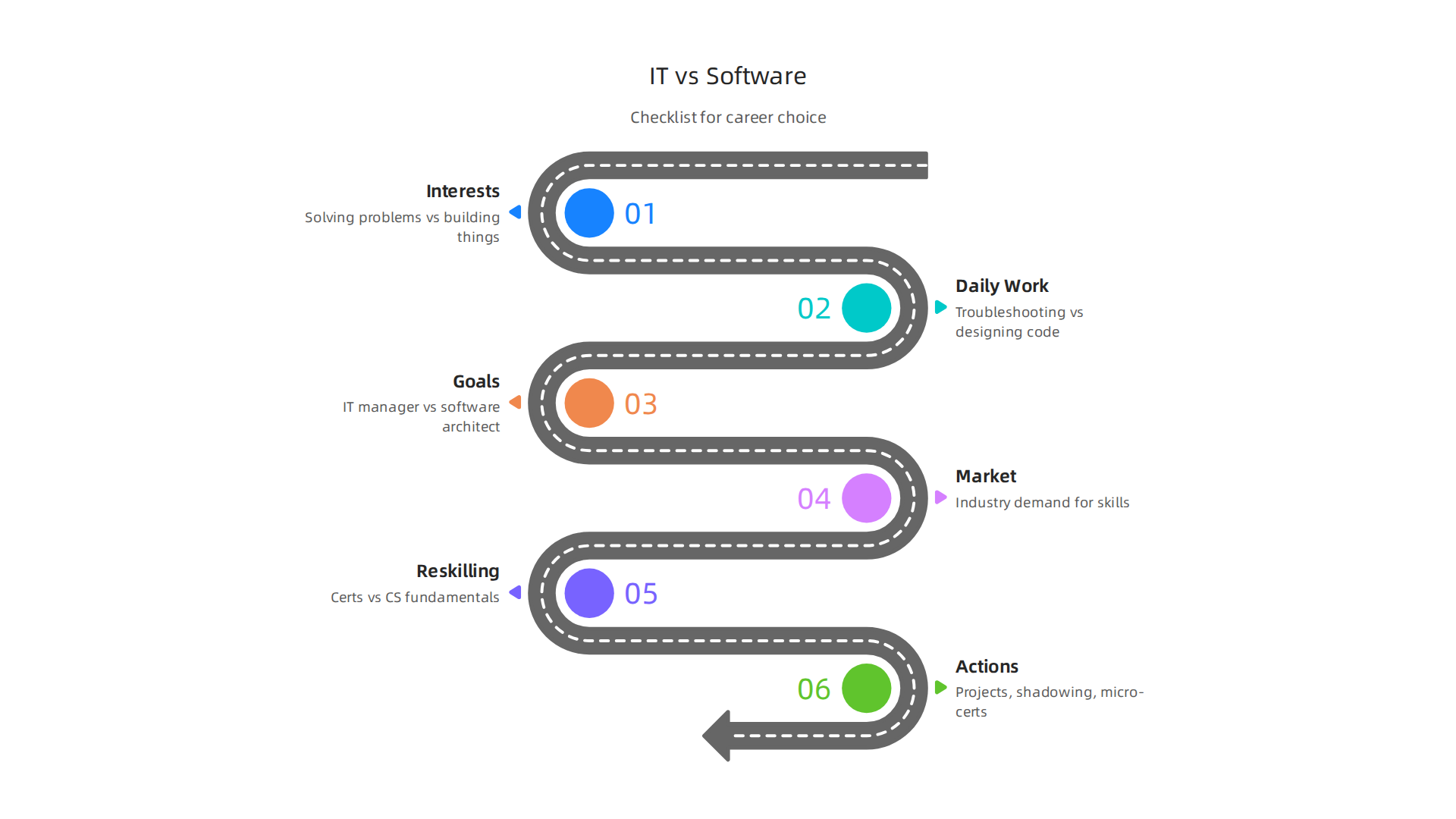
1. Your Interests
Think about what excites you.
- IT: Do you like solving immediate problems with computer hardware, networks, and systems? Are you good at making sure everything runs smoothly and securely? If you enjoy working directly with technology infrastructure and keeping it operational, then IT might be your calling. This includes roles like working in computer information systems jobs.
- Software Engineering: Do you love building new things from scratch, writing code, and seeing your creations come to life? Are you interested in the logic behind applications and how different pieces of software fit together? If so, a software development job might be a better fit.
2. Daily Work Preferences
What kind of tasks do you want to do every day?
- IT: IT professionals often spend their days troubleshooting, maintaining existing systems, setting up new equipment, and dealing with user support. It’s about reacting to issues and making sure services are always available.
- Software Engineering: Software engineers focus on designing, coding, testing, and deploying new software. Their days involve a lot of problem-solving through code and creating innovative solutions.
3. Long-Term Goals
Where do you want your career to go? Both fields offer great paths.
- IT: You can grow into specialized areas like cybersecurity, cloud architecture, or become an IT manager. The IT Career Roadmap 2026: Entry-Level to Senior Roles shows how you can move from junior roles to senior positions and beyond.
- Software Engineering: You could become a lead developer, a software architect, or even move into engineering management. Knowing how companies define developer levels can help you plan your climb.
4. Market Signals
It’s wise to look at what companies are hiring for and what skills are in demand in 2026. Both fields are growing, but the specific skills needed can be different. For example, if you are interested in a specific branch like a solutions engineer career roadmap for 2026, you would look into the specific market demand for that.
5. Reskilling Effort
If you’re looking to switch or start fresh, how much new learning are you ready for?
- IT: Often, IT roles can be entered with certifications like CompTIA, and you can learn on the job. There are clear roadmaps for IT certifications in 2026.
- Software Engineering: This path usually needs strong coding skills and computer science fundamentals. There are many great online courses for software engineering available to help you gain these skills.
Action Steps for Exploring Your Options
It’s okay not to know everything right away! Here are some ways to test the waters:
- Small Projects: Try a basic coding project if you’re leaning towards software engineering. For IT, practice setting up a home network or fixing a friend’s computer.
- Shadowing: If possible, spend a day with someone in each role to see what their daily work is like.
- Micro-Certifications: Take a short online course or earn a micro-credential in an area that interests you. These quick courses let you learn new skills without a big commitment. For anyone thinking about a computer engineering resume, hands-on projects and relevant certifications always make it stronger.
The best choice for your career in it vs software engineering depends on what you enjoy and what you want to achieve. Take your time, explore, and find the path that feels right for you.
Summary
This article explains why the distinction between IT and software engineering still matters in 2026 and shows how that difference affects education, skills, jobs, and hiring. IT focuses on running and securing systems, networks, and user-facing support, while software engineering designs, builds, and tests new applications and systems. The guide covers typical entry routes—certifications and helpdesk roles for IT, degrees or bootcamps for software engineering—plus the technical and soft skills each track needs. It maps common career ladders, crossover roles like DevOps and SRE, and how AI and automation are changing day-to-day tasks and required capabilities. You’ll also get a market view on salary drivers, demand by industry and region, and a simple framework to decide which path fits your strengths and goals. After reading, you’ll know what to study, which jobs to try first, and how to plan a switch or advancement in either field.