
Solutions Engineer Career Roadmap for 2026
· 31 min read

Why ‘solutions engineer’ is one of the most strategic technical careers right now
In today’s fast-paced tech world, just knowing how to build things is often not enough. Companies need people who can understand complex technology and explain how it helps real businesses. This is where the solutions engineer comes in. A solutions engineer is a special kind of technical expert. They act like a bridge between the folks who create software and the customers who want to use it.

They help show how a product can solve a customer’s specific problems, making sure everyone understands the value it brings.
Think of it this way: while a software developer builds the product, a solutions engineer helps sell it by proving it works for the buyer. In 2026, this role is becoming more important than ever because it mixes deep technical skills with strong people skills. They need to understand the product inside and out, but also be great at talking to clients and understanding their needs. This makes the solutions engineer a key player in how companies grow and succeed. In fact, many see them as combining technical expertise with business smarts to drive growth through solving problems for customers, as described in one guide on what a solutions engineer does for companies today. You can find more details on this important role in the Solutions Engineer Job Description Template – 2026 Guide.
Many people who have a background in areas like computer science or other information technology jobs might wonder if a career as a solutions engineer is right for them. Maybe you’re a developer who wants to have more direct impact on customer success, or a product person who wants to use your technical know-how in a client-facing role. You might be looking to move beyond just coding and into a more strategic position that influences business outcomes. This article is for you.
We will give you a clear roadmap to becoming a successful solutions engineer in 2026. You will learn about the key skills you need, how to build a strong portfolio, and how to use new AI tools to get ahead. We will even cover how to talk about your salary and benefits. Get ready to explore a career that truly blends technical depth with vital customer-facing skills. To get started on understanding different tech careers, you might want to read about computer science jobs 2026.
Stay up to date with the newest trends shaping the future of tech.
The AI Newsletter Worth Reading
What a Solutions Engineer Actually Does: Variations by company size and industry
So, what does a solutions engineer actually do all day? Their main job is to help customers see how a product can solve their problems. This often means doing many different tasks. They spend a lot of time giving product demonstrations. These aren’t just simple shows; they are tailored to each customer’s needs to truly show value. They might also create "proofs of concept" (PoCs). This is like building a small test version of the solution to show how it would work in real life for that specific customer, as explained in a guide to solutions engineering for 2026 What is Solutions Engineering? Complete Guide 2026.
A big part of their work is also gathering what customers need. They listen carefully to what challenges a business faces. Then, they use their technical skills to figure out the best way their company’s products can help. This involves coming up with a technical plan, or strategy, that fits the customer’s unique situation. It’s a key role that links sales with the engineering team, helping customers truly understand how complex products work for them What is a Solutions Engineer? Breaking Down the Evolving ….
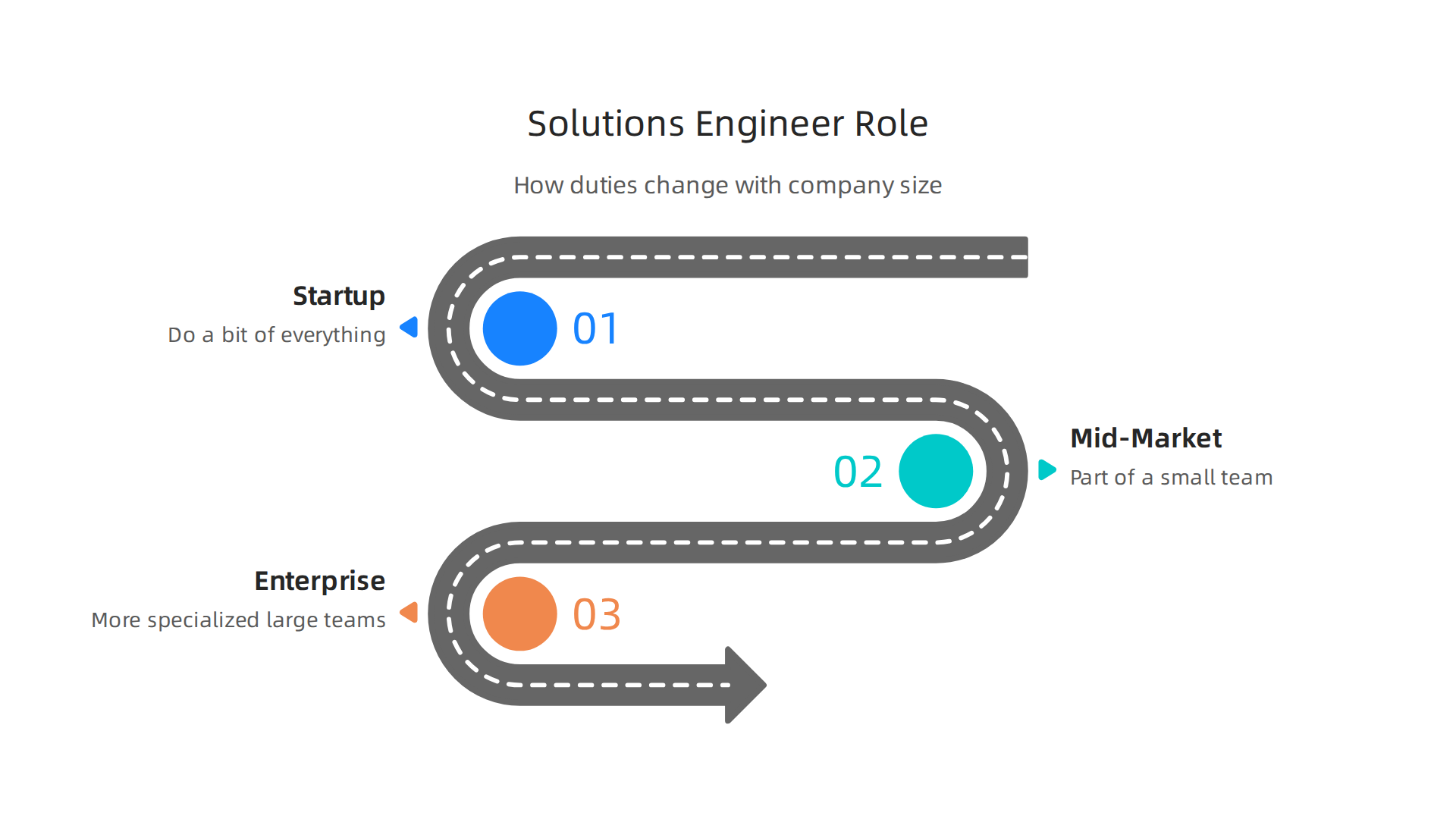
The daily work of a solutions engineer can change a lot based on how big the company is.
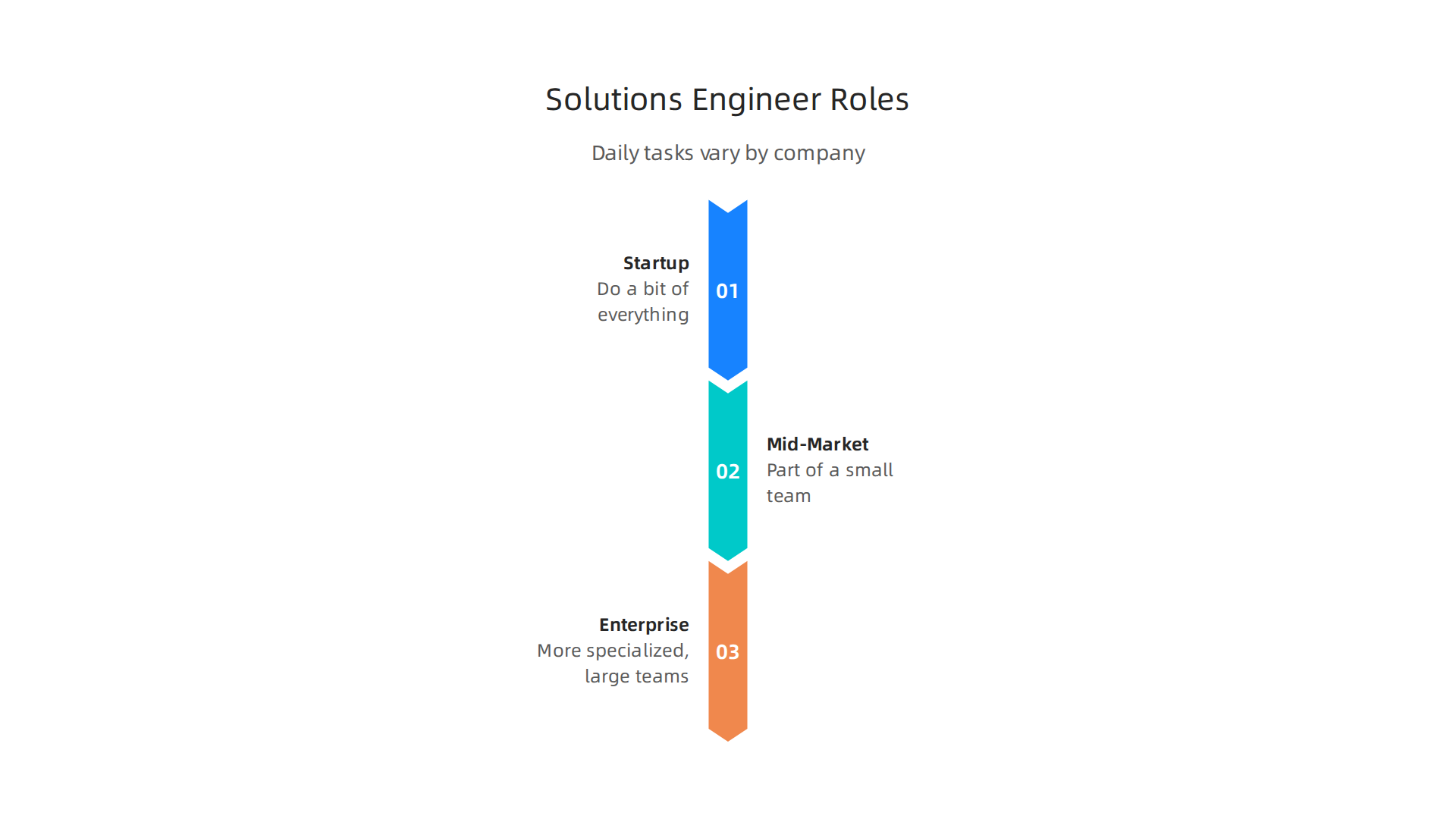
- In a Startup: If you work for a small, new company, you might do a bit of everything. You could be the only solutions engineer, wearing many hats. This means you might do demos, help with customer support, and even give ideas for new product features. You need to be very flexible.
- In a Mid-Market Company: Here, you might work as part of a small team. You’ll still handle a lot of customer interactions, but you might have more help for things like building complex PoCs. Your focus will be on understanding the typical customer in your market.
- In an Enterprise Company: In a very large company, the role is often more specialized. You might work on big projects for huge clients. You’ll likely be part of a larger team of solutions engineers, each focusing on a certain product area or industry. The tasks can involve deep technical strategy and working closely with many different teams inside the company.
How Solutions Engineers are Different from Other Tech Roles
Sometimes, people confuse a solutions engineer with other similar jobs in the tech world.
It’s good to know the difference!
- Sales Engineer: This role is very similar to a solutions engineer. Often, the terms are used to mean the same thing. Both focus on the technical side of selling a product and proving its value to customers What Does a Solutions Engineer Do? Role, Skills & Salary. Think of a solutions engineer as a type of sales engineer who designs more specific plans.
- Solution Architect: A solution architect typically works on even bigger and more complex projects. They often come in after the sale to design the whole system. They make sure all the different parts of a solution work well together. While a solutions engineer focuses on showing how a product solves a problem, an architect focuses on building the entire solution.
- Technical Account Manager (TAM): A TAM usually steps in after a customer has bought the product. Their job is to make sure the customer stays happy and uses the product well over time. They help with ongoing technical issues and grow the relationship. They are less involved in the initial sale.
So, while these roles all need strong technical skills, the solutions engineer stands out by blending technical know-how with sales smarts. They are key players in showing customers how technology can truly help their business. If you’re exploring different information technology jobs, understanding these differences can guide your path. For those trying to decide between broad technical education paths, learning the computer science vs software engineering degree differences can be very helpful.
If you’re looking to become a solutions engineer, it’s really important to know what skills companies are looking for. It’s not just about knowing a lot of technical stuff. You also need to be good at talking to people and understanding their needs.
Key Technical Skills
A solutions engineer needs a strong understanding of technology to show how products work. Here are some of the most important technical skills:
- APIs (Application Programming Interfaces): This is about knowing how different software pieces talk to each other. Solutions engineers often need to show how their product can connect with other systems a customer already uses. Understanding how to use an API for modern web apps is a good example.
- Systems Design: This means knowing how to plan out a whole computer system. You should be able to imagine how different parts of a software solution fit together to solve a big problem. This is like creating a blueprint for how everything will work. Learning about different SDLC models can help.
- Debugging: Sometimes things don’t work right. A solutions engineer needs to be able to find and fix problems in software quickly. It’s like being a detective for computer code.
- Cloud Services: Many businesses today use "the cloud" for their software and data. Knowing about cloud platforms like AWS or Azure is very helpful. You might need to show how a product works in the cloud, or how to manage your TCAPS Cloud Guide for architecture.
- Data Basics: Understanding how data is stored, moved, and used is key. This includes things like databases and how information flows through a system.
These skills help solutions engineers truly understand the products they are selling and show how they can be used in real-world situations.
Important Soft Skills
Beyond technical knowledge, solutions engineers need special people skills. These are often called "soft skills," and they are just as important.
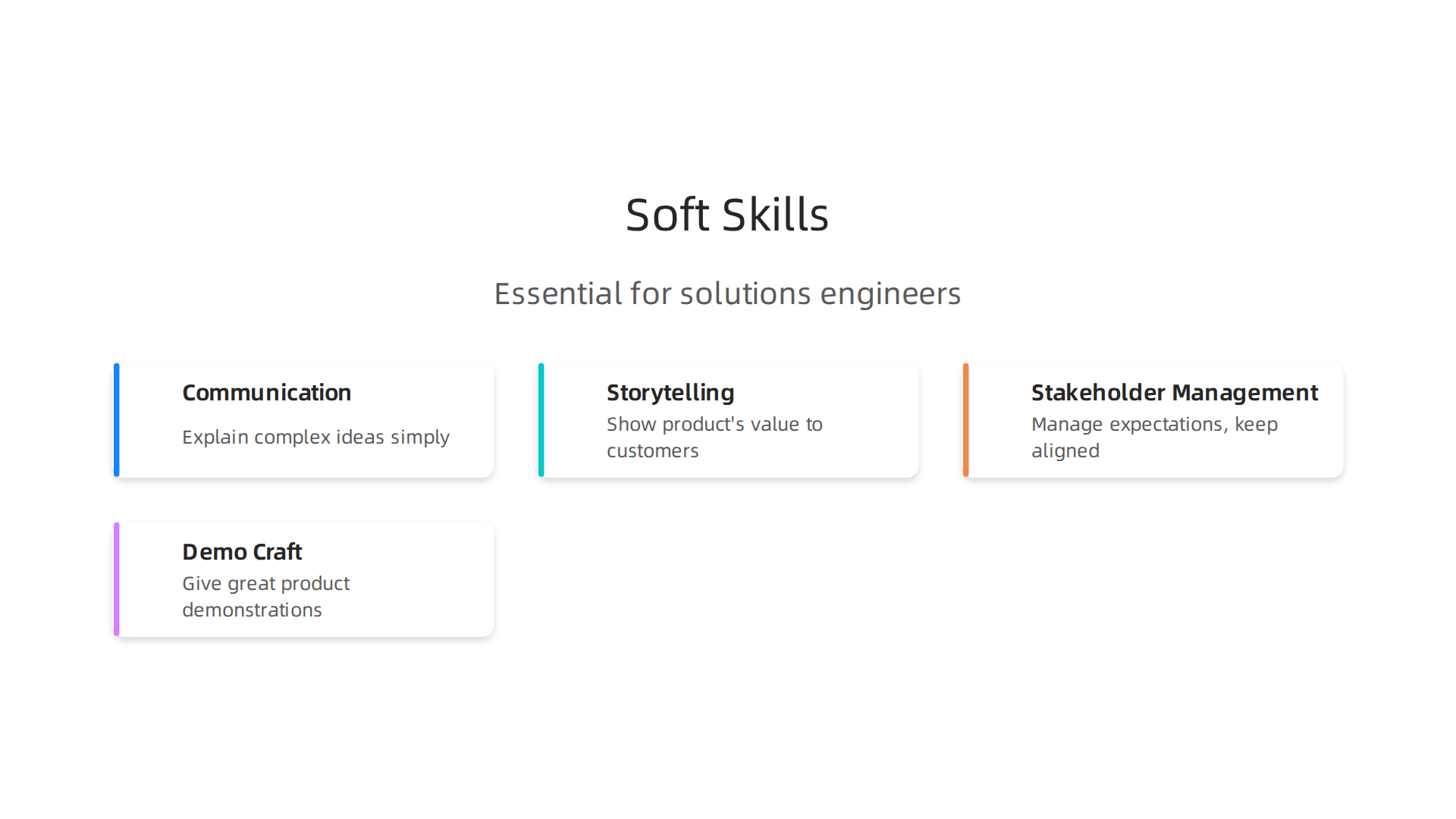
- Communication: You need to be able to explain complex technical ideas in simple ways. You’ll talk to engineers, sales teams, and customers who might not know much about technology. Being clear and easy to understand is a must.
- Storytelling: A solutions engineer doesn’t just list features. They tell a story about how the product will make the customer’s life better. This means showing empathy and connecting the product’s value to the customer’s actual problems.
- Stakeholder Management: You’ll work with many different people, or "stakeholders," both inside your company and at the customer’s company. You need to manage their expectations and make sure everyone is happy and on the same page.
- Demo Craft: Giving a great product demonstration is an art. It’s about making the demo exciting, showing exactly what the customer cares about, and making sure it answers their questions. It’s not just showing buttons; it’s showing solutions.
Skill Expectations by Experience Level
The skills you need also change as you grow in your career as a solutions engineer.
- Junior Solutions Engineer: At this level, you’re learning the ropes. You’ll focus on understanding the core product and helping with standard demos. You might assist more experienced engineers with bigger projects. The main goal is to build a strong foundation in both technical and soft skills. For an entry-level solutions engineer, typical earnings can start around $80,000 to $120,000 in base salary, according to a 2026 guide Solutions Engineer Salary 2026: Complete Guide.
- Mid-Level Solutions Engineer: You’ll start handling projects on your own and become more independent. You’re expected to be good at tailoring demos and solving common customer problems. You might also start giving feedback to the product development team.
- Senior Solutions Engineer: Here, you’re a leader. You’ll handle the most complex accounts, design advanced solutions, and mentor junior team members. You’ll work closely with product and sales leaders to shape strategies. Senior solutions engineers often earn much more, with total compensation reaching $360,000 or even higher for principal levels in 2026, as shown in the 2026 Solutions Engineer Salary Guide.
As you can see, a successful solutions engineer needs a mix of technical know-how and strong communication skills. These skills help them stand out in the competitive computer science job market and other information technology jobs. If you’re looking for more ways to advance your technical knowledge, exploring different learning paths can be very useful.
If you’re looking to become a solutions engineer, knowing which technical skills to focus on first can feel like a big puzzle. It’s smart to start with the most important areas and then practice them in real-world ways. This helps you get ready for the job, whether you’re aiming for entry-level or higher.
Technical Skill Checklist: What to Learn First and How to Practice
When you’re just starting out as a solutions engineer, think about these key areas:
- APIs and Integrations: It’s super important to understand how different software parts connect. Learn about APIs and how to make systems talk to each other. This is often called "integrations." Picking one common API and learning it well, like how to use the FatSecret API for reliable nutrition data in your mobile app, can be a good starting point.
- One Cloud Provider: Instead of trying to learn all cloud services at once, pick one big one like Amazon Web Services (AWS), Google Cloud, or Microsoft Azure. Learn how to set up simple things there. Understanding how to monitor services, like AWS status monitoring, is a useful skill.
- Reproducible Demo Apps: Solutions engineers give demos. Learn how to build small, simple apps that show off a product’s main features in a clear way. These demos should be easy to set up and run every time. You can learn how to build these by finding useful resources like Coursera online courses for software developers in 2026.
Practical Practice Paths
Once you know what to learn, how do you actually practice these skills?
- Build a Reusable Demo Repository: Create a collection of small projects or code examples. Think of it as your toolbox. When you need to show something specific, you can quickly grab a piece from your repository and adjust it. This helps you stay ready for different client needs.
- Create a Sample Proof of Concept (PoC): A PoC is a mini-project that shows an idea can work. Pick a common problem a business might have and build a small solution using the skills you’re learning. This shows you can apply your knowledge. You can find out more about how to master developer skills with free online Harvard courses in 2026.
- Run Mock Client Calls: Practice giving your demo or explaining your PoC to friends or mentors. Pretend they are clients and ask them to ask hard questions. This helps you get better at talking about technical things simply and clearly, which is a core skill for any solutions engineer. Learning how to master programming language fundamentals in 2026 will also build a strong base.
By focusing on these practical steps, you can build a strong foundation and gain confidence in your technical abilities for the solutions engineer role. This will also help you stand out in the competitive computer science job market.
It’s great to know how to build your skills. But sometimes, people wonder if their past jobs can help them become a solutions engineer. The good news is, many different paths can lead you to this role. You don’t always need to start from scratch. People from roles like developers, consultants, or even product teams often make great solutions engineers.
Career pathways: transitioning from developer, consultant, or product roles
Becoming a solutions engineer often means using the smart things you learned in other jobs. It’s about seeing how your past experiences fit into this new role. In 2026, the demand for solutions engineers is strong, and companies look for people with diverse backgrounds.
Common Paths to Becoming a Solutions Engineer
Many people find their way to solutions engineering through a few main career paths. These paths give you key skills that are very helpful for a solutions engineer.
- From Software Developer: If you’ve been a software developer, you’re in a great spot. You already know how software works deeply. You understand code, how to fix problems, and what it takes to build a product. This technical knowledge is super important because a solutions engineer needs to show customers how a product really works and solve their technical questions. It’s a key how to become a solutions engineer pathway. The main difference between a software developer and a solutions engineer is that a developer builds the product, while a solutions engineer helps sell it by showing how it solves problems for customers. To learn more about starting out, check our guide on the junior software engineer 2026 skills hiring career roadmap.
- From IT Consultant or Professional Services: If you’ve worked as an IT consultant or in professional services, you already have lots of experience talking to customers. You know how to listen to their problems and figure out what they need. You’re good at finding solutions and explaining them. This skill of understanding business needs and matching them with technical fixes is what a solutions engineer does every day. They often work as the technical expert to help clients with their software needs, as explained in a guide about what a solutions engineer does.
- From Product Roles (like Product Manager): People who come from product roles, such as product managers, know a lot about what makes a product good. They understand why certain features exist and how they help users. They can think about the "big picture" of a product and how it fits into a customer’s business. This helps a solutions engineer talk about the value of a product in a clear, business-focused way. Some even see a solutions engineer as the "bridge" between the product and the customer. These paths are common ways to move into this role, as highlighted in a guide on 5 common career paths that lead to a solution engineer role.
How to Show Off Your Past Experience
When you apply for a solutions engineer job, it’s important to talk about your past experience in a way that makes sense for this new role.
- Developers: Focus on times you solved tricky technical problems for users or explained complex code to non-technical people. Show that you can not only build but also communicate.
- Consultants: Highlight how you translated customer needs into technical plans, managed projects, or trained people on new systems. Emphasize your customer-facing and problem-solving skills.
- Product Managers: Talk about how you understood market needs, defined product features, and worked with engineering teams to bring solutions to life. Show your ability to connect product capabilities to real-world business outcomes.
No matter your background, the key is to show that you can understand a customer’s problems, deeply know a product, and explain how that product can solve those problems. A solutions engineer acts as a technical expert who helps sales and customers understand how a product works and solves business issues. This role sits between sales and product teams to make buying easier, according to a guide on what is a solutions engineer.
Moving Up: Your Career Options as a Solutions Engineer
Once you become a solutions engineer, there are many ways to grow your career.

The computer science job market offers good opportunities for those with solutions engineering skills.
- Senior Solutions Engineer: After a few years, you can become a senior solutions engineer. This means you handle bigger, more complex deals and might help mentor new team members. You become a go-to person for tough questions and tricky solutions. A typical path starts at an associate level and moves to senior, as noted in Solutions Engineer Career Guides 2026.
- Solution Architect: Some solutions engineers move into a solution architect role. Here, you design even larger and more detailed technical solutions. You focus on how different systems fit together to meet a client’s long-term goals. This role involves a deep dive into designing custom solutions, as detailed in a Solutions Engineer Job Description Template for 2026.
- Customer-Facing Engineering Manager: If you like leading teams and still enjoy working with customers, you might become an engineering manager for a customer-facing team. In this role, you manage other solutions engineers, help them grow, and make sure the team is doing well. Creating clear define developer levels build clear engineering career paths can help with this kind of progression. This can also involve building different career paths to keep top talent, as suggested by an article on career architecture for solutions engineers.
These different pathways show that a career in solutions engineering can be rich and rewarding, with plenty of chances to learn and grow, especially for those with a strong background in information technology jobs.
Once you know the many exciting ways to become a solutions engineer, the next big step is to show what you can do. This means building a strong portfolio and learning how to get noticed for interviews. In 2026, companies want to see your skills in action, not just read about them.
What to Include in Your Solutions Engineer Portfolio
A portfolio for a solutions engineer is like a showcase of your best work. It proves you can not only understand a product but also explain it and show its value to customers.
- Demos and Proof of Concepts (PoCs): These are super important. Instead of just talking about a product, you should show how it works. This could be a short video of you explaining a feature or a simple, working example of how a solution can solve a problem. Think about making "live data over static claims" a core part of your portfolio, as suggested in a guide on Developer Portfolio Examples 2026: 9 Patterns That Work. Recruiters often skip projects without a live demo.
- Problem Statements and Outcomes: For each project in your portfolio, clearly state the problem you were trying to solve. Then, show the solution you created and what good things came from it. For example, "I helped a company save money by showing them how our software could automate a task." Leading with the pain or problem, not just the tech, makes a big difference. This is a top tip for impressing recruiters with your 10 AI Portfolio Examples That Impress Recruiters (2026).
- Technical Depth and Customer Impact: Your portfolio should show you understand the tech deeply, but also how that tech helps people or businesses. It’s about connecting the "how it works" to the "why it matters." Keep your portfolio to a few strong projects, rather than many half-finished ones. A good Software Engineer Freelance Portfolio That Wins (2026) highlights these elements. Many helpful tips for building your portfolio can be found in a Developer Portfolio Guide 2026: What to Build, Skip.
You can build your portfolio as a personal website, a PDF, or even a presentation. The main goal is to make it easy for others to see your skills and how you think. For more ideas on organizing your work, explore Engineer Portfolios: 20+ Well-Designed Examples (2026).
Crafting Case Studies for Solutions Engineering
Case studies are like detailed stories about how you helped a customer using a product. They are a special type of portfolio item.
- Show, Don’t Just Tell: A good case study walks the reader through a real-world problem a customer had. Then, it explains how you, as a solutions engineer, used a product to fix that problem. It shows your technical understanding, but also your ability to communicate and solve real-world business challenges.
- Focus on the Journey: Describe the customer’s original challenge, how you found or designed the solution, any bumps along the way, and most importantly, the positive results. Numbers help here: "We reduced their manual work by 50%!" These stories help potential employers see you in action.
Tactics for Getting Solutions Engineer Interviews
Even with a great portfolio, you need to know how to get your foot in the door.
- Networking: Talk to people who are already solutions engineers or work in similar information technology jobs. Go to online events or join groups where these professionals hang out. Sometimes, the best jobs come from who you know.
- Targeted Applications: Don’t send the same resume to every job. Change your application to match what each company is looking for. Highlight the skills and projects that fit that specific job description best. This shows you care and pay attention.
- Product-Driven Conversations: When you talk to recruiters or hiring managers, show that you understand their company’s products. Talk about how you would explain those products to customers, or how you would solve common customer problems with them. This is often called "pre-sales" thinking and is key for a solutions engineer. Learning how to create a portfolio that gets you hired is a crucial step in this process, as highlighted in How to Build a Portfolio That Gets You Hired in 2026.
Staying informed about the latest trends in software development, including AI and other technologies, can also give you an edge in these conversations. For clear daily updates on AI and broader technology topics, consider subscribing to The AI Newsletter Worth Reading.
By building a strong, story-driven portfolio and actively seeking out opportunities, you can successfully land interviews and start your rewarding career as a solutions engineer in 2026.
Moving into 2026, simply knowing how to get interviews is just one part of the puzzle. To truly stand out in the competitive world of information technology jobs, a modern solutions engineer must also master the latest tools. This especially means knowing how to use Artificial Intelligence (AI) and other smart tools to do your job better and faster. AI is changing how we work, even for solutions engineer roles.
Leveraging AI and modern tooling to excel as a solutions engineer
In today’s fast-paced computer science job market, a solutions engineer who understands AI has a big advantage. These tools can help you simplify complex tasks, speed up your work, and show customers what’s possible much more clearly. Companies are looking for people who can not only use new tech but also apply it wisely.
Useful AI tools for solutions engineers
AI tools come in many forms, and several are super helpful for solutions engineers. They help you do your job, whether that’s understanding customer needs, showing off products, or making sure everything works well.
- Code Assistants: Think of these as your helpful coding sidekicks. Tools like GitHub Copilot and Claude Code can suggest code, fix mistakes, or even write whole sections of code for you. This means you can build Proof of Concepts (PoCs) or custom demo features much faster. These are becoming standard for many software engineers in 2026, as noted in reports about AI Tooling for Software Engineers in 2026.
- Automated Demo Builders: These tools use AI to help you create quick, impressive product demonstrations. Instead of building every demo from scratch, AI can help tailor content, generate realistic data, or even automate parts of your presentation. This saves a lot of time and makes your demos more impactful. Many top AI tools for solutions engineers in 2026 focus on helping with discovery and delivering demos, according to a look at Best AI Tools for Solutions Engineers in 2026.

- Observability Helpers: Once a solution is running, you need to know it’s working well. AI-powered observability tools can watch your systems, find problems, and even suggest fixes before customers even notice. This helps solutions engineers keep things smooth and reliable.
Using these tools can really set a solutions engineer apart from a software developer who might focus more on just writing code. It’s about how you apply the technology to solve customer problems.
How AI speeds up PoC development and demo prep
AI can greatly speed up how you build PoCs and get ready for demos.
For example, an AI coding assistant can quickly generate boilerplate code or help you integrate different parts of a system. This means you spend less time on repetitive tasks and more time focusing on the unique challenges of the customer. You can learn more about this in a guide on How to Use AI for Software Development in 2026.
You can also use AI to create different versions of a demo for various customer types. The AI can help you quickly switch between scenarios or highlight different features without needing to rebuild everything. This saves time and ensures your demos are always sharp and relevant. However, the goal is to speed up, not cut corners. Accuracy and trust remain very important.
Ethical use and correctness for customer-facing technical work
While AI offers many benefits, it’s very important to use it wisely, especially when working with customers. As a solutions engineer, your reputation for accuracy and reliability is key.
- Check AI’s Work: Always double-check any code, content, or suggestions that AI tools provide. AI can sometimes make mistakes or provide outdated information. You need to be the expert who confirms the AI’s output is correct and makes sense for the customer’s specific situation. This relates directly to building trustworthy AI systems, which is covered in topics like AI Ethics for Software Teams: Build Trustworthy AI in 2026.
- Be Transparent (When Needed): You don’t always need to say "AI did this." But if a customer asks, or if an AI-generated part of the solution needs a specific explanation, be ready to discuss how AI helped. It shows you understand the technology and are in control.
- Build Trust: The main goal is to solve the customer’s problem. If using AI helps you do that more effectively and accurately, that builds trust. But if AI makes things confusing or wrong, it can hurt that trust. The solutions engineer’s role is to ensure the AI serves the customer, not the other way around. Understanding Mastering AI Response Design: Evaluation and Safe Implementation is critical for this.
By smartly using AI and keeping ethical rules in mind, solutions engineers can truly shine in their roles. It helps bridge the gap between complex computer science ideas and practical business solutions, helping you stand out in any computer science job market.
To make AI truly work for you as a solutions engineer, it’s helpful to have a clear plan. Let’s look at how you can use AI tools to quickly go from a new idea to a working demo, even in just a weekend.
Practical AI workflows: from idea to demo in a weekend
Here’s a simple checklist to guide you:
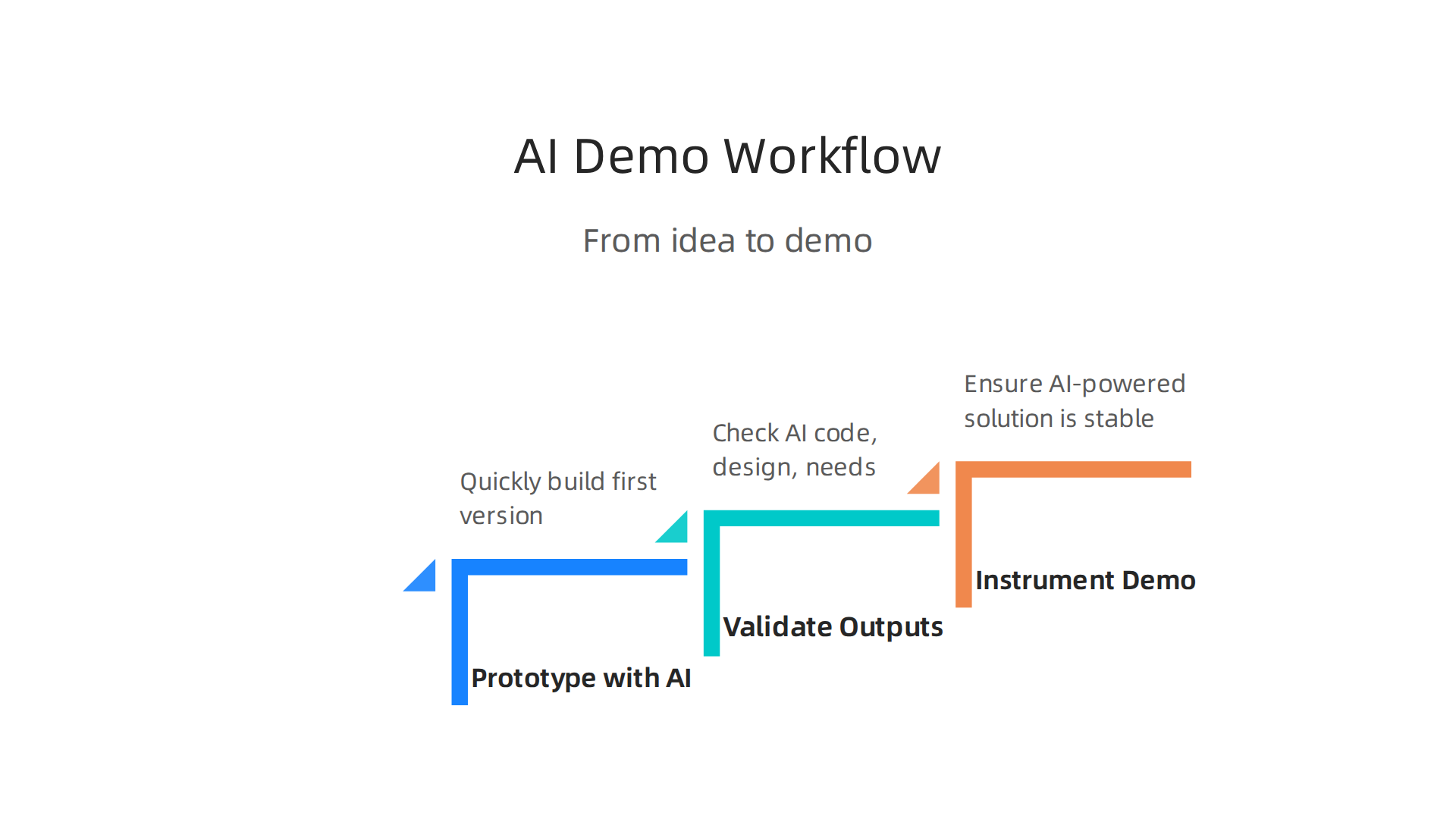
- Prototype with AI: Start by using AI tools to quickly build a first version of your solution. This means letting AI help with code, design ideas, or even setting up basic data. It’s like having a super-fast assistant for your initial work. Tools for engineers in 2026 often include AI assistants for code and general problem-solving, as explained in an overview of Top AI Tools Every Software Engineer Should Know in 2026.
- Validate Outputs: After the AI helps, you must check everything. Is the code correct? Does the design make sense? Does it meet the customer’s needs? Always test what the AI gives you, just like you would any other part of your work. This helps avoid mistakes and makes sure your solution is solid for your solutions engineer role. You can learn how to select the most accurate AI detector for your engineering team.
- Instrument Demo for Reliability: When getting ready for a demo, make sure your AI-powered solution is stable. This means checking that it works every time and handles different situations well. You want the demo to run smoothly, showing off the benefits without any surprises.
Even with great AI tools, there are things to be careful about:
- Hallucination: Sometimes AI can make up facts or give wrong information. Always double-check what AI tells you, especially important details for a client.
- Data Privacy: When working with customer data, you need to be very careful. Make sure any AI tools you use protect sensitive information and follow all privacy rules. This is a big deal for information technology jobs.
- Mismatched SLAs: A Service Level Agreement (SLA) is a promise about how well a system will work. When using AI in demos, make sure the AI’s performance matches what you promise the customer. Don’t show something amazing in a demo if the real-world performance will be much lower. This could impact customer trust.
By following these steps and avoiding these common traps, a solutions engineer can use AI to do their job better and faster. It helps bridge the gap between complex computer science ideas and practical business solutions, making you stand out in any computer science job market.
Want to keep up with the newest AI trends and tools that shape the computer science job market? The AI Newsletter Worth Reading offers daily in-depth insights.
After learning how AI can boost your work as a solutions engineer, it’s time to think about your career growth and what you can earn. Knowing your worth in the job market is super important, especially when you’re ready to take on new information technology jobs.
Salary expectations, market demand, and how to negotiate offers
Finding a great job is one thing, but making sure you get paid fairly is another. Here’s how to understand salaries, what the market wants, and how to talk about your pay.
How to research salaries and spot good job signals
First, you need to know what other solutions engineers are making. This helps you know what salary range to ask for. Many places share salary information. For example, a solutions engineer in the US can expect a wide range of pay, often from around $135,000 to over $200,000 per year, which often includes a base salary plus extra pay like bonuses and commissions. Some reports even show total earnings (called OTE, or On-Target Earnings) going much higher, sometimes between $140,000 and $430,000 for certain roles in 2026, especially at growing software companies Solutions Engineer Salary Guide. Other data for 2026 shows median salaries for solutions engineers at about $170,000 Solutions Engineer Salary in 2026: Real Data from 1.9 Million Job Postings.
Look at websites that share salary data for your area and experience level. These sites collect information from many job postings and employee reports. This will give you a good idea of typical pay for different levels, like an entry-level solutions engineer compared to a senior one.
You can also tell if a company really needs to hire someone quickly. If you see the same job posting pop up often, or if the company is growing very fast, they might be more eager to hire and willing to offer a better package. This shows strong demand in the computer science job market.
What to talk about when negotiating your offer
When a company offers you a job, it’s not just about the basic salary. You have several things you can discuss:

- Base Salary: This is your regular pay. It’s often the first thing people think about.
- Variable Compensation: This means extra money you can earn, like bonuses, commissions, or stock options. For a solutions engineer, this part of your pay is often linked to how well the company or your team does, especially with sales or customer success. This is a key difference between software developer and solutions engineer roles, as developers often have less variable pay.
- Customer-aligned incentives: Sometimes, your bonuses are directly tied to how happy customers are or how much a client’s business grows because of your work.
- Career Progression Promises: Ask about your path forward. Can you become a senior solutions engineer, or even a principal? What training will you get? Clear steps for how you will grow in your role are very valuable. Understanding how your role fits into broader define developer levels build clear engineering career paths can help you see long-term opportunities.
Remember, a good offer looks at the whole picture, not just the base salary.
Prepare for negotiation with facts
To negotiate well, you need to have facts. Think about:
- Your skills: What special things can you do? Do you know a lot about AI tools or a certain kind of software?
- Your experience: How many years have you been working? What big projects have you finished?
- Your location: Salaries can be very different depending on where you live. For example, salaries in big cities are often higher than in smaller towns.
- The company’s situation: Is it a fast-growing startup or a big, established company? This can change how much they can offer.
Gathering this information helps you make a strong case for why you deserve a certain salary. It’s like building a mini-report on yourself. Knowing the average salaries for a junior software engineer 2026 skills hiring career roadmap can also give you a starting point if you’re earlier in your career. When you go into a negotiation, you want to show that you’ve done your homework and that you know your value in the computer science job market. This data-driven approach shows you are serious and prepared.
Summary
This article explains why the solutions engineer role is one of the most strategic technical careers in 2026 by combining deep technical know-how with customer-facing business impact. It walks through what solutions engineers do day-to-day across startups, mid-market firms, and enterprises; distinguishes the role from sales engineers, solution architects, and TAMs; and lists the core technical and soft skills hiring managers value. You get a practical skills checklist—APIs, cloud, systems design, reproducible demos—and advice on building a portfolio of PoCs and case studies that recruiters actually care about. The guide also shows how modern AI tools speed demo and PoC work, plus the ethical checks you must run before customer-facing use. Finally, it covers realistic salary ranges, how to research market signals, and negotiation tactics so you can land better offers and map clear career growth paths from junior to senior or architect roles.