
Coursera Online Courses for Software Developers in 2026 How to Pick the Right Path and Succeed
· 18 min read

Introduction: Cutting Through the Noise of Online Learning
You already know the feeling. You open your browser and see hundreds of courses, boot camps, and certifications all promising to turn you into a top software developer.

Which one actually delivers? With AI tools changing how we code every quarter, picking the right learning path feels harder than ever. In fact, recent AI coding adoption statistics for 2026 show that 84 to 91 percent of developers now use AI-assisted tools, yet trust in AI accuracy has dropped. That means your skills need to be solid, not just what a chatbot tells you.
That is where Coursera online courses come in. Unlike random YouTube tutorials or sketchy boot camps, Coursera partners with top universities and companies like Stanford, Google, and IBM. You get real professors, peer reviews, and hands-on labs that mirror the work you will do on the job. Whether you are looking to switch careers or level up your current role, Coursera offers structured, data-driven pathways that actually prepare you for the real world.
This guide is built to help you cut through the noise. We will walk you through how to pick the right courses, complete them without burning out, and turn that knowledge into career wins. If you are just starting out, check out our practical roadmap for beginners to see how Coursera fits into a bigger plan.
And to stay on top of the fast-moving tech world while you learn, grab The AI Newsletter Worth Reading. It delivers clear daily AI updates straight to your inbox so you never miss a shift that affects your career.
Why Coursera Stands Out for Software Developers in 2026
With so many platforms out there, you might wonder what makes Coursera different. The short answer is trust. When a course comes from Stanford, MIT, Google, or IBM, employers recognize that name. That matters a lot when you are trying to become a software developer or level up in your current role.
Let us break down the biggest reasons Coursera beats the competition in 2026.
Real university and industry partnerships
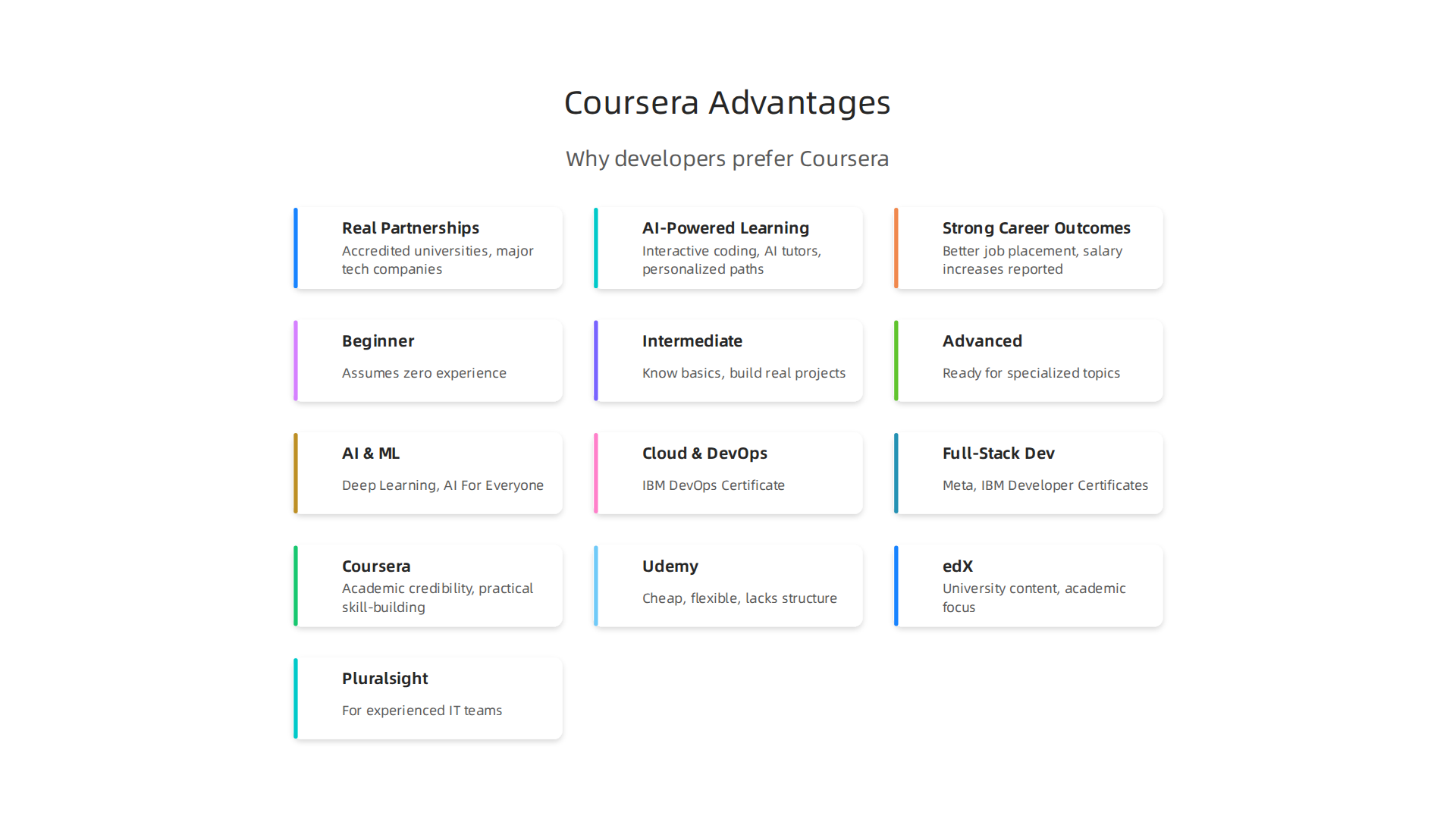
Coursera does not just let anyone slap together a course. Every program comes from an accredited university or a major tech company. That means you get the same material that actual college students or Google engineers study. When you earn a certificate, it carries real weight. Many hiring managers view Coursera credentials from top schools as seriously as a traditional computer science engineering degree.
Compare that to platforms where anyone can publish a course with no quality check. The detailed comparison of Udemy vs Coursera for 2026 explains that Coursera wins on structure, depth, and respected branded certificates while Udemy wins on cheap lifetime-access courses. For career growth, depth and credibility matter more.
AI-powered learning that matches how developers actually work
Here is where Coursera has evolved fast in 2026. The platform now offers interactive coding environments, AI-powered tutors that help you debug in real time, and personalized learning paths based on your skill level. This matters because the 2026 State of Code Developer Survey found that 96 percent of developers do not fully trust AI-generated code to be correct. You need to build real coding skills, not just learn to prompt a chatbot. Coursera hands-on labs force you to actually write code and solve problems yourself.
Strong career outcomes for tech learners
Learner surveys consistently rank Coursera high for content depth and career results. Graduates of computer engineering programs and specializations on Coursera report better job placement and salary increases compared to other platforms. The structured path from beginner to job-ready is clear.
If you want to see how different learning formats stack up for your goals, check out our guide on the best online web development courses to learn in 2026. It compares Coursera against other platforms so you can pick what fits your style.
How to Choose the Right Coursera Course for Your Skill Level
So you have decided to use Coursera. Great choice. But now you face a wall of options. Hundreds of courses, certificates, and specializations. Which one fits where you are right now? The answer depends on your current skill level.
Understand the three skill tiers
Coursera organizes most of its courses into three main levels. For beginners, you want courses that assume zero experience.
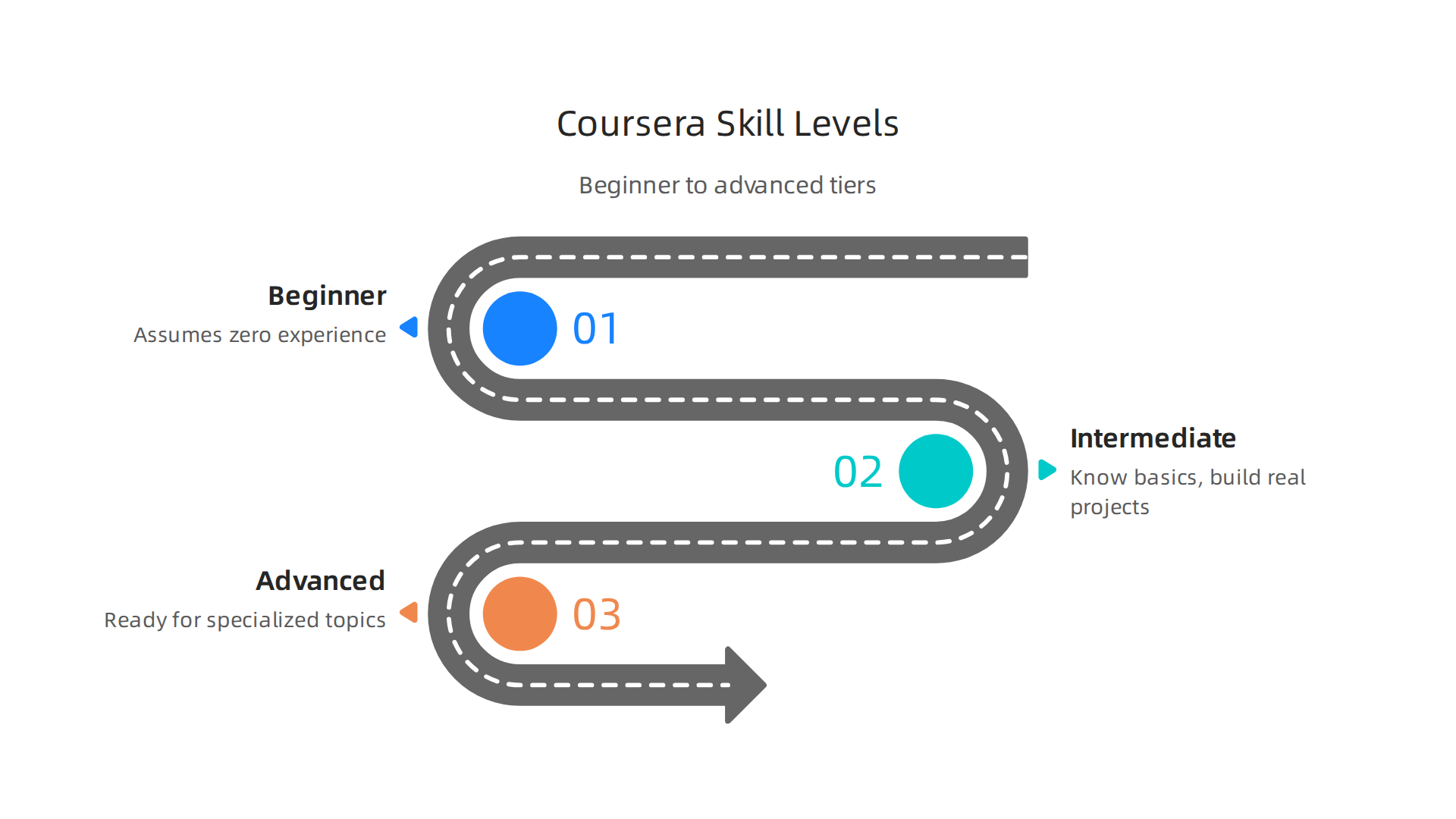
A great example is the Google IT Support Professional Certificate. It teaches you the basics of troubleshooting, networking, and operating systems. No coding background needed.
For intermediate learners, you already know the basics and want to build real projects. The Python for Everybody Specialization is perfect here. It walks you through programming fundamentals and then moves into data structures and web scraping.
For advanced learners, you are ready for specialized topics like deep learning, machine learning, or system design. The Deep Learning Specialization from Andrew Ng is a standout. It covers neural networks, convolutional networks, and sequence models at a professional level.
Use Coursera filters to find your match
When you browse the site, use the filter options. You can select Beginner, Intermediate, or Advanced under the Level dropdown. You can also filter by Project to find hands-on courses that let you build something right away. This saves time and keeps you from getting lost in irrelevant content. Check out the Software Development Online Courses on Coursera to see how these filters work in practice.
**Match the course to your career goals

**
A course review tells you if other learners found the material useful. Skill demand data shows you what employers actually want. And the course syllabus reveals the exact topics covered. Put all three together before you commit. For example, if you want to become a software developer and need a strong foundation, start with a beginner course and plan a path toward intermediate material. Then move to software developer certifications that carry weight with hiring managers.
If you are completely new to coding, check out this practical roadmap for learning to code in 2026. It pairs perfectly with the beginner courses on Coursera.
One last tip
Do not skip the free trial or audit option. Many Coursera courses let you preview content before paying. Watch the first week of lectures. Try a practice quiz. If the pace feels right and the instructor clicks with you, then enroll. If it feels too fast or too slow, move on to another course.
As you build your skills, staying current with tech trends matters a lot. The The AI Newsletter Worth Reading delivers clear daily updates to help you stay ahead. Try it while you plan your learning path.
Top Specializations and Certificates for Career Growth in 2026
Once you know your skill level, the real fun begins: picking a specialization that can move your career forward. Here are the top coursera online courses and certificates that stand out in 2026.
AI and Machine Learning
AI skills are still in high demand across every industry. The Deep Learning Specialization from Andrew Ng is a favorite among developers who want to understand neural networks and build real AI applications. If you are brand new to AI, try the AI For Everyone course first. It explains the key concepts without requiring coding. For a broader view of the most popular options, check out this list of the best Coursera courses with professional certificates for 2026.
Cloud Computing and DevOps
Cloud skills earn you a quick return on your learning time. Certificates from AWS, Microsoft Azure, and Google Cloud are popular for a reason. Employers need people who can manage infrastructure and deploy apps. The IBM DevOps and Software Engineering Professional Certificate is a solid pick. It teaches you continuous integration, containers, and monitoring. If you want to become a software developer with a focus on infrastructure, this path works well.
Full-Stack and Mobile Development
Structured pathways from Meta and IBM make it easier to become a software developer from scratch. The Meta Front-End Developer Professional Certificate covers React, HTML, CSS, and responsive design. The IBM Full Stack Software Developer Certificate goes deeper into both front-end and back-end technologies. For mobile, the Meta Android Developer Certificate is a great choice. These programs are designed to help you earn real software developer certifications that hiring managers recognize.
If you are still deciding between a formal degree and a certificate, take a look at this comparison of computer science vs software engineering degree to see which fits your goals better.
The bottom line: pick one path, finish it, and build a project to show off your new skills. That is how you turn a Coursera course into a real career move.
The Role of AI in Modern Online Learning: Coursera’s AI Features
Picking the right specialization is only half the battle. How you learn matters just as much. In 2026, Coursera has rolled out several AI-powered features that make your study time more efficient and less frustrating. These tools help you stick with your course and actually master the material.
Meet Coursera Coach: Your AI Study Buddy
The biggest change is Coursera Coach, an AI learning assistant built into the platform. Think of it as a tutor who never sleeps. You can ask it questions about the course material, get step-by-step explanations, and even receive career guidance recommendations. According to Coursera’s official announcement, the AI-powered Coursera Coach features for educators allow the assistant to interact with learners in a personalized way. The University of Michigan was one of the first schools to integrate this tool into an online course, helping students learn through Socratic dialogue instead of just watching videos. This Coursera Coach review from 2026 explains how it provides instant answers and helps you stay on track.
No more waiting for an instructor to reply on a forum. The Coach gives you immediate help when you get stuck on a tough concept. That alone can save you hours of frustration.
Smart Course Recommendations
Ever spent twenty minutes scrolling through course catalogs, unsure which one to pick? Coursera AI solves that. It looks at your skill gaps, your career goals, and what you have already completed. Then it suggests the next course that actually makes sense for you. This feature cuts down on decision fatigue and helps you move faster toward your target, whether that is to become a software developer or earn specific software developer certifications. The system remembers your preferences from past conversations, so each recommendation gets smarter over time.
Real Practice with AI-Assisted Coding
Some of the most popular Coursera specializations now include AI-assisted coding labs. These labs act like a smart coding partner, similar to GitHub Copilot. Instead of just reading about loops or functions, you write real code while an AI suggests improvements, catches errors, and explains what went wrong. This hands-on practice is exactly what you need to build confidence. For a deeper look at how AI is changing the way developers work, check out this guide on AI software development in 2026.
The bottom line: these AI features make coursera online courses more than just video lectures. They turn learning into an interactive, personalized experience. If you want to stay on top of how AI continues to reshape tech and learning, consider subscribing to a daily update that breaks it all down. The AI Newsletter Worth Reading gives you clear, daily insights into the latest AI developments, so you never miss a trend that could boost your career.
Maximizing Your Learning: Study Strategies and Community Engagement
Even the smartest AI tutor can only do so much. Real learning still comes down to your habits. The best coursera online courses give you the tools, but you need a plan to get the most out of them. Here is how to stay on track and actually finish your specialization with skills you can use.
Build a Consistent Study Routine
Set aside the same time each day for your coursework. Treat it like a work meeting that cannot be rescheduled. This protects your learning time from other distractions. For technical topics, use spaced repetition to fight the forgetting curve. Review old material a little bit each week. A good starting point is to skim key points from previous lessons before starting a new module. The 10 Effective Study Tips and Techniques guide shows that surveying headings and subheadings first helps your brain organize new information better.
Another trick is to break your study time into shorter blocks. Focus for 25 to 30 minutes, then take a short break. This keeps your mind fresh. If you are working through a computer engineering programs course or something heavy on theory, this rhythm helps a lot. You absorb more in less time.
Tap Into the Community

Coursera courses have discussion forums. Use them. Do not just lurk. Ask a question when you get stuck. Answer someone else’s question if you understand the topic. Teaching someone else is one of the fastest ways to solidify your own knowledge.
Many specializations also have peer-reviewed assignments. These are gold. You get feedback on your work from other learners, and you get to see how they solved the same problem. That exposes you to different approaches and makes you think deeper. If you want to go further, find a study group. Some learners form small groups on platforms like Reddit or Discord. Searching for fellow students can lead to lasting connections. You can find software engineer projects on Reddit and even collaborate on open source work with your classmates.
Capstone Projects: Your Portfolio Power
Most Coursera specializations end with a capstone project. This is not busywork. This is your chance to build something real that proves you can become a software developer. Treat the capstone like a professional assignment. Plan it, build it, and polish it. Then add it to your portfolio or GitHub.
When you finish, you can list the project under your skills section. If you are aiming for specific software developer certifications, some Coursera courses even prepare you for official exams. The capstone project shows employers you did not just watch videos. You built something.
The key is to stay consistent with your schedule, lean on the community when you need help, and finish strong with a portfolio piece. Do that, and your investment in online learning will pay off.
Coursera vs. Other Platforms: A Developer-Focused Comparison
You now have a study plan and know how to tap into the community. But picking the right platform matters just as much. Coursera is a top choice for developers, but other platforms have their own strengths. Let’s break down how Coursera stacks up against Udemy, edX, and Pluralsight so you can choose the best fit for your goals.
Udemy: Cheap and Flexible, but Lacks Structure
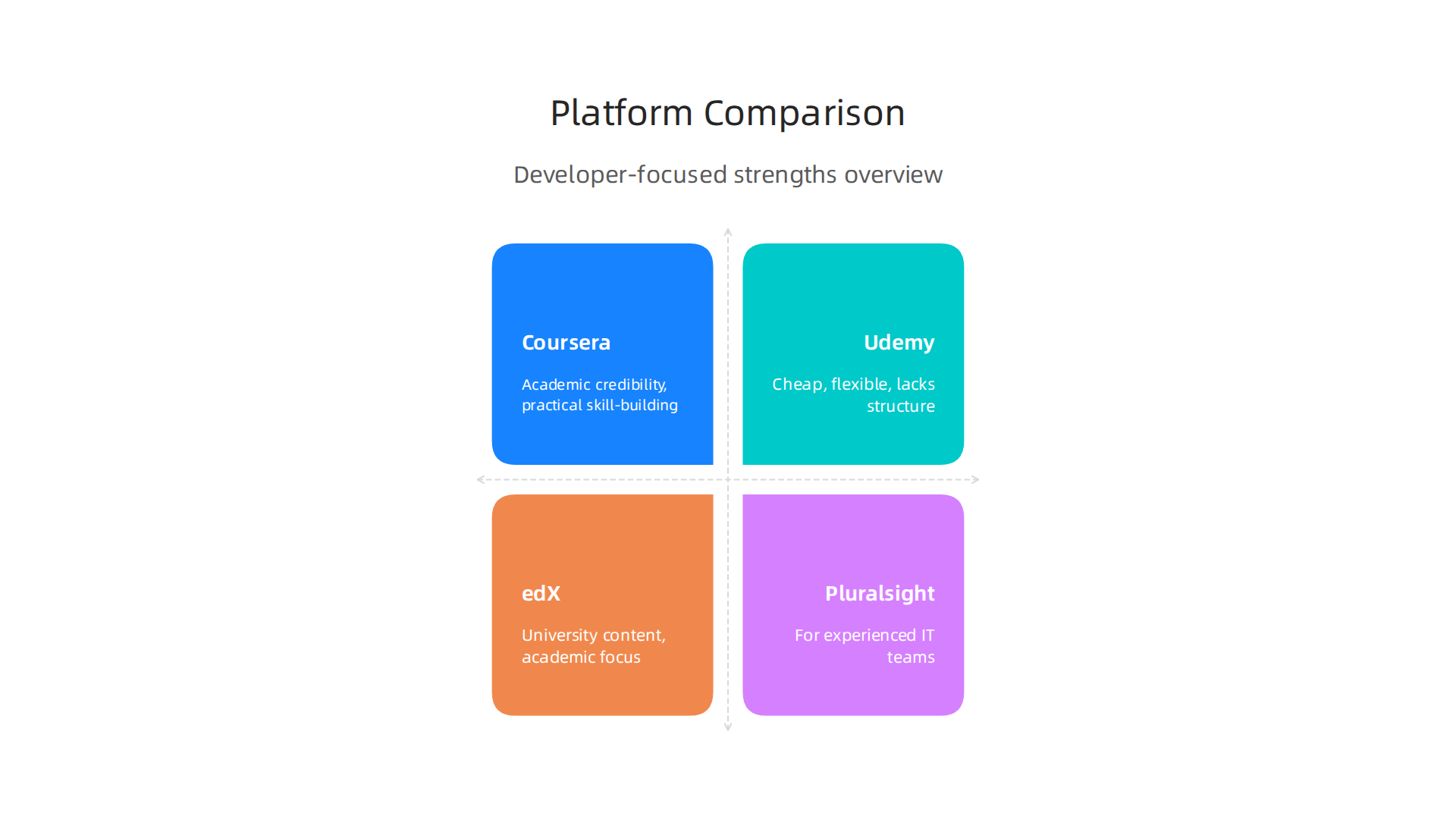
Udemy is great for picking up a specific skill fast. Courses often cost between $10 and $20 during sales, and you get lifetime access. That sounds great if you just want to learn one topic. But there is a catch: anyone can create a course, so quality varies wildly. There are no structured paths, accredited certificates, or hands-on labs that prepare you for real-world development. For a developer trying to become a software developer, Udemy can feel scattered. You end up jumping from course to course without a clear progression.
edX: University Content with Less Practical Focus
edX is very similar to Coursera. Both partner with top universities to offer courses and even degrees. edX has strong content in computer science and engineering. However, edX courses tend to be more academic. They focus on theory over applied projects. If you want a computer science engineering degree from a respected school, edX is a solid option. But for hands-on coding practice and career-focused specializations, Coursera pulls ahead with more industry partnerships from companies like Google, IBM, and Meta.
Pluralsight: Built for Professional IT Teams
Pluralsight targets experienced developers and IT teams. It offers skill assessments, learning paths, and deep dives into specific technologies. If you already work as a developer and need to level up in a specific tool or language, Pluralsight is excellent. But it is more expensive for individual learners and less beginner-friendly. For someone just starting out in a computer engineering program or chasing software developer certifications, Coursera’s guided specializations and beginner options are a better starting point.
Where Coursera Wins for Developers
Coursera’s biggest advantage is its mix of academic credibility and practical skill-building. You can earn accredited certificates and even full degrees from top universities. At the same time, you get hands-on labs, real-world projects, and capstones that prove you can actually build software. The Coursera Plus subscription gives you access to thousands of courses for one monthly fee. That makes it affordable if you plan to take multiple courses in a year.
For developers serious about learning, Coursera offers a clear path from beginner to job-ready. The structured specializations walk you through a topic step by step. And the capstone projects become portfolio pieces that show employers you can ship code.
If you are still unsure which platform fits your learning style, check out our guide on the best online web development courses to learn in 2026. And as you compare your options, staying on top of industry trends helps you make smarter choices. The AI Newsletter Worth Reading delivers daily AI and tech insights straight to your inbox, keeping you informed without the noise.
Staying Current: How to Keep Learning After Your Certification
Earning a certification from Coursera is a big win. But technology moves fast. To really grow as a developer, you need to keep learning after the course ends. The good news? The habits you built during your courses will carry you forward.
Use Coursera’s Built-in Tools to Stay Updated
Coursera doesn’t just drop you after a certificate. The platform offers emerging content alerts and recommended specializations based on what you’ve already studied. These personalized suggestions help you spot the next skill worth learning. For example, the Coursera Coach AI feature gives you tailored course picks and answers questions about new topics. According to a recent review, the Coursera Coach review for 2026 shows how AI helps learners stay on track with personalized recommendations. That means less time guessing what to learn next and more time actually building skills.
You can also browse trending courses in areas like AI, cloud computing, and full-stack development. If you want to switch from backend to frontend or dive into machine learning, Coursera’s suggestions will point you in the right direction.
Join Developer Communities and Follow Thought Leaders
No one learns in a silo. After your certification, jump into communities where developers share real-world experiences. GitHub is great for contributing to open source. Stack Overflow helps you solve tricky problems. And Reddit? It is full of honest advice and project ideas. You can find proven strategies for finding software engineer projects on Reddit that match your new skills.
Follow developers you respect on Twitter or LinkedIn. Subscribe to YouTube channels that break down new frameworks. The conversations in these communities often show you what employers will ask for next year.
Mix Credentials with Continuous Learning
A certification proves you can finish a course. But employers also want to see that you stay curious. Combine your certificate with habits like reading a weekly tech newsletter or listening to podcasts during your commute.
Conference talks are another goldmine. Many are free to watch online. They give you a peek into what the industry is working on right now. After you become a software developer, these resources help you keep your edge.
The path from certification to career is not a finish line. It is a ramp. Use Coursera’s recommendations, engage with other developers, and feed your curiosity every day. That mix is what turns a certificate into a real career advantage.
Summary
This article is a practical guide to using Coursera for software development in 2026, showing why its university and industry partnerships make its certificates credible with employers. It explains how to pick courses by skill level—beginner, intermediate, advanced—and how to use filters, trials, and syllabi to match classes to career goals. You’ll see which specializations (AI, cloud, full-stack, DevOps) deliver the best ROI and how Coursera’s AI tools like Coursera Coach and AI-assisted coding labs make learning interactive and efficient. The piece also covers study strategies—consistent schedules, spaced repetition, forum participation—and why capstone projects matter for your portfolio. There’s a developer-focused comparison with Udemy, edX, and Pluralsight so you can choose the right platform. Finally, the article explains how to keep learning after certification using Coursera recommendations, communities, and ongoing habits that turn certificates into long-term career wins.