
Effective LLM AI Adoption for Developers
· 29 min read

Why developers need a practical grasp of LLMs now
In 2026, the world of software development is changing faster than ever. A big reason for this change is the rise of LLM AI, which stands for Large Language Model Artificial Intelligence. These powerful tools are not just fancy new gadgets; they are shaping how developers work every day and changing what products can do. If you are a developer or someone who makes big technical choices, understanding LLMs isn’t just nice to have; it’s a must.
LLM AI is like a helpful assistant that can write code, fix problems, and even dream up new features.

It can take simple ideas and turn them into working parts of a program. This means developers can build things quicker and smarter. Think about how much faster you could work if an intelligent system could understand your requests and help you write code, test it, or even suggest improvements. That’s the power of having a practical grasp of LLMs.
These types of AI models are built on complex ideas like "tokens" and "embeddings," which help them understand and create human language and code from vast amounts of data used during their training Introduction to Large Language Models. They are making it possible to create smarter apps that can talk to users, write reports, or even help with things like Anthropic prompt engineering, which means learning how to ask AI the right questions to get the best answers. This greatly improves what products can offer to people.
But here is the challenge: with so much new information coming out every day, it’s hard to keep up. Developers and technical leaders often feel swamped by new terms, tools, and best practices. It’s tough to know which parts of LLM AI are truly important for your work and which are just passing trends. This article is here to help with that.
We will show you how to cut through the noise and get a clear understanding of LLM AI. You will learn practical ways to use these tools to make your projects better and your team more productive. We will help you see how AI software development transforms how you build and ship code. By the end, you will feel more confident about using AI to build amazing software solutions.
Want to stay informed on the latest AI advancements without the daily information overload?
Sign up for The AI Newsletter Worth Reading to get clear daily updates from The Deep View Newsletter.
To truly use LLM AI well, it helps to know a few basic ideas. Don’t worry, we will keep it simple. Understanding these core concepts will make it easier to work with these powerful tools in 2026.
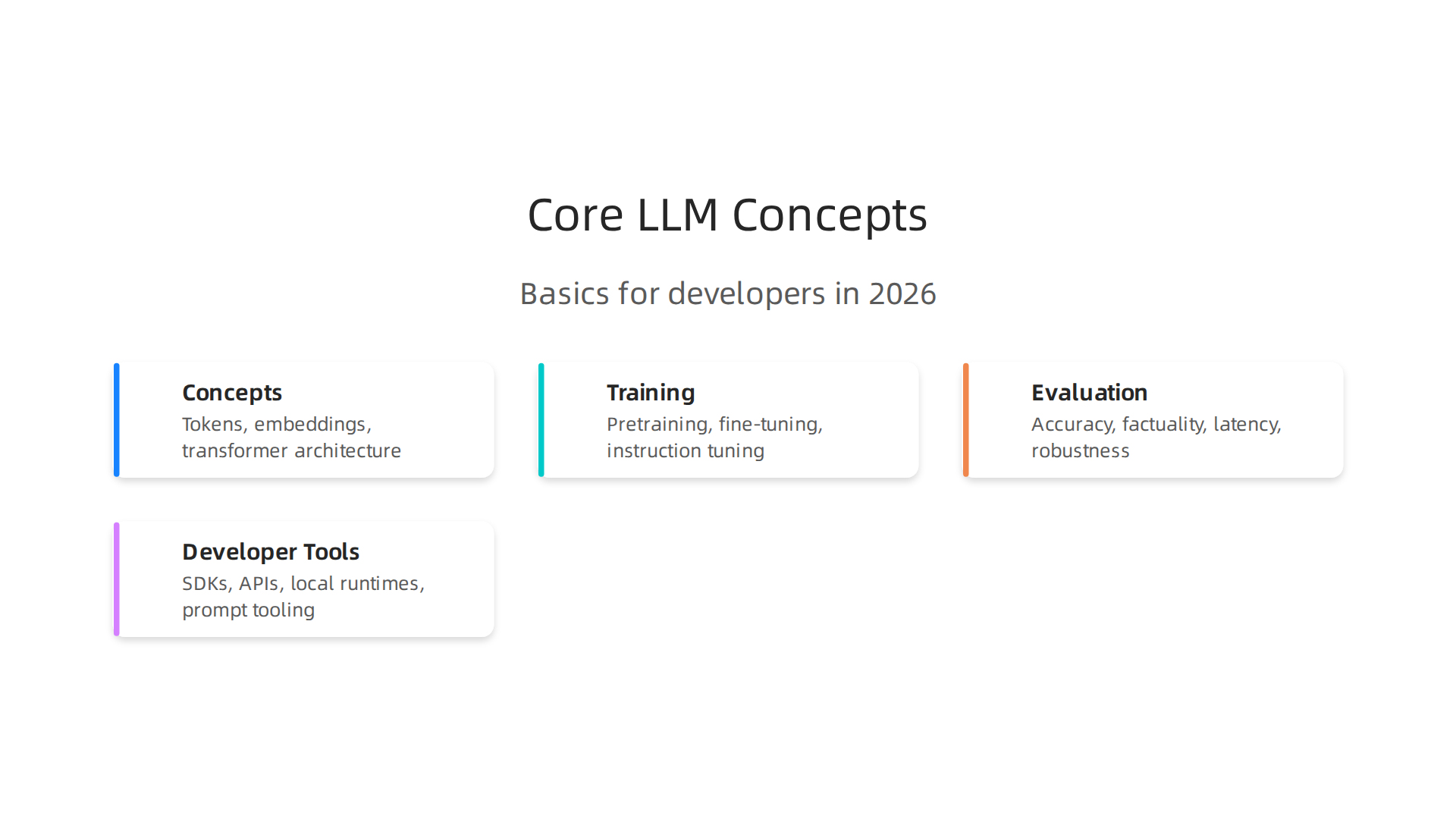
Tokens: The Building Blocks of Language
Imagine you have a long sentence. Before an LLM AI can understand it, it first breaks the sentence into smaller pieces. These pieces are called "tokens." A token can be a whole word, part of a word, or even a punctuation mark. For example, the sentence "I love coding" might become three tokens: "I", "love", and "coding". Breaking text into tokens is an important first step in how LLMs process information A Comprehensive Overview of Large Language Models.
Embeddings: Giving Tokens Meaning
Once we have tokens, the LLM AI needs to understand what each token means. This is where "embeddings" come in. Think of an embedding as a special number code for each token. These number codes are not just random; they are designed so that tokens with similar meanings have similar number codes. For instance, the embedding for "apple" would be numerically closer to the embedding for "fruit" than to the embedding for "car." These embeddings help the LLM AI understand the context and relationships between words, representing the meaning of each token as a high-dimensional vector Foundational Large Language Models & Text Generation.
Transformer Architecture: The LLM Brain
The "transformer architecture" is like the brain of modern LLM AI. It is a special setup that helps the AI process many tokens at once and understand how they relate to each other, even if they are far apart in a sentence. A key part of this is called "self-attention," which lets the model focus on the most important parts of a sentence when trying to understand or create new text. This powerful architecture helps LLMs learn complex patterns in language and code Machines and Society: Technical Overview.
Model Size: Bigger Can Be Smarter
When people talk about LLMs being "large," they are often talking about "model size." This refers to how many connections, or "parameters," the AI model has. Generally, a larger model with more parameters means it has learned more from the vast amounts of data it was trained on. This can make bigger LLM AI models better at understanding complex requests and giving more accurate or creative answers.
How LLMs Learn: Pretraining, Fine-tuning, and Instruction Tuning
LLM AI models learn in a few main steps:
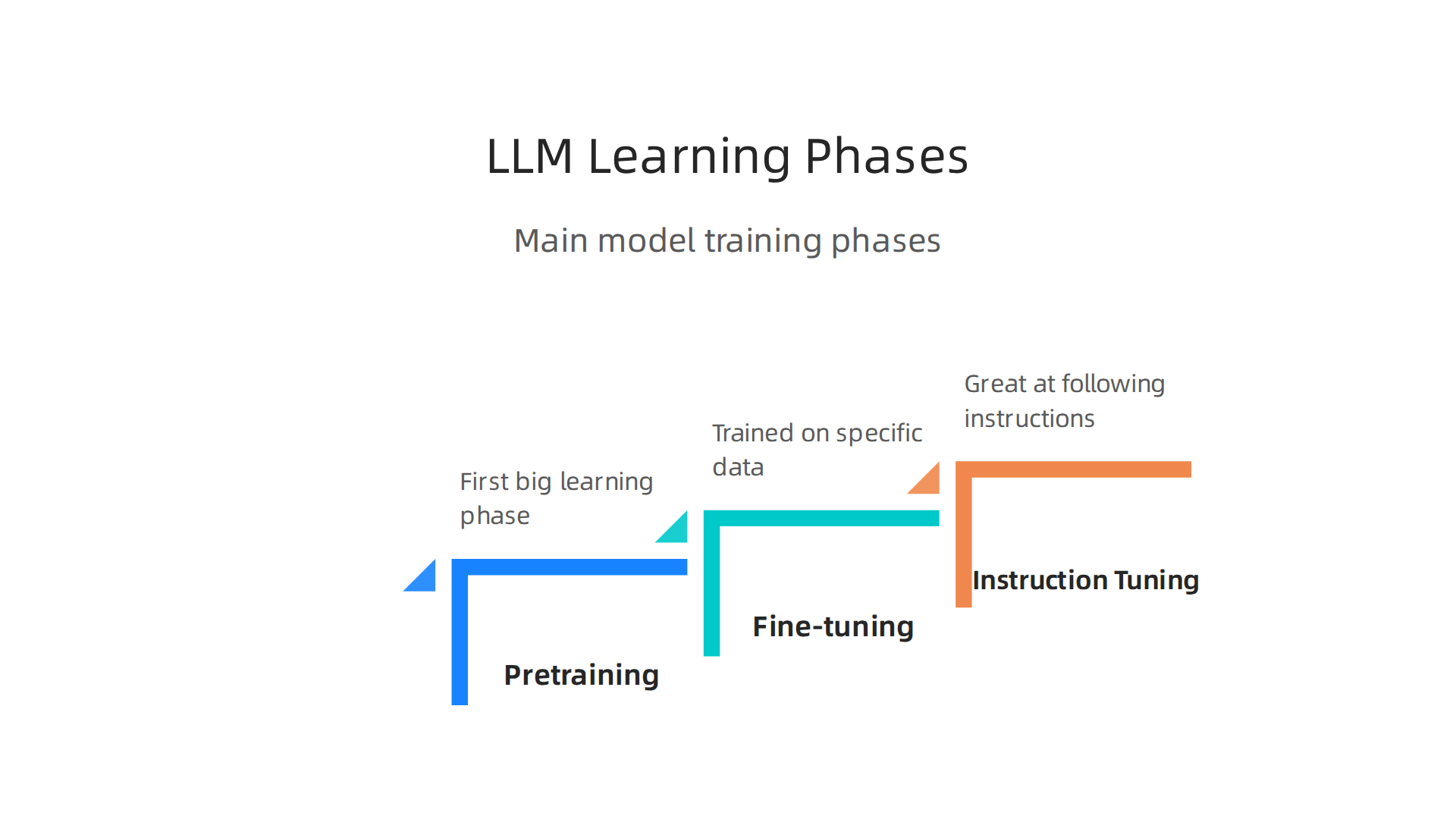
- Pretraining: This is the first big learning phase. The LLM AI is fed a huge amount of text data from the internet. During this step, the model learns to predict the next word in a sentence, or fill in missing words. This helps it understand grammar, facts, and different ways people express ideas Transformers and Large Language Models. It’s like teaching a child everything there is to know about the world from reading every book.
- Fine-tuning: After pretraining, the general LLM AI model is then trained on a smaller, more specific set of data. This helps it become better at certain tasks. For example, you might fine-tune an LLM to be very good at writing code, or at answering questions about a specific topic. This process makes the model more useful for particular jobs.
- Instruction Tuning: This is a special type of fine-tuning that makes the LLM AI great at following instructions. Developers use instruction tuning to teach the model to understand prompts and carry out tasks exactly as asked. This is especially important for
anthropic prompt engineeringand getting precise outputs when you takenotes aiusing an LLM. It helps the model behave like a helpful assistant that can truly understand your commands.
Understanding these concepts is a great step toward knowing how to use LLM AI effectively in your daily work. If you want to dive deeper into how AI is changing the developer landscape, you can explore more about AI for software development and its impact on teams in 2026.
After an LLM AI learns from huge amounts of data through pretraining and fine-tuning, how do we know it’s actually performing well? This is where evaluating and benchmarking come in. It’s like giving the LLM AI a report card and a standardized test to see how smart it really is.
Training Datasets and Objectives
First, let’s briefly remember the training part. LLM AI models learn from massive collections of text and code. These collections are called datasets. During pretraining, the main goal is often for the model to guess the next word in a sentence or fill in missing words. This helps it build a broad understanding of language. Then, fine-tuning uses more specific datasets to teach the model how to do certain tasks better, like writing clear answers or summarizing text. The quality and variety of these datasets are super important because a model can only be as good as the data it learns from.
Evaluation Metrics: How We Measure LLM Performance
To check an LLM AI’s performance, we use different "evaluation metrics."
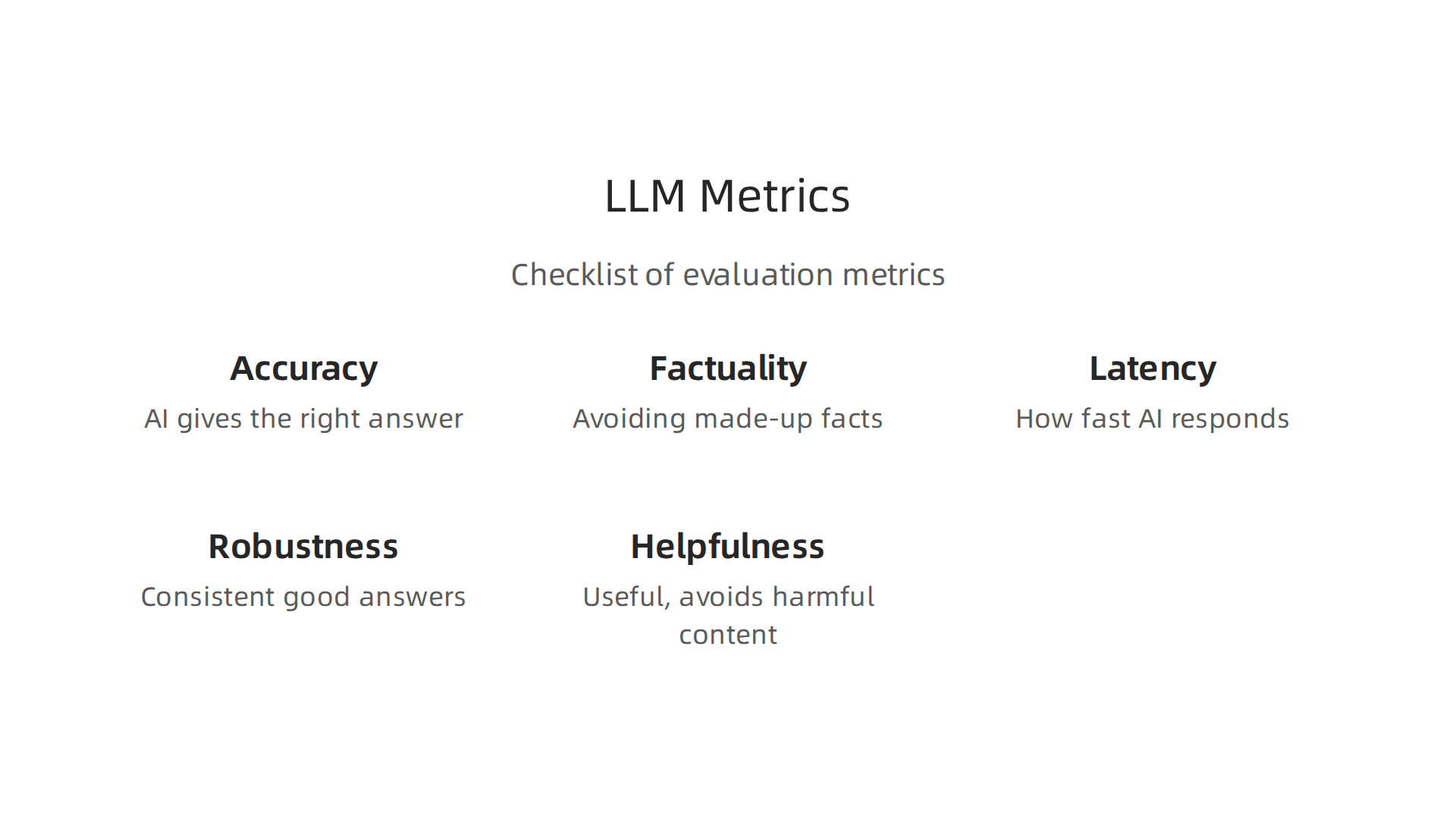
Think of these as different ways to score how well the AI did on a task.
- Accuracy and Correctness: This is about whether the LLM AI gives the right answer. For tasks like answering questions, we want high accuracy.
- Factuality (Avoiding Hallucination): A big problem with LLMs can be "hallucination," which means the AI makes up facts or gives wrong information with confidence. This is a huge concern for many uses, especially when you are trying to take
notes aiwhere facts are important. Measuring how often an LLM AI hallucinates is key for trustworthy systems LLM Evaluation Metrics: Precision vs Robustness Compared. - Latency: This refers to how fast the LLM AI responds. For real-time applications, like chatbots or tools used for
anthropic prompt engineeringwhere quick feedback helps, low latency is a must. - Robustness: Does the LLM AI give consistent, good answers even if the question is phrased a little differently or has small mistakes? Good models are robust.
- Helpfulness and Safety: Beyond just being correct, is the answer actually useful and does it avoid harmful or biased content? These subjective qualities are often judged by humans or other AI models.
Common Benchmarks: Standardized LLM Tests
"Benchmarks" are like standardized tests for LLM AI models. They are a collection of specific tasks and questions designed to test different skills of an LLM. By running an LLM AI through a benchmark, developers can compare its performance against other models on a fair playing field.
Some benchmarks test specific skills, such as:
- Reasoning: How well the LLM AI can solve logic puzzles or complex problems.
- Coding: Its ability to write, debug, or explain computer code.
- Math: How accurately it performs calculations.
- General Knowledge: Its understanding of a wide range of topics.
Many benchmarks exist, and new ones are always being created to keep up with new types of ai tasks A Survey on Large Language Model Benchmarks. Choosing the right benchmark depends on what you want the LLM AI to do.
Why Evaluation and Benchmark Choice Matters for Product Requirements
Understanding how LLMs are evaluated is not just for scientists. For anyone building products with llm ai in 2026, choosing the right evaluation metrics and benchmarks is vital.
Imagine you are building a product that uses an LLM AI to summarize medical reports. If the LLM AI hallucinates facts, it could have serious consequences. So, your product requirements would demand extremely high factuality, even if it means sacrificing some speed. On the other hand, for a creative writing assistant, some minor "hallucinations" might even be desired for imaginative output.
Similarly, if your product needs to give instant responses, like a real-time coding assistant, then low latency becomes a critical product requirement. You might choose an LLM AI that is faster, even if it’s slightly less accurate in some areas.
Choosing the right ways to measure and test your LLM AI helps you build a product that truly meets user needs and works well. To learn more about how to ensure AI models are effective and safe, check out how to master AI response design evaluation and safe implementation.
Want to stay informed about the latest advancements and evaluations in the fast-moving world of AI?
The AI Newsletter Worth Reading
Making sure an LLM AI works well is one thing, but it’s just as important to make sure it’s safe and fair.

This is especially true when these powerful tools are used in real products. This need for caution is what we mean by safety, alignment, and governance.
Common Safety Problems with LLM AI
Even with the best training, LLM AI models can still cause problems if we are not careful. Here are some common ways they can fail us:
- Hallucination: We talked about this before. An LLM AI making up facts is not just wrong; in important situations, it can be really dangerous. Imagine an AI giving wrong medical advice or incorrect financial information.
- Bias: LLM AI models learn from huge amounts of data. If this data has unfair ideas or old prejudices, the AI can learn them too. This means the AI might give unfair or biased answers, which can harm people.
- Privacy Leaks: An LLM AI might accidentally share private information it learned during its training. Or, if you give it sensitive information, it might repeat it or use it in ways you don’t want. This is a big worry, especially for tools that handle important
notes aior personal details. - Harmful Content: Sometimes, an LLM AI can be tricked into making content that is hateful, violent, or goes against laws. This is a serious safety concern for any
types of aithat create text or images.
How Developers Make LLM AI Safer
Developers use different methods to help stop these problems.
- Careful Data Handling: One key step is to make sure the data used to train the LLM AI is clean, fair, and free of private information.
- Smart Prompt Engineering: This is about giving the AI very clear and specific instructions so it knows how to act safely. For example, using techniques from
anthropic prompt engineeringhelps guide the AI to stay within safe limits and avoid harmful outputs. - Output Filters: Developers can put special filters on the AI’s answers. These tools check what the AI says before it’s shown to users, blocking anything unsafe or incorrect. You can think of it like a smart gatekeeper for the AI’s responses.
- Human Checks: For important tasks, real people should review the AI’s answers. Human oversight is still very important, even in 2026.
Governance Practices for Engineering Teams
"Governance" for LLM AI means having clear rules, steps, and systems in place to make sure the AI is used responsibly and safely. It’s like having a good plan for how to manage and control your AI tools.
- Testing and Red-Teaming: Before an LLM AI is widely used, teams often try to find all the ways it could go wrong. This is called "red-teaming" where experts try to break the AI or make it act unsafely LLM Safety and Compliance Guide for 2026: A Practical Playbook. This helps find hidden problems early.
- Monitoring in Real Time: Once an LLM AI is being used by people, it needs to be watched closely all the time. Tools can check what questions users are asking and what answers the AI is giving. This "runtime observability" helps catch new safety problems quickly Runtime AI Governance Security Platforms for LLM Systems (2026).
- Access Controls: Not everyone should have full power over how an LLM AI is changed or used. Setting clear rules for who can do what helps keep the system secure and prevents mistakes.
- Clear Rules and Frameworks: Companies must set clear rules for how their
llm aishould behave and what it should not do. These rules are part of a bigger plan called an "AI governance framework," like the useful guides provided by organizations such as the NIST AI Risk Management Framework (United States, 2026). - Assigning Owners: Every LLM AI model or system used in a company should have a clear person responsible for it. This person makes sure the AI follows all the safety and fairness rules LLM Governance: A Practical Framework for Business Leaders.
Building trust in llm ai is not just about making it smart; it’s about making it safe, fair, and well-managed. These practices are key for all engineering teams working with AI in 2026. To understand more about making AI models dependable, you can learn about AI Ethics for Software Teams: Build Trustworthy AI in 2026.
After making sure our LLM AI tools are safe and fair, the next big step is to move them from simple experiments to real products that people use every day. This part is all about how we take a smart idea for an LLM AI and build it into something that works reliably. It involves choosing the best way to set up the AI and changing how developers work to make sure everything runs smoothly.
How Companies Use LLM AI in Products
When a company wants to use an LLM AI, they often pick one of a few common ways to put it into their systems. Each way has its good points and its not-so-good points.
-
Using an Outside Service (API-first):
Many companies use an LLM AI by connecting to a service provided by another company, like calling an "API." Think of it like ordering food from a restaurant instead of cooking it yourself.- Good parts: It’s often easier and faster to get started because the outside company handles all the hard computing work. You don’t need powerful computers of your own.
- Not-so-good parts: It can cost more money over time, and you might worry about sending your private information to another company.
-
Running AI on Your Own Computers (On-Premise Inference):
Some companies choose to run the LLM AI directly on their own computers and servers. This is like cooking your own food at home.- Good parts: You have full control over the AI and your data, which can be very important for privacy and security. It might also be cheaper in the long run if you use the AI a lot.
- Not-so-good parts: It’s much harder to set up and keep running. You need special, powerful computers, and a team of experts to manage everything.
-
Mixing Both Ways (Hybrid Architectures):
Many businesses use a mix of both. They might use an outside service for some parts of theirllm aiand run other parts on their own computers. This way, they get some of the benefits from both methods. For example, they might use an outside service for general questions but keep sensitivenotes aitasks on their own systems. This approach is more complex to set up but offers flexibility.
Making Developer Workflows Smarter for LLM AI
Putting types of ai like LLMs into products means developers need to change how they work. It’s not just about writing code anymore; it’s also about making sure the AI behaves as expected, all the time.
-
Testing Early and Often:
Before any LLM AI goes live, developers test it locally on their own computers. This helps them find and fix small problems quickly. They need to make sure the AI gives good answers and doesn’t make mistakes. -
Continuous Integration and Continuous Delivery (CI/CD):
This is a smart way that teams constantly check and update their AI systems. Every time a developer makes a small change, like updating how the AI responds, it goes through many automatic tests. This helps catch issues fast. These tests check not just if the code works, but also if the AI is still safe, fair, and performs well. Good CI/CD setups for AI include testing the quality, speed, and safety of responses during updates Automated Testing for LLM Deployments in CI/CD. It’s a key part of making sure AI deployment goes well in 2026, especially for large language models and other smart systems AI Deployment in 2026: CI/CD for LLMs & Agents. Learning about the 6 Phases of Software Development Life Cycle Reimagined for 2026 with AI can help teams adapt to these new methods. -
Rolling Out Changes Slowly (Canary Rollouts):
When a new change is ready for the LLM AI, it’s not given to everyone at once. Instead, it’s first shown to a very small group of users, often called a "canary group." If everything looks good, more and more users get the new version. This way, if there’s a problem, it only affects a few people, making it easier to fix before it causes bigger issues for everyone. This method helps ensure safe deployment of new LLM features Canary Testing for LLMs: CI/CD Best Practices 2026 and is a common practice in modern LLM deployment strategies LLMOps — CI/CD, Eval Gates & LLM Deployment (2026). -
Watching the AI Closely (Observability):
Even after an LLM AI is working in a product, developers need to keep a close eye on it.

"Observability" means having tools that show exactly what the AI is doing, what questions it’s getting, and what answers it’s giving. This helps teams understand if the AI is still performing well and if any new problems are popping up. It’s like having many sensors and cameras watching the AI’s every move. This monitoring includes keeping track of every step of a request, from the user’s input to the AI’s final answer LLM Observability: A Complete Guide to Monitoring Production Deployments.
These steps help move an LLM AI from an idea to a reliable, working tool in the real world. Staying updated on these practices is important for anyone building with AI. If you want to keep up with all the fast changes in AI, there’s a great way to do it.
Get clear daily AI updates from The AI Newsletter Worth Reading.
After successfully setting up and monitoring an LLM AI, the next big challenge is making sure it works efficiently without costing too much. This means finding smart ways to handle how the AI thinks and responds. It’s about getting the best performance for the lowest price.
Cost, Latency, and Performance Optimization Strategies
When you use an LLM AI in a real product, you want it to be fast and affordable. "Latency" is how long it takes for the AI to give an answer, and "cost" is how much money it takes to run it. Here are some tricks to make your LLM AI better:
-
Batching: Imagine you have many small questions for the LLM AI. Instead of asking one question at a time, "batching" means gathering several questions and sending them to the AI all at once. The AI can then work on them together, which is often faster and cheaper than handling each one separately. This is like putting many items on a single grocery conveyor belt instead of ringing them up one by one.
-
Caching: Sometimes, people ask the same question, or a very similar one, over and over. "Caching" means saving the AI’s answer to a question so that if it comes up again, you don’t need to ask the AI to think it through from scratch. You can just give the saved answer. This saves time and computing power, making the system faster and cheaper.
-
Quantization: LLM AIs use many complex numbers to work. "Quantization" is a way to make these numbers simpler, usually by using less memory. This makes the AI model smaller and faster to run, especially on less powerful computers. The trick is to do this without making the AI lose its smarts or give bad answers. It’s like turning a very detailed, high-resolution photo into a slightly simpler one to save space, but still keeping it clear enough to understand.
-
Model Selection: Not all jobs need the biggest, most powerful LLM AI. Sometimes, a smaller, more specialized model can do the job just as well, or even better, and much cheaper. For example, if you only need an AI to summarize
notes ai, you might not need a giant model that can write poems and code. Choosing the righttypes of aimodel for your task is key.
Measuring Cost-Performance Trade-Offs
It’s important to know how much performance you get for your money. This is called the "cost-performance trade-off." You need to look at things like:
- How fast does the AI respond?
- How accurate are its answers?
- How much does each answer cost in terms of computer use?
You can use special tools and benchmarks to check how well your LLM AI is performing. These tools help measure different aspects, like how precise the AI is or how robust it stays when things change LLM Evaluation Metrics: Precision vs Robustness Compared. There are even datasets made to help evaluate how well LLMs perform in tasks like statistical analysis in 2026 StatLLM: A Dataset for Evaluating the Performance of Large … – Nature. Looking at these numbers helps you decide if you’re spending your money wisely.
Smaller Specialized Models vs. Large General Models
When thinking about which LLM AI to use, you often have a choice:
- Large General Models: These are like a super-smart general expert. They can do many different things, from writing long stories to solving math problems. They are very flexible but also more expensive and slower because they are so big and powerful. A broad overview of these
llm aimodels can be found in surveys that describe their capabilities and benchmarks Large Language Models: A Survey – arXiv. - Smaller Specialized Models: These are like experts in one specific area. They are trained to do one thing very well, like only answering questions about a certain product or just helping with
anthropic prompt engineering. They are often faster, cheaper, and can be more accurate for their specific job.
The best choice depends on what you need the AI to do. If you need a versatile AI for many different tasks, a large general model might be best. But if you have a very specific job, a smaller specialized model can be a much smarter and more cost-effective choice. It’s all about balancing your needs with the resources you have. Learning how to get the most out of your applications can help you achieve flawless speed and user experience with any model you choose Master Installed Apps Performance.
When you build a product with an LLM AI, you also need the right tools to put it all together. These tools help developers make the AI work smoothly, keep it safe, and make sure it does what it’s supposed to do. Think of it like a builder needing a good set of hammers, saws, and measuring tapes to build a house. For llm ai applications, these tools are called SDKs, APIs, local runtimes, prompt tooling, and evaluation suites.
What are these developer tools?
- SDKs (Software Development Kits): These are like toolkits that give developers pre-made parts and instructions to connect their apps to an LLM AI. They make it easier to add AI features without building everything from scratch.
- APIs (Application Programming Interfaces): An API is a way for two different computer programs to talk to each other. For LLMs, an API lets your app send questions to the AI and get answers back. It’s like a waiter taking your order to the kitchen and bringing your food back.
- Local Runtimes: Sometimes, you might want to run a smaller
llm aidirectly on your own computer or server, instead of sending every request to a big cloud service. Local runtimes provide the environment to do this, giving you more control and sometimes faster results. - Prompt Tooling: Remember how we talked about
anthropic prompt engineeringand writing good instructions for the AI? Prompt tooling helps you do this better. These tools let you create, test, and save your prompts, making sure the AI understands what you want every time. Some tools even manage different versions of your prompts, which is like saving different drafts of a story 6 Best AI Prompt Management Tools with Built-In LLM Observability …. - Evaluation Suites: After you’ve set up your LLM AI, you need to know if it’s working well. Evaluation suites are tools that help you test the AI’s answers to see if they are accurate, helpful, and safe. They are very important for checking things like quality, performance, and cost, especially when you update your AI Best Practices for LLM Observability in CI/CD.
Picking the right tools for your LLM AI
Choosing the best tools and APIs for your llm ai project means looking at a few important things:
- Security: You need tools that help keep your data and your users’ data safe. This means looking for features like protecting private information and guarding against prompt injection, which is when someone tries to trick the AI into doing something it shouldn’t How to Add LLM Security Testing to Your CI/CD Pipeline.
- Latency: How fast do you need the AI to respond? Some tools or APIs are quicker than others. If your app needs instant answers, you’ll want tools that help reduce the time it takes for the AI to process requests and give a reply.
- Feature Set: What can the tools actually do? Do they offer ways to track how your AI is performing? Can you easily change and test your
anthropic prompt engineering? Do they help with deployment or give you differenttypes of aimodels to choose from? Tools that offer full visibility into your AI’s behavior are super helpful for fixing problems quickly LLM Observability: A Complete Guide to Monitoring ….
Using the right developer tools makes building and managing your LLM AI much easier and helps ensure your application works perfectly for users. It’s an important part of making sure your software development is efficient. If you want to dive deeper into how AI is changing how we build software, you can learn more about how to use AI in software development workflows.
Choosing the right collection of tools helps you monitor your llm ai system and react to any issues, like changes in quality or unexpected costs. This is part of a larger practice called LLMOps, which combines many engineering steps to manage LLMs from start to finish LLMOps — CI/CD, Eval Gates & LLM Deployment (2026).
Want to stay on top of the latest in AI and technology?
The AI Newsletter Worth Reading
Product strategy and team skills for effective LLM AI adoption
After picking the right tools and learning about LLMOps, the next big step is figuring out how to use LLM AI in your products and making sure your team is ready. It’s not just about the technology itself, but about having a smart plan and the right people.
Planning where to use LLM AI
Product managers and engineering leaders need to look closely at where llm ai can truly help their users. It’s not about adding AI just because it’s new. It’s about finding real problems that LLM AI can solve better or make easier. They need to ask:
- What problem does this
llm aifeature solve for our users? - How will it make our product better?
- What makes this AI feature special compared to other ways of doing things?
It’s also super important to set clear goals for what success looks like. This means figuring out how to measure if the AI feature is working well. For example, does it save users time, make tasks simpler, or give more accurate information? Measuring success also means checking things like how often the AI gives correct answers and how happy users are with it. Tools for checking how well your AI works often include ways to do quality checks and reviews by people for important tasks Ultimate Guide to CI/CD for LLM Evaluation.
Building the right skills for your team
To make llm ai products work well, teams need to learn new skills. One very important skill is anthropic prompt engineering. This means knowing how to write clear instructions or "prompts" so the AI understands exactly what you want it to do. Learning about the different types of ai and how they work is also very helpful for everyone on the team. You can find many resources to help your team master AI skills with an AI powered learning platform in 2026. If your team is working with Anthropic’s AI, you might find specific guides on Anthropic AI for Developers.
Teams also need to think about AI ethics. This means making sure the llm ai features are fair, unbiased, and keep user information safe. Delivering AI features responsibly is key to building trust with your users. Knowing how to build trustworthy AI in 2026 is a must for modern software teams.
How teams work together
Product teams often grow to include people who specialize in llm ai. This might mean having dedicated AI engineers, data scientists, and product managers who truly understand AI’s unique challenges. They work together to build, test, and launch AI features, making sure everything runs smoothly.
Just like with other software, LLM AI products need constant checks and updates. This is part of the engineering steps in LLMOps. It ensures that the AI stays helpful and accurate over time, using practices like automated testing and careful deployment strategies. Many teams now use special ways of working, called CI/CD, for llm ai and smart agents AI Deployment in 2026: CI/CD for LLMs & Agents. This helps them get updates out quickly and safely. You can learn more about LLM Deployment Best Practices in 2026 to make sure your AI applications are robust and reliable. Understanding the full software development lifecycle is vital for every team working with AI today.
Summary
This article explains why every developer and technical leader needs a practical understanding of large language models (LLMs) in 2026 and gives a clear, task-oriented guide to getting started. It walks through core building blocks — tokens, embeddings, and transformer architecture — and describes how models learn via pretraining, fine‑tuning, and instruction tuning. The piece shows how to evaluate LLMs with metrics and benchmarks, and why choosing the right tests matters for product requirements. It covers safety risks like hallucination, bias, and privacy leaks, and offers governance and engineering practices to reduce those harms. You’ll also find pragmatic advice on deployment choices (API, on‑premise, hybrid), developer workflows (CI/CD, canary rollouts, observability), and cost/performance strategies like batching, caching, and quantization. Finally, the article highlights the developer tools and team skills needed to move LLMs from experiments into reliable, measurable products so your team can ship AI features responsibly and efficiently.