
Computer Science vs Software Engineering Degree How to Decide Which Is Right for You
· 17 min read

Introduction
Are you trying to decide between a computer science vs software engineering degree? You are not alone. Every year, thousands of aspiring tech professionals ask this exact question. Both paths can lead to well-paying, rewarding careers. But they are not the same thing. One leans into theory and math. The other is all about building real software that people use.
Think of computer science as the science behind the computer. It asks why things work. It covers algorithms, data structures, artificial intelligence, and computational theory. You will spend a lot of time on math and logic. Software engineering, on the other hand, is the practice of turning that science into working applications. You learn how to design, build, test, and maintain software using real-world tools like Git and Agile workflows. As the Intuit blog explains, computer science is about the "why" while software engineering is about the "how."

In 2026, the tech world moves fast. New fields like AI jobs and devops engineering are changing what employers look for. The choice you make now can shape your entire career direction. A computer science degree might open doors to research, machine learning, or specialized fields. A software engineering degree often prepares you directly for roles like software developer, full stack engineer, or app developer.
So which one is right for you? This article gives you a clear, data-driven comparison.

We break down the differences in courses, skills, career paths, and salary expectations. By the end, you will know exactly what fits your goals and interests.
If you want to stay on top of the latest AI and tech trends while you decide, consider getting clear daily AI updates from The Deep View Newsletter. It is a simple way to keep learning as you build your future.
1. Understanding the Core Difference
At first glance, computer science and software engineering look almost identical. Both involve writing code. Both lead to careers in tech. But when you start looking at what you actually study, the two paths diverge in a big way. The core difference comes down to theory versus practice.
Computer science is the science behind the screen. It digs into how computers process information, the math that makes it possible, and the abstract logic that powers everything from search engines to artificial intelligence. You spend a lot of time on algorithms, data structures, and computational theory. It is academic by nature. It asks why things work the way they do. The University of Europe’s comparison of the fields explains that computer science courses focus on the theoretical understanding of computers, while software engineering takes a more practical approach.

This grounding in theory is what fuels advanced fields like ai jobs and machine learning. The computer science requirements typically include heavy doses of calculus, linear algebra, and discrete math. If you are curious about what a CS degree can unlock, this breakdown of facts about computer science growth and learning paths in 2026 gives you a clearer picture.
Software engineering, on the other hand, is about taking that science and building something real. It applies engineering principles to design, develop, test, and maintain software systems that people use every day. The focus is on practical skills: learning the software development lifecycle, managing projects, using tools like Git and Docker, and working in Agile teams. Wikipedia describes software engineering as a branch of both computer science and engineering that centers on creating and maintaining software applications. This degree is much more hands-on. Instead of proving a theorem, you are shipping a feature.
These different starting points shape everything that follows. If you love math, puzzles, and understanding the deep logic of computation, computer science might feel like home. If you prefer building things, collaborating on teams, and seeing your work go live, software engineering could be the better fit. A computer science degree gives you the flexibility to move into research, AI, or specialized areas. A software engineering degree prepares you directly for roles like software developer, devops engineer, or full stack engineer. Knowing this core difference makes the rest of the comparison much easier to follow.
2. Curriculum Breakdown: Theory vs. Practice
Once you understand the core difference, the real contrast shows up in the courses you actually take.
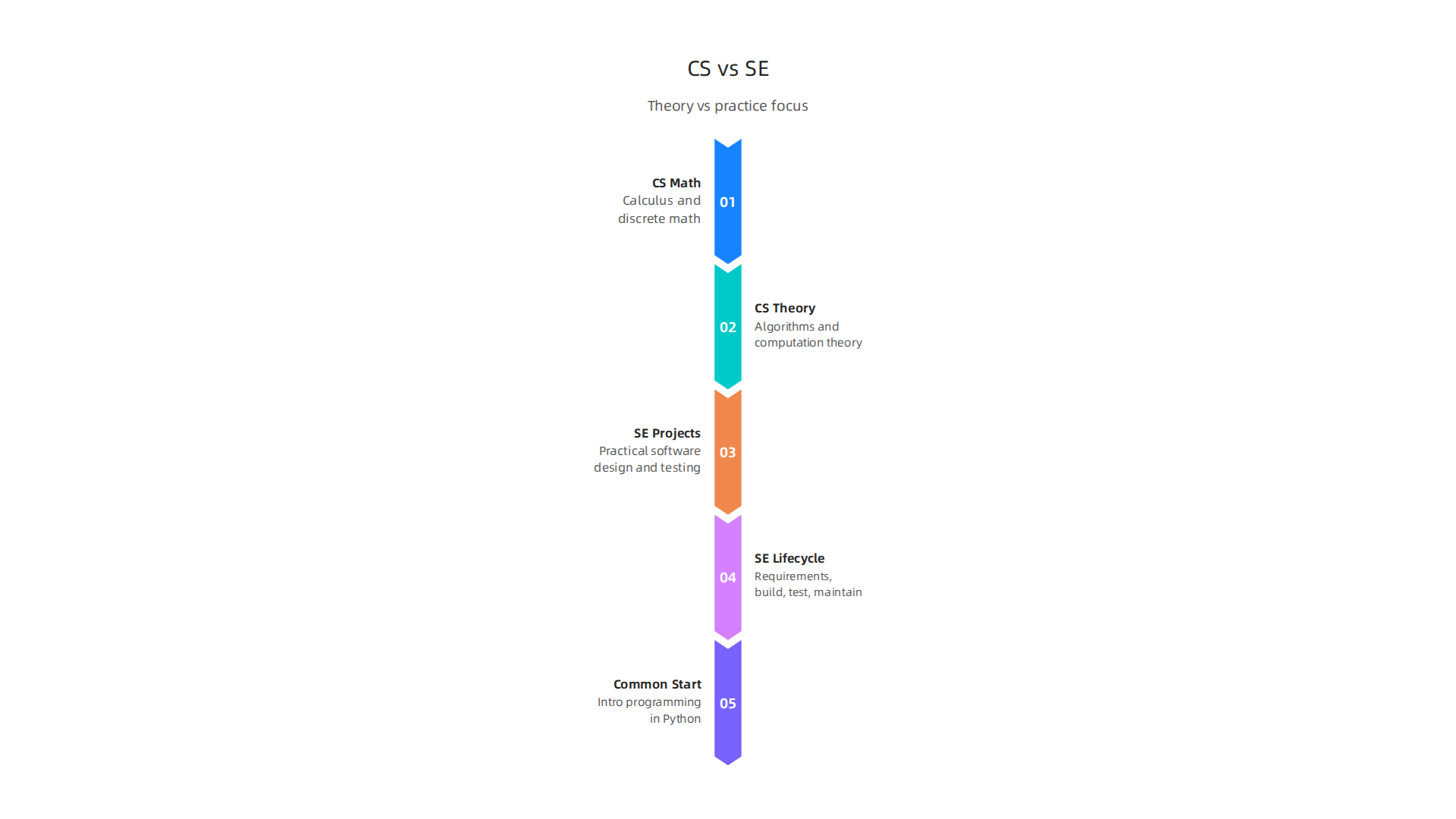
Your class schedule tells you everything about which path you are on.
Computer science curricula are math heavy. From day one, you dive into calculus, linear algebra, and discrete math. These are not optional. They build the foundation for everything else. Then you move into theory of computation, algorithms analysis, and data structures. You learn how to prove that a program is correct and how to measure its efficiency. A lot of your time goes into understanding the why behind computing. This focus on rigorous foundations is why top programs like those at MIT and Stanford are known for their depth in theory and systems. The 2026 college rankings for computer science highlight how the strongest programs combine deep theoretical grounding with hands-on systems work. If you enjoy abstract thinking and mathematical puzzles, this curriculum feels natural.
Software engineering curricula are project heavy. You still take programming courses, but the emphasis shifts to building real applications. Core classes cover software design patterns, testing and quality assurance, version control, and project management. You learn the software development lifecycle: how to gather requirements, design architecture, write code, test it, deploy it, and maintain it. Team projects are everywhere. Instead of proving a theorem, you ship a product.

You also study human factors and user experience because good software must work for real people. The practical focus prepares you to step into a devops engineer or full stack engineer role right after graduation.
Both degrees share a common starting point. In your first year or two, you take similar programming classes. You learn a language like Python or Java, basic data structures, and introductory algorithms. Both paths also cover computer architecture and operating systems at a foundational level. The shared curriculum means you can switch between majors early without losing much ground.
The divergence happens in upper level electives. That is where you choose your specialty. Computer science students pick from advanced topics like machine learning, artificial intelligence, computer graphics, cryptography, and formal verification. Software engineering students choose from courses on mobile app development, cloud computing, security engineering, and software maintenance. The CS path opens doors to ai jobs and research. The SE path leads directly to building and maintaining production systems.
Staying current is vital no matter which route you take. AI is reshaping both fields at a rapid pace. If you want to keep up with the latest AI trends and how they affect developers, The AI Newsletter Worth Reading delivers clear daily updates straight to your inbox.

It is a smart way to stay ahead while you finish your degree.
For a deeper look into how AI fits into a modern development workflow, check out this guide on how to study AI for software development in 2026. It covers practical ways to add AI skills to your toolkit, whether you come from a CS or SE background.
The courses you take will shape the first few years of your career. Choose the curriculum that matches how you like to work. Both can lead to great jobs, but the day to day experience will feel very different.
3. Career Paths and Salary Trends
So you have picked your curriculum. Now the big question: where does each degree take you?
The short answer is that both open strong doors. But the rooms behind those doors look different.
Computer science graduates tend to work on the cutting edge. Many head into research, data science, artificial intelligence, machine learning, and systems architecture. These roles are about building new technology and solving tough problems. A computer scientist might design a faster algorithm, train a neural network, or figure out how to scale a system to millions of users. If you love deep thinking and abstract challenges, this path feels natural. The US Bureau of Labor Statistics backs this up with strong numbers. It reports that computer and information research scientists earn a median annual salary of $140,910 and that the field is growing 20 percent from 2024 to 2034. That is much faster than average.
Software engineering graduates move into building and shipping products. Common roles include software developer, full stack developer, test engineer, project manager, and devops engineer. The focus is on making reliable, user friendly applications. You write code that people actually use every day. Teams rely on you to manage releases, fix bugs, and keep systems running. If you enjoy building things and seeing instant results, this side suits you well.
Salary differences between the two degrees are small overall. Both lead to high paying careers. But specific job titles shift the numbers.

For example, a devops engineer often earns around $141,000, while a software architect can pull in $227,000. Meanwhile, computer science starting salaries for the Class of 2026 are projected at $81,535, the highest of any bachelor’s degree. So your exact role matters more than the name on your diploma.
For a deeper look at which roles are hiring most in 2026, check out this comprehensive guide on computer science jobs in 2026. It breaks down demand, required skills, and real salary ranges across different positions.
Industry also plays a big role. Working in finance or big tech tends to pay higher than education or government. Location matters too. San Francisco salaries run about 12 percent above the national average, while cities like Atlanta and Los Angeles fall below it.
The bottom line: both degrees lead to excellent careers. Pick the one that matches the kind of work you want to do each day. Do you want to invent new systems or ship great products? Either way, you will be in demand.
4. Essential Skills and Competencies Employers Value
You have chosen your degree path. Now, what do employers actually want? The truth is, the name on your diploma matters less than the skills you bring. And in 2026, the list of must-have skills is broader than you might think.
Employers are looking for a mix of technical know-how and human strengths. They want people who can code, but they also want people who can explain their code to a team. They want problem solvers, not just task completers. According to the latest data from CN.edu on top workplace skills for 2026, employers are doubling down on communication, critical thinking, and adaptability alongside technical abilities. This blend is what makes a candidate stand out.
So how do computer science and software engineering degrees compare in building these skills?
Computer science graduates tend to be stronger in theoretical problem solving. Their coursework includes algorithms, data structures, and the math behind computing. This makes them great at tackling abstract problems. They can analyze a system from the ground up and design new approaches. If a company needs someone to research a new AI model or optimize a complex algorithm, they often look for a CS grad.
Software engineering graduates excel in engineering processes and real world building. Their training focuses on software design, testing, version control, and project management. They know how to work in teams, how to ship code on time, and how to keep a product reliable. Employers love that because it reduces risk. An SE grad is often ready to jump into a devops engineer role or lead a product team from day one.
But here is the thing. Many employers care more about what you can actually do than which degree you hold. A strong portfolio of projects, open source contributions, and internship experience often outweighs the course name. If you have built a mobile app, contributed to a GitHub repo, or completed a real world capstone, that shows you have the skills. This is especially true for AI jobs and other fast moving fields where practical experience matters most.
So which path is better? That depends on the work you enjoy. If you love deep theory and inventing new solutions, a CS degree will build that muscle. If you love building products and seeing them used, an SE degree will set you up. Either way, you need to keep learning beyond the classroom.
Technology changes fast. The skills that got you hired today might shift in two years. That is why staying curious and adaptable is your greatest asset. For a deeper look at how to build in demand AI skills, check out this practical guide on how to study AI for software development in 2026. It covers the specific tools and learning paths that employers are looking for right now.
One more thing. To stay ahead of the curve, make it a habit to follow industry updates daily. The AI Newsletter Worth Reading delivers clear daily AI updates straight to your inbox. It is a simple way to keep your skills sharp and know what employers will want next.
5. The AI Factor and Future Outlook
Here is something that changes everything about the computer science vs software engineering degree debate. Artificial intelligence is not coming. It is already here. And it is reshaping what both types of graduates do at work.
AI tools can now write code, debug software, and even design algorithms. That might sound scary. But it actually creates new opportunities. The key is understanding how AI changes the roles each degree prepares you for.
Computer science graduates are moving deeper into AI research and model development. If you study CS, you learn the math behind machine learning. You understand neural networks, natural language processing, and how to train new models. These skills are in high demand for building the next generation of AI systems. Companies need people who can invent better algorithms, not just use existing ones. According to the NMSU blog on in-demand skills for 2026, digital fluency and AI literacy have become baseline expectations across most industries. That is especially true for CS focused roles.
Software engineering graduates focus on integrating AI into real applications. Instead of building AI from scratch, SE grads learn how to deploy AI models, connect them to APIs, and make them work inside products. This is where devops engineer roles come in. You set up the pipelines that get AI running in production. You handle version control, testing, and reliability. Without SE skills, even the best AI model stays stuck in a lab.
But the biggest growth area is for people who can do both. Roles like machine learning engineer or AI engineer are exploding. These jobs require a mix of theoretical understanding and practical engineering. You need to know how algorithms work and how to ship code that users actually interact with. For anyone asking how to become a software engineer in an AI world, the answer is simple. Learn the theory. But also learn how to build.
The Coursera list of high income skills for 2026 confirms that analytical thinking and AI collaboration top the list of what employers want. That is true whether you choose CS or SE. The degree is just a starting point. What matters is whether you keep learning.
So here is the bottom line. If you want to do pure AI research, lean toward computer science. If you want to build products that use AI, software engineering is your path. But if you want the best job security, bridge both worlds.
For a deeper look at how AI is becoming the new standard for developers, check out this guide on AI as the new standard for developers in 2026. It breaks down the specific skills that will keep you relevant no matter which degree you choose.
6. Decision Framework: Which Degree Is Right for You?
By now you have a clear picture of what each degree offers. But making the final call between a computer science vs software engineering degree can still feel tough. The best choice comes down to three things: what you enjoy, where you want to work, and how you learn best.
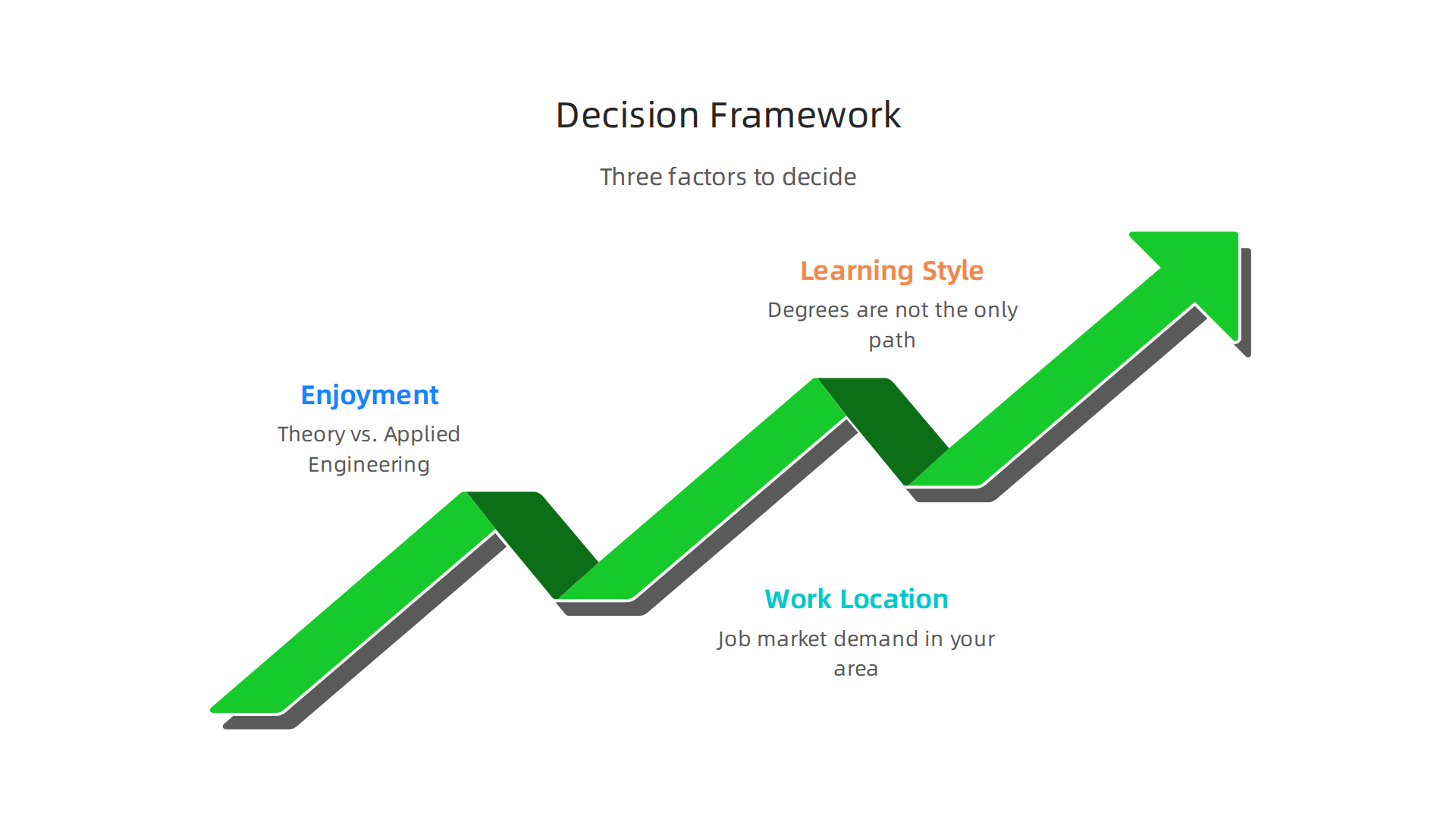
Factor 1: Theory vs. Applied Engineering
Ask yourself a simple question. Do you love understanding how things work under the hood? Or do you love building things that people actually use?
If you get excited about abstract problems, algorithms, and math, computer science is probably your lane. The Computer Science vs. Software Engineering guide from UoPeople explains that CS is typically the better choice if you are interested in AI and machine learning, since it covers algorithms, data science, and computational theory.

This path leads to roles like AI researcher or data scientist.
If you prefer hands-on development, building apps, and seeing your code go live, software engineering suits you better. You will focus on design patterns, testing, and deployment. This leads to jobs like web developer, mobile engineer, or devops engineer.
Factor 2: Job Market Demand in Your Area
The second factor is where you plan to work. Some cities and industries need more software engineers. Others need more computer scientists.
Big tech hubs and research labs often hire CS grads for AI jobs and cybersecurity. Product focused companies and startups usually need SE grads who can ship features fast. Look up job postings in your target city. See which degree appears more often in the roles you want. Both fields have strong growth, but the mix shifts by region.
Factor 3: Degrees Are Not the Only Path
Here is an important truth. A traditional four year degree is not the only way in. Bootcamps, self study, and continuous education matter more than ever. Many successful developers learned to code through online courses and real projects.
If you are asking how to become a software engineer without a degree, the answer is build a portfolio. Contribute to open source. Learn the tools that companies actually use. And never stop learning.
For more on the different paths available, check out these facts about computer science growth and learning paths for 2026. It breaks down how to keep your skills fresh no matter which route you choose.
The Bottom Line
There is no single right answer. The best degree is the one that matches your interests, your local job market, and your learning style. Pick the path that excites you most and commit to growing every year.
To stay ahead of the curve, get clear daily AI updates from The Deep View Newsletter. It helps you track which skills matter most in an AI driven world.
Summary
This article compares a computer science degree with a software engineering degree to help you choose the path that fits your goals. It explains the core difference—CS focuses on theory, math, and algorithms while SE emphasizes practical software design, testing, and deployment—and breaks down typical curricula, shared first‑year courses, and diverging upper‑level electives. You’ll learn which careers each degree commonly leads to, how salary and industry affect outcomes, and which technical and soft skills employers value in 2026. The piece also covers how AI is changing both fields, why hybrid skills (theory plus engineering) are increasingly valuable, and practical alternatives to a four‑year degree like bootcamps and self‑study. Finally, it offers a decision framework to match your interests, local job market, and learning style so you can pick and plan the right educational route.