
Master Programming Language Fundamentals in 2026
· 20 min read

Introduction
You might feel like you’re drowning in new programming languages and frameworks. Every week there’s a new tool or AI assistant promising to write your code for you.

In 2026, nearly 40% of all code written is AI generated or AI assisted, according to industry surveys. That number keeps climbing.
But here’s the thing: AI tools are not a shortcut to becoming a great developer. A recent study published in Science found that less experienced programmers get almost no productivity boost from AI. The real gains go to developers who already understand the fundamentals. If you don’t know how object oriented programming works, AI won’t save you. It might even make things worse by generating code you can’t read or fix.
The challenge today is not a lack of information. It’s too much of it. You need a clear path forward. This guide cuts through the noise. We will help you master core concepts in programming languages, compare different paradigms like object oriented and functional programming, and build a practical learning roadmap for 2026. Along the way, we’ll point you to a practical roadmap for beginners using AI if you need step by step help.
Whether you’re focused on back-end development or figuring out how to be a developer in the age of AI, you’ll find a structured approach here. We’ll also share resources to keep you updated. For daily insights on AI and software trends, check out The AI Newsletter Worth Reading. It’s a quick way to stay sharp.
Let’s start with the most important piece: understanding why programming language fundamentals still matter more than ever.
Why Programming Language Fundamentals Still Matter in 2026
Think about the last time you heard about a "must-learn" new framework. Maybe it was a hot new JavaScript library or a backend tool that everyone swore would replace the old one. By next year, that framework might be forgotten. But the programming language it was built on? That stays.
Here is the reality of 2026. Frameworks like React, Angular, and Vue change their APIs all the time. Even backend tools like Django or Express get major updates. But the core programming languages — JavaScript, Python, Java — stay remarkably stable. If you lock in a solid understanding of how a language works underneath, you can pick up any framework in days.

Without that base, every new tool feels like starting from zero.
Let’s look at the numbers. JavaScript still powers nearly 99 percent of all websites, according to the most popular programming languages in 2026 overview from Coursera. Python leads in AI and data science. Both have been dominant for years. The syntax and core rules of these languages don’t flip every season. What changes are the libraries and frameworks around them. That means your energy is better spent mastering the language itself.
Here is where AI trickiness comes in. An AI assistant can spit out code for you in seconds. But if you do not understand object oriented programming basics — like classes, inheritance, or encapsulation — you cannot tell if that code is safe or even correct. AI makes mistakes. It generates code that looks right but has hidden bugs, security holes, or performance problems. The only way to catch those issues is with your own knowledge of programming fundamentals.
So how do you build that foundation without drowning in too much information? Start by focusing on one core language and learning it deeply. Understand data types, control flow, functions, and how memory works. Once you have that, pick up another language to see how the concepts transfer. For a broader view of where your skills fit in the industry, check out these facts about computer science growth and learning paths.
The bottom line: frameworks come and go, but programming language fundamentals endure. They are the one investment that pays off no matter what shiny new tool arrives next.
Core Concepts Every Backend Developer Must Master
So you understand why fundamentals matter. Now let’s get specific. If you want to build a career in back-end development, there are five core building blocks you absolutely need to know.
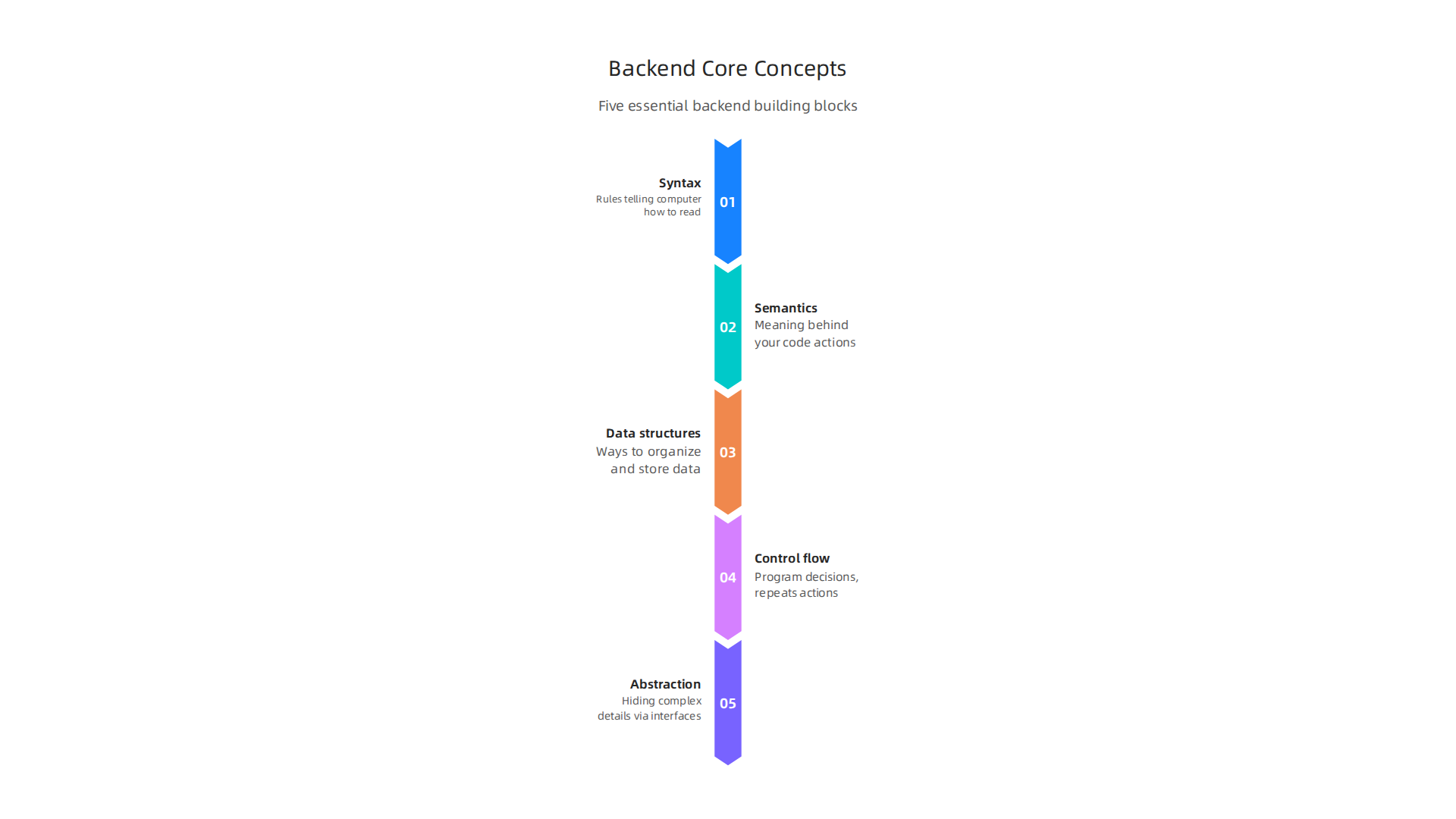
The best part? Once you learn them in one programming language, you can use them in nearly any other.
Here they are.
Syntax. This is the set of rules that tells the computer how to read your code. Every programming language has its own syntax. Python uses indentation. Java uses curly braces. But the logic underneath is the same. Learning syntax is like learning the grammar of a new spoken language. It takes practice, but the concepts are reusable.
Semantics. This is the meaning behind your code. It is not enough to write code that runs. You need to understand what each line actually does. For example, a for loop cycles through items. An if statement checks a condition. The exact keywords may differ across languages, but the semantic meaning stays the same. When you grasp semantics, you can read code in any language and quickly figure out what it does.
Data structures. These are the ways you organize and store data. Arrays, lists, dictionaries, trees, queues, and stacks are everywhere. Choosing the right data structure can make your software backend run fast or slow. The concept of a "hash map" in Java is the same as a "dictionary" in Python or an "object" in JavaScript. Master data structures once, and you own them forever.
Control flow. This is how your program makes decisions and repeats actions. Loops, conditionals, function calls, and error handling fall under this. Every programming language has these. The logic is identical. The only difference is syntax. Once you understand control flow deeply, you can write complex logic without looking up how to do a basic loop.
Abstraction. This is the skill of hiding complex details behind simple interfaces. It includes functions, classes, modules, and yes, object oriented programming. Abstraction lets you manage big projects without getting lost in the weeds. It is the key to writing code that other humans can read and maintain.
These five concepts are the same whether you choose Python, JavaScript, Java, or Go. The list of top backend languages for 2026 shows that each language has its own strengths, but they all share these fundamentals. That is why investing time in them pays off no matter which language you pick for your next project.
If you are serious about learning how to be a developer, start here. Get comfortable with these five blocks. They are your foundation for everything else, including type systems, concurrency, and error handling which we will explore next in this guide.
And as you build your skills, staying up to date with industry trends helps. The AI Newsletter Worth Reading delivers clear daily updates on the tools and technologies shaping modern software development. It is a simple way to keep learning without the noise.
Type Systems and Memory Management
You know the five core building blocks of any programming language. Now let’s talk about two deeper features that separate beginner-friendly languages from production-grade ones: type systems and memory management.
First, type systems. These are the rules that tell your code what kind of data it can use and how. Some languages like Java and Go are statically typed. That means every variable gets a fixed type at the start, like a number or a string. The compiler checks your code before it runs and catches type mistakes early. This makes your software backend more reliable.
Other languages like Python and JavaScript are dynamically typed. Variables can hold any type of data, and checking happens while the program runs. This gives you flexibility and speed when writing code, but it can lead to surprises later. As the CC 410 Textbook on type systems explains, static typing catches errors at compile time, while dynamic typing trades some safety for ease of use.
Now for memory management. Every program uses memory to store data. In some languages like C and C++, you must manually allocate and free memory. This gives you full control and can make your code very fast. But it also opens the door to bugs like memory leaks and crashes.
Most modern backend languages handle memory automatically using a garbage collector. Java, Go, Python, and JavaScript all do this. The garbage collector finds memory that is no longer needed and frees it for you. This makes coding safer and easier, but it can slow things down at unexpected moments.
Your choice of programming language often comes down to these trade-offs. Do you need maximum performance and don’t mind manual work? Rust gives you memory safety without a garbage collector. Do you want to build quickly and safely? Go or Java handle memory for you while still being fast.
Understanding these differences helps you pick the right language for each project. And if you are just starting your journey, these concepts will make you a smarter developer faster. For a full step-by-step path from beginner to builder, check out this practical roadmap for learning to code in 2026. It covers the exact skills you need, including how to choose your first language wisely.
Concurrency and Parallelism Models
Most modern applications need to handle many tasks at once. A web server must respond to hundreds of users at the same time. A data pipeline processes multiple records in parallel. How your programming language handles this is called its concurrency model.
There are a few common approaches. Threads are the oldest. Your program splits into multiple threads that run at the same time. But threads come with risks. If two threads try to change the same data at once, you get a race condition. These bugs are sneaky and hard to fix.
Async/await is a newer model. Instead of threads, your code pauses at certain points and waits for slow operations. JavaScript uses this with its event loop. When you make an API call, the event loop handles other work until the response comes back. This keeps your app responsive without the complexity of managing threads.
Actor models and CSP (Communicating Sequential Processes) offer a cleaner structure. Actors are independent units that send messages to each other. CSP works similarly through channels. Go’s goroutines are a famous example. A goroutine is a lightweight thread that Go manages for you. You can run thousands of them without slowing down. As the guide to the best programming languages in 2026 explains, Go keeps concurrency shallow, explicit, and predictable. This makes your software backend much easier to reason about.
Java recently added virtual threads. They work like goroutines but stay inside the Java ecosystem. They let you write threaded code without the big performance cost of traditional threads.
The most common concurrency bug is the race condition. Two parts of your program race to write to the same variable. The fix? Use channels or message passing instead of shared data. Many languages now encourage these safer patterns. If you want to go deeper on how modern developers handle these challenges, this guide to modern development workflows shows how concurrency fits into real projects.
And if you want to keep learning about AI tools that help debug tricky issues like race conditions, The AI Newsletter Worth Reading delivers daily updates straight to your inbox.
Error Handling and Robustness
Just as race conditions can crash a concurrent system, poor error handling can bring down any application. How a programming language handles errors has a huge impact on how reliable your software backend becomes.
Languages use a few main approaches. Error codes are the old way. A function returns a number that tells the caller if something went wrong. The problem? It is easy to forget to check the code. Your program keeps running with bad data.
Exceptions are more common now. When something bad happens, the code throws an exception and jumps to a handler. This keeps your main logic clean. But exceptions can hide problems if you catch them too broadly. And in languages like Python or Java, throwing exceptions is slow.
Monadic types like Rust’s Result and Option offer a different path. Instead of throwing, a function returns a value that might be an error or might be a success. The compiler forces you to handle both cases. You cannot ignore it. This catches many bugs before your code ever runs. Rust’s type system makes this possible. As this discussion on Basic Concepts of Language Type Systems explains, a sound type system proves that certain errors cannot happen. That is exactly what monadic types do for error handling.
Beyond choosing the right approach, you need patterns like graceful degradation and retries. If a database call fails, do not crash the whole app. Show a cached version instead. If a network request fails, retry after a short wait. These small habits make your system much more resilient.
Strong error handling reduces technical debt. You spend less time debugging strange failures later. If you want to see how these ideas apply to real high-stakes systems, check out this guide on how to build trustworthy systems for high-stakes industries. It shows how error handling connects to reliability at scale.
From choosing reliable error handling to picking your programming language style, every decision shapes your software backend. How do you decide which way to write your code? Most languages fall into one of three main paradigms.
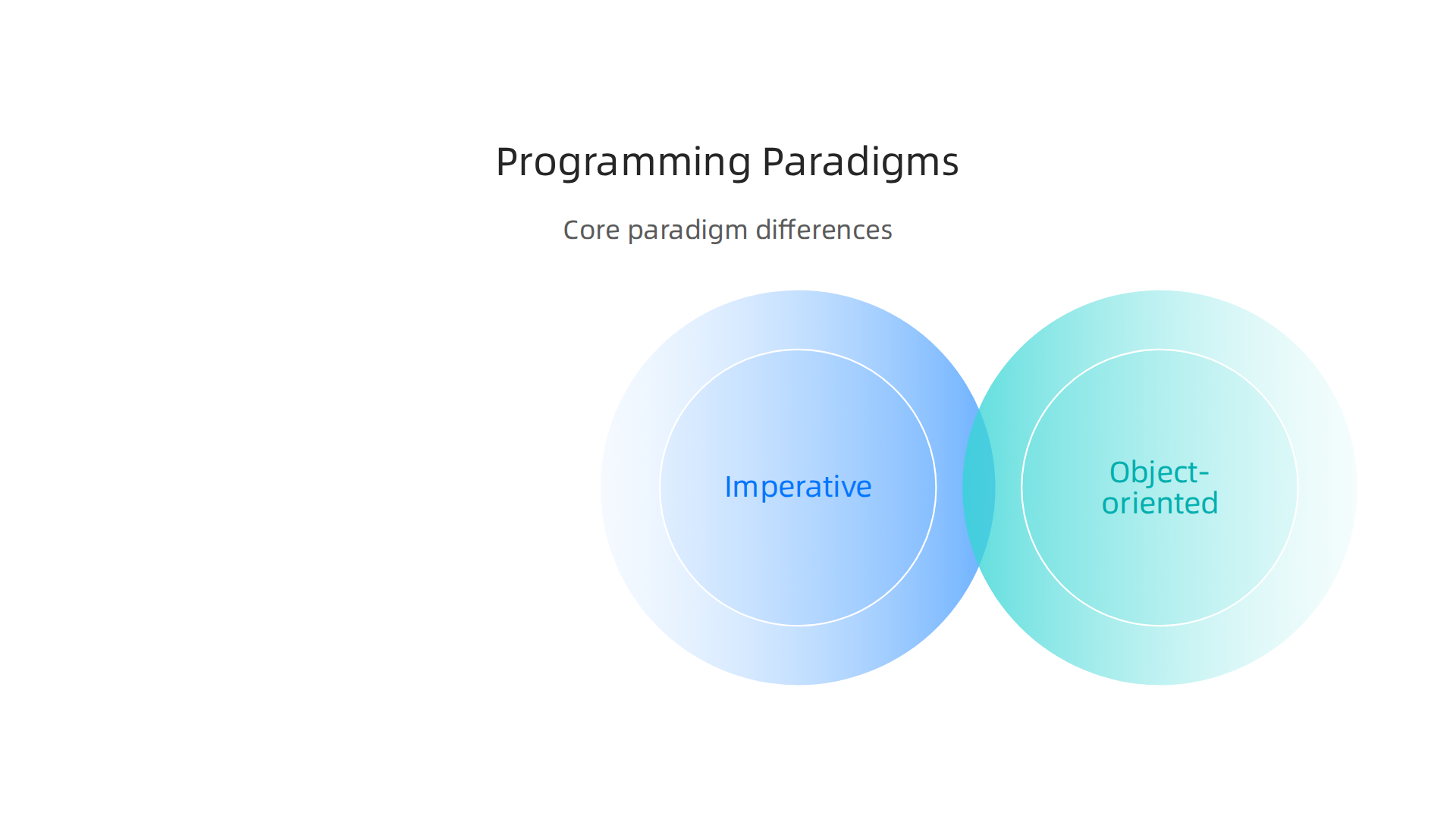
Imperative programming tells the computer exactly how to do something step by step. You write loops, change variables, and track state. C is a classic example. Python works this way too when you write procedural code. This approach feels natural for many developers because it mirrors how we think about tasks.
Object-oriented programming organizes code around objects that hold data and behavior. Java and C++ are the big names here. You encapsulate data, inherit behavior, and use polymorphism. This works great for large projects where you model real-world entities. As one guide on imperative vs functional vs object-oriented programming explains, each paradigm offers a different way to structure solutions.
Functional programming focuses on what to compute, not how. Pure functions take input and return output without changing any state. Haskell and Scala are pure functional languages. This style avoids side effects and makes code easier to test and debug. Think of it like a math problem, where the same input always gives the same output.
Here is the thing: the old paradigm wars are over. Most modern languages are multi-paradigm. Java now supports lambdas and streams for functional style. Python lets you mix OOP, imperative, and functional features. Scala blends OOP with functional programming. This flexibility lets you pick the best tool for each part of your project.
So how do you choose? Consider your team. If everyone knows Java, stick with OOP. If your project needs heavy concurrent processing, lean toward functional. For general backend work, multi-paradigm languages like Python or Scala give you the most room to grow.
If you are just starting your development journey, a solid foundation in these concepts helps. Check out this guide on how to learn to code in 2026 for a practical roadmap.
And if you want to stay current with tools and trends across all paradigms, The AI Newsletter Worth Reading delivers clear daily updates that keep you ahead of the curve.
Backend Language Ecosystem and Tooling
Picking a programming language is only half the battle. The ecosystem around that language can make or break your development experience. You might love the syntax of a language, but if it lacks good package managers, testing tools, or community support, your daily work becomes much harder.
Let’s look at what makes a backend ecosystem mature and why it matters for your choice.
Package Managers Speed You Up
Every major language has a package manager that lets you install ready-made libraries. Python uses pip, JavaScript uses npm (or the faster alternatives pnpm and Yarn), and Java relies on Maven or Gradle. These tools handle version control and dependencies so you don’t have to reinvent the wheel. A rich package repository means you can add authentication, database drivers, or email sending with a single command. The Top 7 Backend Languages For 2026 guide notes that languages with strong ecosystems like Python and JavaScript dominate because they save developers countless hours.
Testing Frameworks Catch Bugs Early
Good testing tools are a sign of a healthy ecosystem. Jest and Mocha for JavaScript, PyTest for Python, and JUnit for Java give you reliable ways to write unit tests and integration tests. When your language has robust testing frameworks, you can ship code with more confidence. No one wants to debug a production outage that a simple test could have caught.
CI/CD Integration Automates the Boring Stuff
Continuous integration and continuous deployment tools like GitHub Actions, Jenkins, and CircleCI work best when they integrate smoothly with your language. Languages with strong CLI tools and community-maintained CI templates let you set up automated builds and deployments in minutes. This directly affects how fast you can deliver features.
Community Support and Documentation Matter
A language with active forums, clear documentation, and helpful Stack Overflow answers saves you from getting stuck. Python’s documentation is famously beginner-friendly. Java has years of enterprise guides. JavaScript has endless tutorials. When you hit a wall, a strong community pulls you through.
How Tooling Boosts Your Productivity
Modern IDEs like VS Code, IntelliJ IDEA, and PyCharm offer deep language support, autocomplete, debugging, and refactoring tools. If you want to stay on the cutting edge of development tools, check out this guide on VS Code Insiders for the newest features and AI tools. It shows how tooling updates can improve your flow.
In short, don’t choose a language only by its syntax. Look at the full ecosystem: package managers, testing tools, CI/CD support, community, and documentation. These factors will shape how productive and happy you are as a backend developer.
How AI Is Changing the Way We Learn and Choose Languages
Ecosystems matter, but in 2026 there is a new factor that changes everything: artificial intelligence. AI coding assistants like GitHub Copilot, Amazon CodeWhisperer, and Claude Code are now standard tools for developers. A study published in Science found that AI already helps write about 29% of new code in the United States, with usage climbing fast. This shift is changing how people pick programming languages and how they learn them.
Languages with Strong AI Support Gain an Edge
When your editor can autocomplete Python, refactor Java classes, or explain Go functions instantly, those languages become easier to work with. The most in-demand programming languages for 2026 report shows Python powers nearly half of all AI-tagged repositories on GitHub, with over 582,000 repos. This creates a feedback loop: more AI tools support Python, more people use it, and even more tooling follows. Languages that lack good AI assistant support start to fall behind.
The Hidden Cost of Relying Too Much on AI
Here is the tricky part. AI tools can help you move fast, but they do not replace real understanding. Researchers from the Complexity Science Hub found that less experienced developers use AI for 37% of their code, yet they see almost no productivity gains. Experienced developers are the ones who benefit. If you lean on AI without building a strong foundation, you may struggle with deeper problems like system design and security.

AI-generated code also carries real risks. A 2026 analysis of AI coding assistants found that AI code produces 1.57 times more security issues and 2.74 times more cross-site scripting vulnerabilities than human-written code. Without a solid grasp of your language, you might not catch these problems before they reach production.
What This Means for Your Learning Path
When you evaluate programming languages today, look at AI tool support. But also commit to learning the fundamentals. A balanced approach uses AI for speed while keeping human oversight for quality. Our guide on how to use AI for software development in 2026 walks through practical workflows that strike this balance.
For a daily dose of clear, no-fluff AI updates that help you stay informed, check out The AI Newsletter Worth Reading. It covers the trends that matter most for developers like you.
Building Your Language Roadmap: A Practical Framework
So how do you actually build a roadmap that works in 2026? It starts with a simple shift in thinking.
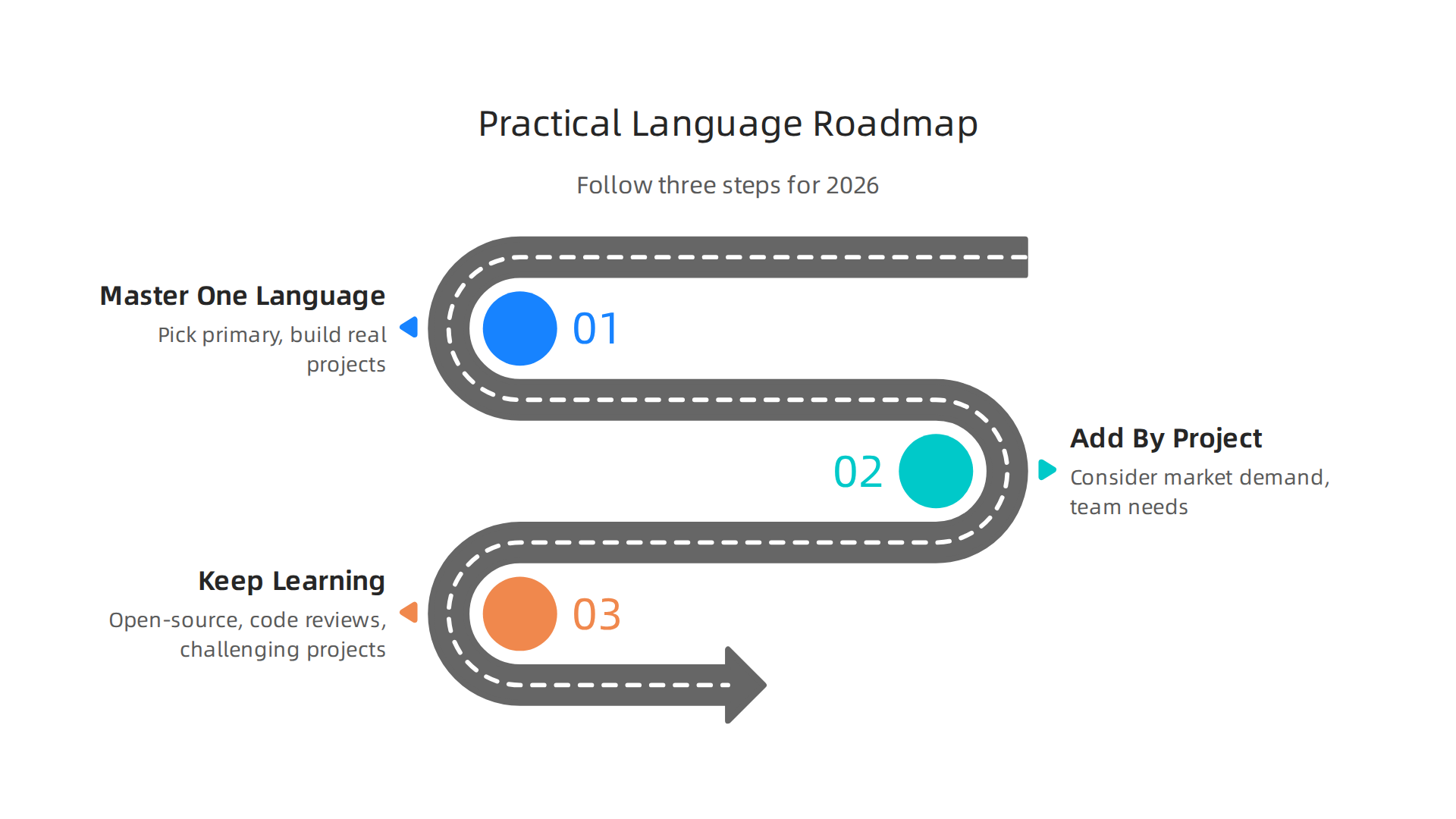
Instead of asking "Which programming language should I learn?" ask "What do I want to build and where do I want to work?" Once you answer that, the language choice becomes much clearer.
Step 1: Master One Language Deeply
Pick a primary language and stick with it until you understand the fundamentals. That means variables, loops, conditionals, data structures, and object-oriented programming concepts. Python is a great starting point because it is beginner-friendly and powers nearly every AI tool out there. JavaScript is another strong choice since it runs everywhere.
Do not bounce between languages every few weeks. Build real projects with your chosen language. Create a simple API. Write a small game. Automate a boring task. This deliberate practice will give you a solid foundation that makes learning any other language easier.
Step 2: Add Languages Based on Projects and Market Demand
Once you are comfortable with one language, look at what you actually need. If you want to build backend services, frameworks like Django for Python or Express for Node.js are popular choices. A guide to the best backend frameworks in 2026 shows that Django and Spring Boot remain the most trusted options for complex applications. If your team uses Java already, Spring Boot is the safe bet for enterprise work.
Market demand also matters. A list of the 12 best programming languages to learn in 2026 confirms that Python and JavaScript are the most in-demand languages for careers right now. If you want a job fast, start there.
Step 3: Keep Learning Through Real Work
Continuous learning is not about reading tutorials forever. It is about contributing to open-source projects, joining code reviews, and building things that scare you a little. Open-source contributions teach you how to read other people’s code, follow project standards, and work with version control on real teams.
If you need a starting point for building projects with AI in your learning loop, check out our guide on how to learn to code in 2026 with AI and real projects. It walks through a practical approach that combines deliberate practice with modern tools.
The best roadmap is one you actually follow. Start small. Stay consistent. And let the work itself teach you.

Summary
This guide explains why deep programming language fundamentals matter more than ever in 2026 and shows a practical way to learn them. It covers the five core building blocks every backend developer needs—syntax, semantics, data structures, control flow, and abstraction—then digs into type systems, memory management, concurrency models, and error-handling patterns that shape production code. The article also compares programming paradigms, evaluates ecosystems and tooling, and explains how AI coding assistants change what you should learn and how you use tools. Readers will learn how to pick a first language based on projects and market demand, how to avoid common AI-related pitfalls, and how to build a realistic learning roadmap that combines deliberate practice with modern AI workflows. By following the guidance here you’ll be able to choose the right languages, write more reliable backend code, and use AI to boost productivity without sacrificing understanding.