
Computer Engineering Requirements The Key Steps to a Hardware Software Career
· 20 min read

Introduction: What Does It Take to Become a Computer Engineer?
Are you someone who loves both building software and understanding how hardware works? If so, computer engineering might be the perfect path for you. In 2026, this field is growing faster than ever. Companies need people who can design chips, write code for embedded systems, and connect the digital world with the physical one.
Computer engineering is one of the most exciting types of engineering because it sits right at the middle of hardware and software. But to get started, you need to meet some important computer engineering requirements. Whether you are a high school student planning your courses or an adult looking to switch careers, knowing the steps ahead is key.

In this guide, we will walk through everything from the best high school classes to take to the college degree requirements you will need. We will also look at the skills that top employers are looking for and alternative ways to enter the field without a traditional four-year degree.
One question people often ask is, is computer science engineering the same as computer engineering? The short answer is no. Computer science focuses more on algorithms, software, and theory. Computer engineering, on the other hand, includes hardware design, electronics, and how computers work at the circuit level. Both are great careers, but the requirements differ.
Another related field is mechatronics engineering, which mixes mechanical, electrical, and computer engineering. If you enjoy robotics and smart machines, that might be worth exploring too. But for now, let us focus on computer engineering.
What High School Courses Prepare You Best?
If you are still in high school, the most important thing you can do is load up on math and science.
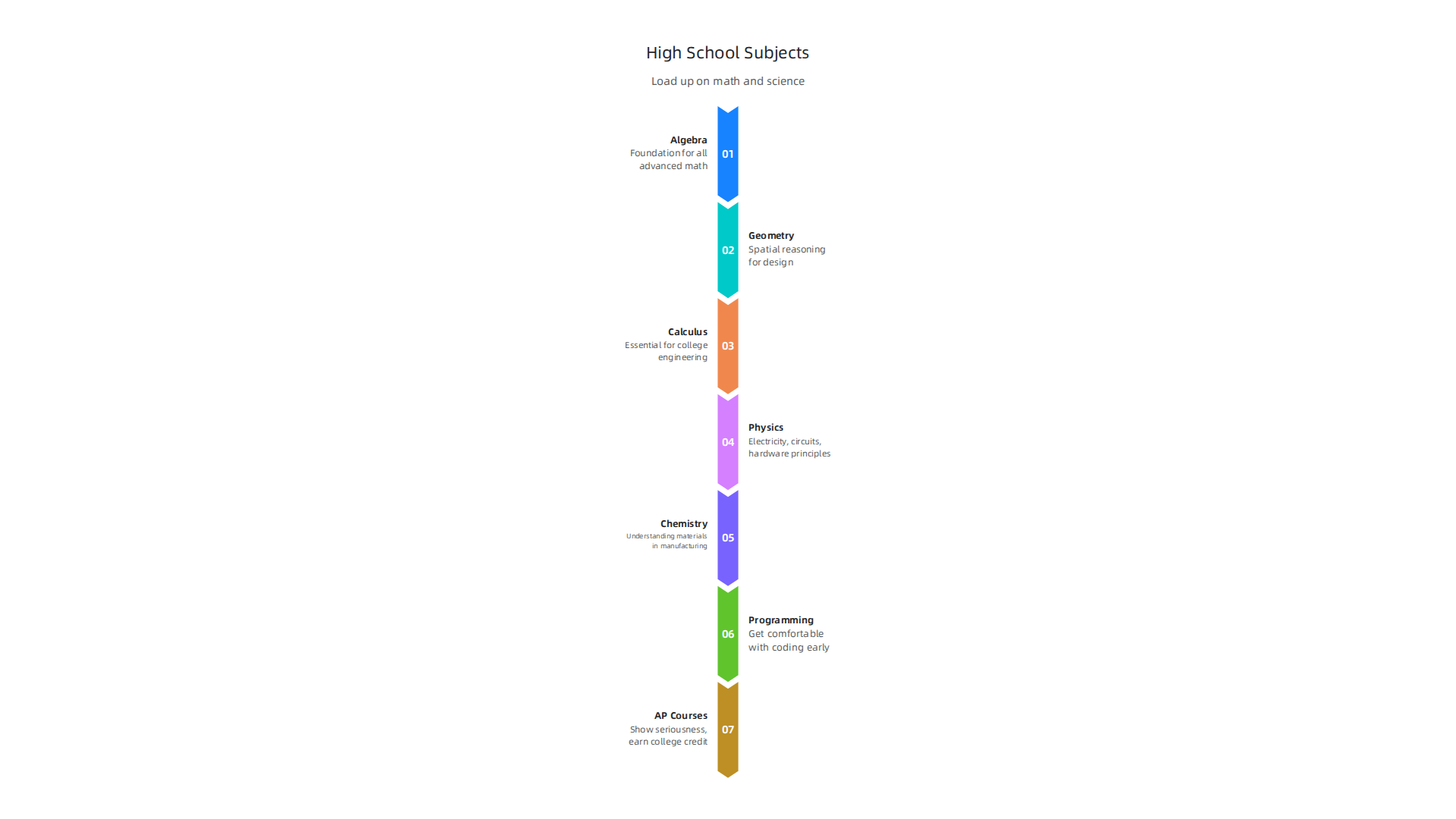
According to advice from engineering professionals, you should take as much math as possible, including Algebra, Geometry, and Calculus. Physics is also crucial because it teaches you how electricity and circuits work. And if your school offers any programming classes, take those too. High school classes for computer engineering can set you up for success in college.
Advanced Placement (AP) courses like AP Calculus BC and AP Physics C are strongly recommended if you are aiming for a competitive engineering program. Many colleges also like to see four years of math and three years of lab science.
What About College Degrees?
Most computer engineers earn a Bachelor of Science in Computer Engineering. This degree usually takes four years and covers topics like calculus, discrete math, data structures, digital logic, and electronics. You will also learn about operating systems and computer architecture. Some programs require up to 142 credits, so be ready for a heavy workload.
For those who want to take a different route, there are online courses and bootcamps that teach coding and hardware basics. But for a deep understanding, a degree is still the most common path. If you want to build coding skills alongside your studies, you can check out a practical roadmap for beginners using AI and real projects to get hands-on experience.
Stay Updated on Trends
Technology changes fast. Even after you meet the initial computer engineering requirements, you will need to keep learning. One great way to stay on top of AI and software development trends is to subscribe to The AI Newsletter Worth Reading from The Deep View. It delivers clear daily updates that help engineers and tech professionals stay ahead.
Now that we have covered the basics, let us dive deeper into each requirement step by step.
Essential High School Prerequisites for Computer Engineering
If you are planning your high school schedule right now, the choices you make today can save you a lot of headaches later. Computer engineering programs are demanding. They expect you to walk in on day one with a strong foundation already in place. Let us break down exactly what you need.
Math Is the Non-Negotiable Foundation
Every college engineering program requires four years of math through at least Pre-Calculus. Most competitive programs want you to have taken Calculus by your senior year. As one expert explained, the standard high school math sequence runs Algebra 1, Geometry, Algebra 2, Pre-Calculus, then Calculus. Students who finish Algebra 1 in 8th grade can reach AP Calculus BC by senior year. That extra acceleration matters because college computer engineering courses jump straight into Calculus I and II, Discrete Mathematics, and sometimes Linear Algebra. If you have already seen those topics in high school, your first year of college will feel manageable instead of overwhelming.
Physics and Science Matter Almost as Much
Physics is the most important science for computer engineering. It teaches you how electricity, circuits, and signals behave. That knowledge is the backbone of hardware design and embedded systems. Chemistry also helps, especially for understanding materials used in chip manufacturing. According to college prep experts, engineering applicants should take biology, chemistry, and physics at rigorous levels, with calculus-based physics being especially important. If your school offers AP Physics C, take it. It directly mirrors the physics you will study in your engineering degree.
Advanced Placement and Computer Science Give You an Edge
Admissions officers look for students who challenge themselves. Taking AP Calculus BC, AP Physics C, and AP Computer Science A shows you are serious about engineering. These courses also let you earn college credit, which can lighten your course load later. If your high school does not offer AP classes, look for dual enrollment options at a local community college or online courses that let you study ahead.
One more thing: getting comfortable with programming early is a huge advantage. Even a single introductory coding class in high school will make your first college programming course feel familiar. If you want to build coding skills on your own time, you can explore a practical roadmap for beginners using AI and real projects to get a head start before college.
What If Your High School Has Limited Options?
Not every school offers AP courses or advanced math tracks. Do not worry. You can still prepare by taking the hardest courses available to you. Focus on getting straight A’s in those classes. Then supplement with free online resources like Khan Academy for math and physics, or YouTube tutorials for basic programming. Admissions officers consider your school’s course offerings when evaluating your transcript. Doing well in what is available is more important than having a long list of AP classes that were not offered.
The bottom line: load up on math, take physics seriously, learn some coding, and challenge yourself as much as you can. Your future engineering self will thank you.
Undergraduate Degree Path: What to Expect from a Computer Engineering Program
Once you finish high school and enroll in college, the real journey begins. A computer engineering degree is demanding, but it is also incredibly rewarding. Here is what a typical program looks like so you can plan ahead.
The Core Curriculum: Hardware Meets Software
Computer engineering sits at the intersection of electrical engineering and computer science. That means you will study both hardware and software. The core curriculum typically includes digital logic design, electronic circuits, programming fundamentals, data structures, operating systems, and computer architecture. Some days you build circuits on a breadboard. Other days you write code in C++ or Python.
Most programs split the first two years into foundational courses. Expect to take Calculus I through III, differential equations, linear algebra, physics, chemistry, and introductory programming. Then in your junior and senior years, you dive into specialized topics like embedded systems, VLSI design, networking, and real-time operating systems. Many programs also let you pick a concentration area such as robotics, cybersecurity, or artificial intelligence. The full set of computer engineering requirements will vary a bit from school to school, but the core stays mostly the same across accredited programs.
Why ABET Accreditation Matters
Not all computer engineering programs meet the same quality standards. That is where ABET accreditation comes in. ABET is a nonprofit organization that reviews engineering programs to make sure they prepare students properly. Programs with ABET accreditation have passed a tough evaluation. According to UC Riverside, ABET accreditation for computer engineering programs proves that a program has met the standards needed to produce graduates who are ready for their careers.
Graduating from an ABET-accredited program matters for several reasons. Some employers prefer or require it. And if you ever want to become a licensed Professional Engineer (PE), you almost always need a degree from an ABET-accredited program. When researching schools, always check whether their computer engineering program holds this accreditation.
The Capstone Project: Your Final Challenge
Near the end of your degree, most programs require a capstone design project. This is your chance to apply everything you have learned.

You might design a smart sensor system, build a robotic arm, or create an embedded device that talks to the internet. It is hands-on, challenging, and very rewarding. Plus, it gives you something impressive to show employers during job interviews.
Building Skills Beyond the Classroom
While you are in school, do not focus only on grades. Join engineering clubs, attend hackathons, and look for internship opportunities every summer. Real-world experience matters just as much as what you learn in lectures.
As you move through your program, keeping up with new technologies can give you an edge. Many professionals refer to a 2026 software engineer certification guide to figure out which credentials actually help their careers. You can also explore topics like AI-assisted coding and modern development frameworks to stay ahead.
Computer Engineering vs. Computer Science
People confuse these two fields all the time. Here is the simple breakdown. Computer science focuses mostly on software, algorithms, and theory. Computer engineering combines that with hardware design. You learn about chips, circuits, and signal processing alongside programming and data structures.
So when you ask "is computer science engineering?" the answer gets tricky. Computer science is not always considered a traditional engineering discipline, while computer engineering definitely is. Understanding the difference between types of engineering helps you pick the right major.
Other Engineering Paths Worth Knowing
Computer engineering is just one of the many types of engineering out there. If you enjoy building robots that sense and react to the world, you might look into mechatronics engineering. That field mixes mechanical engineering, electronics, and computer control. But if you are excited by both coding and circuit boards, computer engineering is probably the perfect fit for you.
Stay Informed as You Build Your Career
The tech world changes fast. Even after you graduate, you will need to keep learning. One easy way to stay current is by following a daily newsletter that summarizes the biggest technology news. The AI Newsletter Worth Reading delivers clear daily updates about AI and broader tech trends. It helps you understand what is happening without spending hours reading articles. For any engineer who wants to stay sharp, that kind of resource is a game changer.
Core Competencies and Skills You Must Develop
Knowing what classes you will take is only part of the picture. To succeed as a computer engineer, you also need to build a specific set of skills that go beyond passing exams.
These core competencies will separate you from the crowd and make you ready for real-world work.
Technical Skills: The Programming Languages You Need
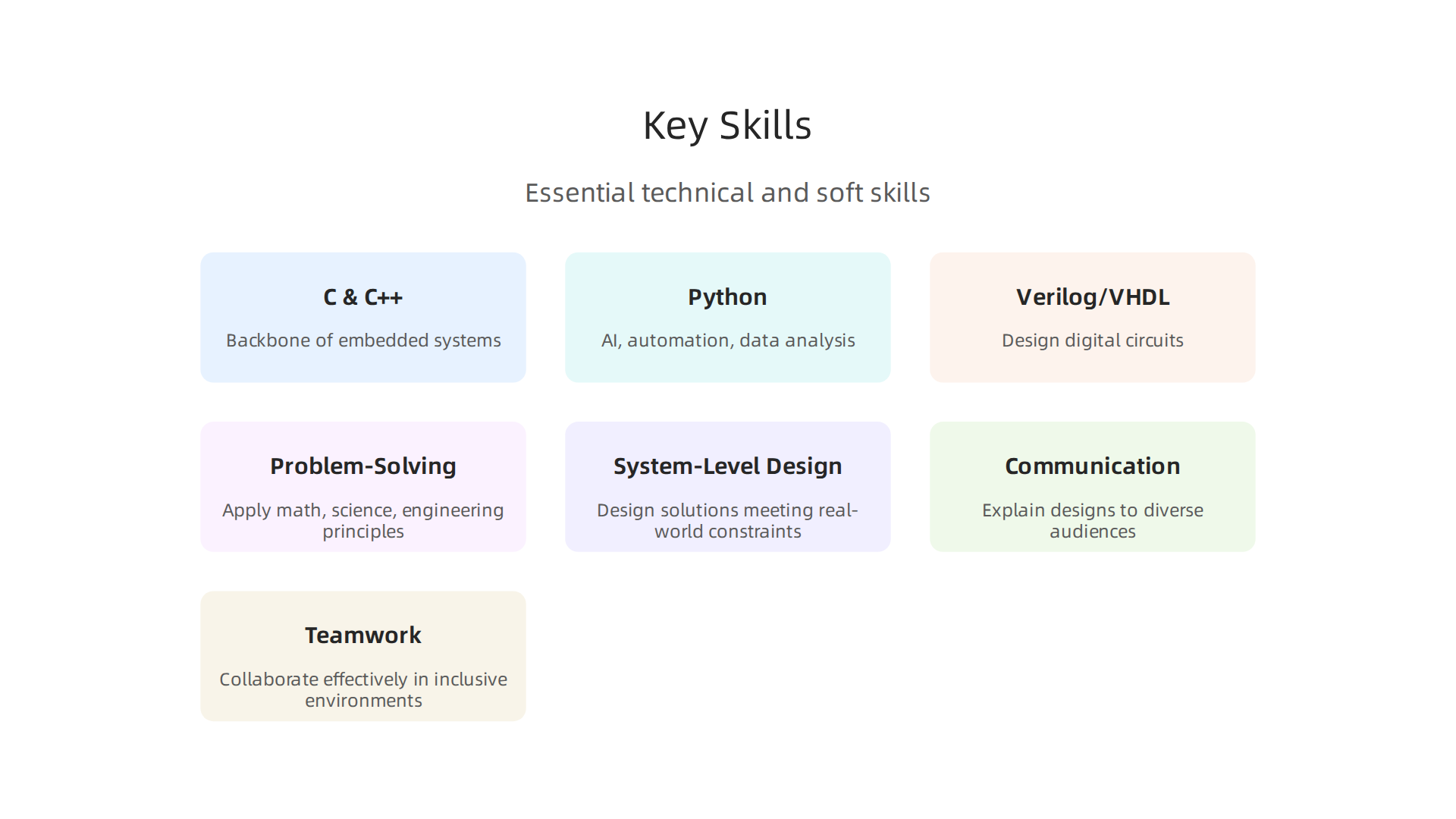
First, you must get comfortable with the languages that power both hardware and software. C and C++ are the backbone of embedded systems and operating systems. Python is everywhere in 2026, from AI to automation. And you need at least one hardware description language like Verilog or VHDL to design digital circuits.
According to a 2026 guide on programming languages worth mastering in 2026, C++ remains essential for performance-critical systems, while Python dominates data analysis and machine learning. For computer engineering, that combination is a must. You will use C++ to write firmware and Python to test and automate your designs.
Modern development is also changing fast. Many engineers now use AI coding assistants to write and debug code faster. If you want to stay efficient, check out this breakdown of AI coding assistants in 2026 to see how tools like Cluely AI help solve the trust problem with generated code.
Problem-Solving and System-Level Design
Knowing syntax is not enough. You must learn to solve complex engineering problems by applying principles from math, science, and engineering. That is the number one outcome that ABET accredited programs track. A strong computer engineering program trains you to break down big problems, design solutions that meet real-world constraints, and test your work thoroughly.
The ABET student outcomes for computer engineering at Illinois list the ability to identify, formulate, and solve complex engineering problems as the first priority. You also need to apply engineering design to produce solutions that consider public health, safety, and environmental factors. That is a high bar, but it is exactly what employers expect.
Soft Skills Matter More Than You Think
Hard technical skills will get you in the door. Soft skills will help you grow your career. You need to communicate clearly with non-engineers, work in teams, and act ethically.
The core competencies required by ABET for computer engineering graduates include an ability to communicate effectively with a range of audiences and function effectively on a team that creates an inclusive environment. These skills are not optional. In a typical job, you will collaborate with software engineers, product managers, and clients.

If you cannot explain your design decisions or work well with others, your technical talent will not matter.
Build These Skills While You Are in School
Don’t wait until you graduate. Practice problem-solving by joining engineering competitions. Improve your communication by presenting in class or writing documentation for your capstone project. And always keep learning. The best engineers in 2026 combine strong programming fundamentals with a willingness to adapt. That is the mindset that will carry you through your entire career.
Alternate Routes: Bootcamps, Self-Study, and Online Degrees
Not everyone follows the standard four-year college path into computer engineering. And that’s okay. In 2026, many skilled engineers entered the field through coding bootcamps, self-study, or online degree programs. These alternate routes are faster, cheaper, and more flexible than traditional university. But they come with trade-offs you need to understand.
Bootcamps focus on practical, hands-on skills. You learn to build real projects in weeks or months instead of years. A 2026 comparison of bootcamps vs. degrees from TripleTen shows that 86% of hiring managers are confident hiring bootcamp grads, and bootcamp job placement rates average 71%. That’s solid. But bootcamps often skip the deep hardware topics that a full computer engineering degree covers. If your goal is to work with embedded systems or chip design, a bootcamp alone will not prepare you.
Self-study through online courses, YouTube tutorials, and open-source projects is another path. Many successful engineers taught themselves using platforms like freeCodeCamp or Coursera. You can build a strong portfolio that proves what you can do. If you are just starting out, a practical roadmap for beginners using AI and real projects can help you structure your learning efficiently. But self-study requires serious discipline. And without a formal credential, some employers will screen you out before they ever see your work.
Employer acceptance of non-traditional paths varies a lot. Large tech companies like Google and Apple have removed degree requirements for many software roles. They care more about your portfolio and interview performance. However, regulated industries like finance, defense, and healthcare still often require a bachelor’s degree. According to a detailed 2026 guide on this topic, financial services and enterprise software firms hold onto degree requirements longer than startups. So your target industry matters.
Online degree programs sit in the middle. They offer the structure and credential of a university education but with the flexibility of learning from home. Many are ABET accredited, which matters if you plan to work in fields that require professional engineering certification.
The bottom line: choose the path that matches your career goals. If you want to build web apps fast, a bootcamp or self-study can work. If you need the depth and credential for hardware or regulated roles, a degree is still the safer bet. Either way, keep learning and building. That’s what employers actually reward.
One more thing: no matter which path you take, staying current with tech trends is essential. The field changes fast. The AI Newsletter Worth Reading delivers clear daily updates on AI and software development so you never fall behind.
Graduate Education and Specializations
Once you have your bachelor’s degree, you might wonder about a master’s. A graduate degree is not required for most computer engineering jobs, but it can open doors to advanced roles. In 2026, many employers in AI, chip design, and cybersecurity actively look for candidates with a master’s. That is where the real computer engineering requirements start to get specific.
Here is the thing: not all master’s programs are the same. You basically have two paths.
Research oriented programs focus on theory and original work. You take deep dives into mathematics, algorithms, and systems design. These programs are great if you want to work on new chip architectures, develop AI models from scratch, or build secure systems for government use. You will likely write a thesis and work closely with a professor. The BLS projects that overall employment in computer and information technology occupations will grow much faster than average through 2024 to 2034, with about 317,700 openings each year. A research master’s can help you land those higher-level roles.
Professional master’s degrees are the other option. These programs focus on applied skills. You take courses in software engineering, cloud computing, or embedded systems. Many include a capstone project with an industry partner. So you graduate with real experience and a portfolio. This path is faster and more practical if you want to move into a specialized role right away.
So what specializations can a master’s unlock? Here are a few of the biggest in 2026:
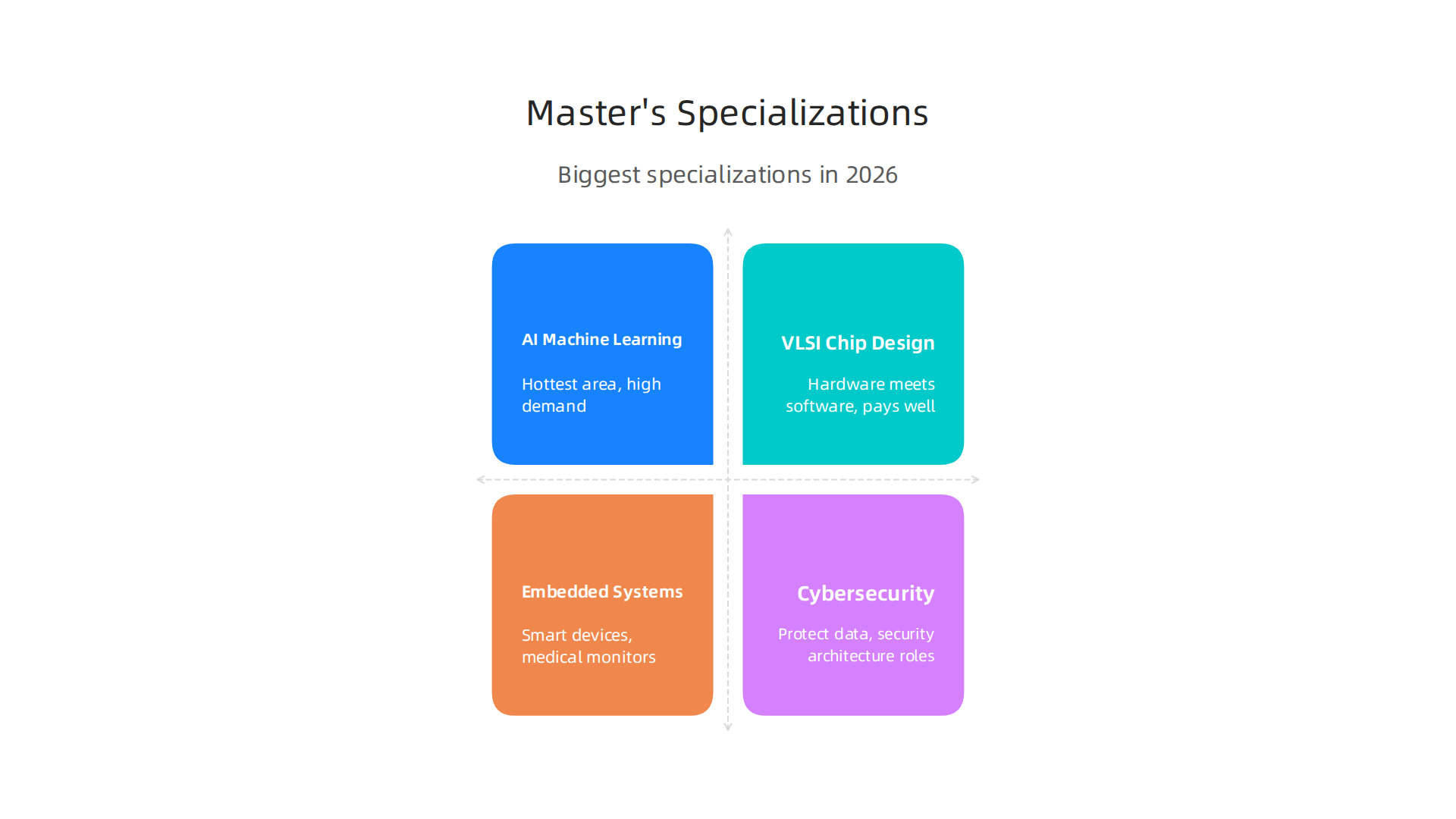
- Artificial Intelligence and Machine Learning – This is the hottest area. Demand for AI engineers is growing fast, and companies like Apple, Google, and TikTok are hiring aggressively.
- VLSI and Chip Design – This is where hardware meets software. You learn to design integrated circuits. It is a niche field but pays very well.
- Embedded Systems – Think of devices like smart home gadgets, medical monitors, and car control units. These require engineers who understand both hardware and software.
- Cybersecurity – Every company needs to protect its data. A master’s in cybersecurity can lead to roles like security architect or penetration tester.
If you are curious about how AI is changing the way developers work, you can explore how Anthropic AI for developers can supercharge your coding workflow. It is a great example of the kind of advanced tool you might study in a graduate program.
One more note: the type of engineering you choose matters. While computer engineering is its own field, it overlaps with other types of engineering like electrical engineering and software engineering. Some programs even combine them. For example, mechatronics engineering blends mechanical, electrical, and computer engineering for robotics. So when you look at programs, think about where you want to end up. That will guide which specialization fits best.
A master’s is a serious investment of time and money. But for many of the most exciting roles in 2026, it is the credential that sets you apart.
The Role of Experience and Continuous Learning
Degrees and specializations get your foot in the door. But in 2026, what really makes you stand out is what you can actually do. Employers want to see that you have built things, solved real problems, and kept your skills fresh. That is where experience and continuous learning come in.
Internships and co-op programs are the single best way to get that real world experience while you are still studying. Many companies use internships as a testing ground for future hires. Do well during a summer internship, and you often get a return offer before you even graduate. The hands on work teaches you how code behaves in production, how teams collaborate, and how to handle deadlines. It is the kind of learning no classroom can fully replace.
After you land your first job, the learning does not stop. Technology moves fast. Languages and frameworks that were popular five years ago may be fading today. That is why continuous learning is a core part of the computer engineering requirements. You need to keep up with new tools, security practices, and architectural patterns. Certifications can help. A focused certification in cloud computing, AI, or cybersecurity can boost your resume and prove you have current skills. If you are considering a deep dive, check out a software engineer certification that actually pays off. Workshops and industry conferences are also great ways to learn and network.
Another powerful way to show what you can do is to build a personal portfolio of projects. This does not have to be fancy. A GitHub repo with a few solid projects that solve real problems is worth more than a list of courses. For example, you could build a small web app, a data dashboard, or a simple AI model. When interviewers see your code, they can judge your skills directly. According to a 2026 guide on the topic, many hiring managers care more about a strong portfolio than about a specific credential. That is especially true at companies like Apple and Google, which have removed degree requirements from many roles. Your projects tell the story of what you can deliver.
Finally, staying informed about industry trends is a habit that pays off. The best engineers read blogs, follow thought leaders, and subscribe to newsletters. To keep up with the fast moving world of AI and software development, you can subscribe to The AI Newsletter Worth Reading. It gives you clear daily updates so you never fall behind.
Experience, certifications, portfolio projects, and ongoing learning. Combine these with your degree and you will meet the full picture of what employers look for in 2026.
Summary
This article explains what it takes to become a computer engineer in 2026, covering the path from high school to the workforce and beyond. It outlines the high‑school math, physics, and early programming classes that make college easier, then describes the typical computer engineering bachelor’s curriculum, ABET accreditation, and the capstone project. The guide contrasts computer engineering with computer science, lists the technical and soft skills employers expect (C/C++, Python, Verilog/VHDL, system design, communication), and shows how internships, portfolios, and certifications fit into hiring. It also examines alternative entry routes—bootcamps, self‑study, and online degrees—their trade‑offs, and which industries still prefer formal degrees. Finally, the article discusses graduate options and specializations (AI, VLSI, embedded systems, cybersecurity) and stresses continuous learning through projects, certifications, and industry resources to stay competitive.