
Godfather of AI: Its Meaning and Impact on Modern Software Teams
· 22 min read

Why the question ‘godfather of ai’ matters for modern software teams
Many people today ask, "Who is the godfather of ai?" It’s a natural question to wonder about the person or people who started something as big as artificial intelligence. But this question isn’t just about finding one name. It’s about understanding where AI came from, who shaped its early ideas, and why their influence still matters for how we build software in 2026.
Thinking about the "godfather of AI" helps us look at the deep history of this field. It makes us consider the first big ideas, the smart people who worked on them, and the most important breakthroughs. For example, before computers were even common, thinkers like Alan Turing laid down key ideas about how machines could "think" and learn. He even proposed a test to see if a machine could act like a human when talking to it in 1950, which is still talked about today The History of AI: A Timeline of Artificial Intelligence. Later, the actual term "artificial intelligence" was first used at a special workshop in 1956 The History of Artificial Intelligence.
For software teams, knowing about these beginnings is more than just a history lesson.

It helps us understand the basic elements of ai that make up current systems. By looking at the people who were key in the past, we can better grasp the thinking behind today’s powerful AI tools. This understanding can help your team make smarter choices, build better AI, and even avoid common problems.
In this article, we will look closely at what the term "godfather of AI" really means. We will compare different leading figures and their groundbreaking ideas. Most importantly, we’ll show you how this knowledge gives modern software teams practical ways to think about AI, innovate faster, and create amazing new solutions.
Want to keep up with the fast-changing world of AI every day? The AI Newsletter Worth Reading delivers clear, in-depth updates right to your inbox.
A concise history of early AI: ideas, labs, and turning points
After seeing how the question of the godfather of ai helps us look at history, let’s go back in time even further. You might think AI started with computers, but the idea of machines that can "think" is actually very old. For example, way back in the early 1900s, a Spanish engineer named Leonardo Torres Quevedo made a chess-playing machine. It could even play some endgames on its own around 1912 Timeline of artificial intelligence. This shows that people have dreamed of smart machines for a long, long time.
But the real start of AI as a field of study happened much later. We already talked about Alan Turing’s important ideas in 1950. Just a few years later, in 1956, a special meeting at Dartmouth College brought together smart people like John McCarthy and Marvin Minsky. They called this meeting the "Dartmouth Summer Research Project on Artificial Intelligence." This is where the term "artificial intelligence" was first officially used. It was a big moment because it set the stage for all the work that followed Pioneers of Artificial Intelligence.
How early labs and funding shaped AI
In the years after Dartmouth, many smart people started to work on AI in university labs. Places like MIT, Carnegie Mellon, and Stanford became famous for their AI research. These labs were like playgrounds for new ideas. Researchers tried to make computers solve puzzles, understand language, and even prove math problems.
A lot of this early research was also helped by money from governments. In the United States, groups like ARPA (Advanced Research Projects Agency) gave money to fund these projects. They wanted to see if AI could help with important tasks, sometimes even for things that could be seen as strategic or advanced technology. This funding helped shape what researchers focused on. It often pushed them to work on big, challenging problems that needed a lot of resources. Learning about these early efforts can help today’s software developers understand the deeper history of computer science and how it relates to AI. If you want to dive deeper into how to make the most of your learning in this area, you can learn how to maximize computer science time for smarter development and learning.
Over the decades, the goals of AI research changed. At first, there was a lot of hope that computers would quickly become super smart. But it turned out to be much harder than expected. There were times, known as "AI winters," when progress slowed down, and people became less excited. During these times, researchers learned that they needed to break down big problems into smaller, more manageable parts. This led to new ways of thinking about AI, focusing on specific "elements of ai" rather than trying to create a fully human-like mind all at once. This constant learning and changing of focus has been a key part of AI’s journey from its early days to the powerful tools we use in 2026.
Who gets labeled the ‘godfather of AI’? A careful comparison of claimants
The journey of AI, from its early dreams to the smart tools we use in 2026, has been long and full of changes. This journey makes us wonder: who really started it all? Who is the "godfather of AI"? The answer is not simple, because different people and groups see different figures as the most important. It often depends on which part of AI history they care about most.
Many people are named when we talk about the beginnings of AI.
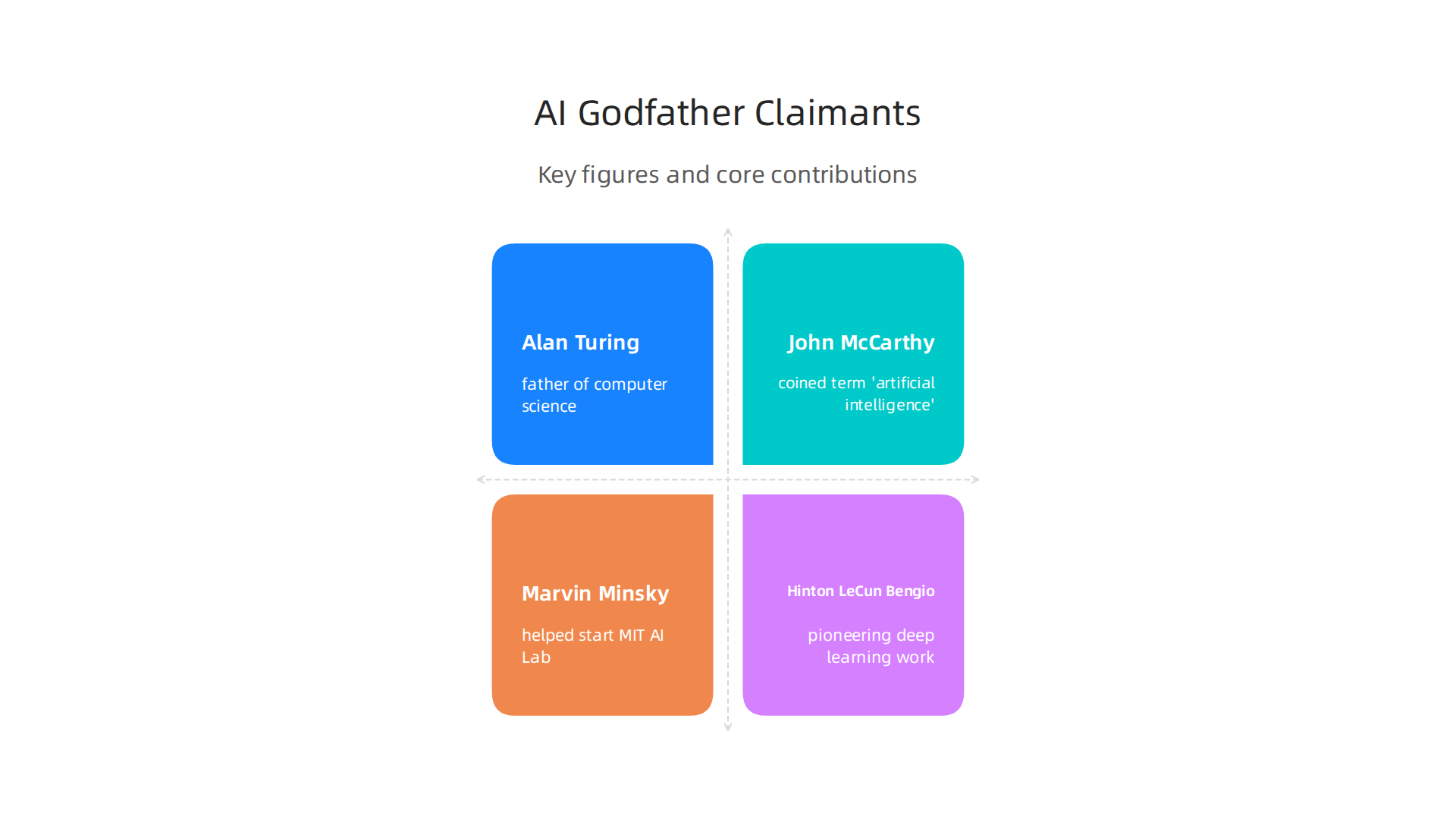
Let’s look at some of the main contenders for this important title:
- Alan Turing: He is often called the father of computer science and AI. Back in 1950, he shared ideas about "thinking machines" and created the Turing Test. This test helps us figure out if a machine can think like a human The History of AI: A Timeline of Artificial Intelligence. His work was a big step for the theory behind AI history of artificial intelligence (AI).
- John McCarthy: He is famous for coining the term "artificial intelligence" itself in 1956. This happened at the important Dartmouth conference, which really kick-started AI as a field of study The History of Artificial Intelligence. He helped give the field its name and direction.
- Marvin Minsky: He was a key figure who helped start the MIT AI Lab. He worked with McCarthy and others to push early AI research forward, focusing on making computers solve problems and understand things.
- Geoffrey Hinton, Yann LeCun, and Yoshua Bengio: In more recent times, these three scientists are often called the "Godfathers of AI" because of their pioneering work in deep learning. Their research helped create the strong AI systems we use today, especially those that learn from lots of data Getting to know The Godfathers of AI. Geoffrey Hinton, in particular, is well-known for his work on artificial neural networks Geoffrey Hinton – Wikipedia.
Why do people pick different "godfathers"?
The choice of who gets the "godfather of AI" label depends on what criteria people use:

- Technical Breakthroughs: Some look at who made the biggest scientific discoveries or inventions. For example, Turing’s ideas about computation or the breakthroughs in neural networks by Hinton and his colleagues.
- Founding Labs or Institutions: Others value those who created the places where AI research grew. People like McCarthy and Minsky helped set up early AI labs that trained many future leaders in the field.
- Conceptual Framing: Coining the term "artificial intelligence" itself, as McCarthy did, is a huge part of how we talk about and understand AI today. It gave the whole field a name.
- Mentorship: Leading labs and guiding many students to become AI experts is another way someone earns respect. This helps spread new ideas and keeps the field growing.
So, while Alan Turing is widely seen as a foundational figure, the more modern "godfathers" are recognized for bringing AI to its current powerful state, especially with things like multimodal AI. Understanding these different viewpoints helps us appreciate the many "elements of AI" that have come together over time. For those interested in this rich history, learning how to study AI for software development in 2026 can help connect these early ideas to today’s innovations, even when dealing with advanced fields like top secret technology applications.
The discussion about who truly deserves the title of "godfather of AI" shows how many smart people built the field. Now, let’s explore the actual basic ideas these early thinkers gave us. These are the "elements of AI" that still form the backbone of the amazing systems we use in 2026.
Symbolic AI and Logic
In the early days, pioneers like John McCarthy and Marvin Minsky imagined computers that could "think" using symbols and rules, much like people use words and logic. This approach is often called symbolic AI. The goal was to teach computers to reason step by step. They would give machines a set of facts and rules, and the machines would use these to solve problems.
For example, early AI programs could figure out medical diagnoses or play simple games by following a clear set of logical steps. This way of thinking helped make the first "expert systems," which were computer programs that tried to act like human experts in very specific areas. These foundational ideas helped shape the "historical progress of AI" from its very beginning reflecting on the past and looking towards the next paradigm shift.
Search Algorithms
Another big idea was making computers good at searching for answers. Imagine a huge maze. An AI program would systematically try different paths until it found the right way out. This is how early AI systems tackled complex problems, like playing chess or proving math theorems. They would "search" through many possible solutions to find the best one.
These search methods are still very important. They are the core of many AI programs today, even if they are hidden inside more complex systems.
Early Learning Concepts
Even though deep learning is a newer breakthrough, the idea of machines learning is quite old. Frank Rosenblatt introduced something called the "perceptron" in 1957. It was a very simple machine that could learn to recognize basic patterns. This was a tiny, but very important, step toward what we now call neural networks, which are crucial for today’s AI. You can trace back these ideas as part of a chronology of deep learning. These early experiments showed that computers could, in a basic way, learn from information and get better over time.
How These Ideas Build Modern AI
These early ideas are like the strong foundation of a tall building. Even the most advanced AI systems we use today, like those capable of multimodal AI (which understands different kinds of information like pictures and sounds), still rely on these basic building blocks. For instance, the learning methods in modern AI, including those in top secret technology that handle sensitive tasks, can often be traced back to these first learning paradigms.
For developers in 2026, understanding these old concepts is still key to making new breakthroughs. It helps them better understand how to approach AI software development and make smart choices. The Algorithmic Advancement in Artificial Intelligence we see now is thanks to these decades of continuous effort. If you want to dive deeper into these topics, learning how to improve your skills for leveraging AI in software development can connect you directly to these core elements.
Key Algorithmic Breakthroughs and Why They Mattered
Beyond those initial concepts, AI has grown through many clever algorithms that helped machines understand the world better, especially when things are not clear-cut. One important step was using "probabilistic models." These are ways for AI to deal with guesswork and uncertainty, helping them make smart choices even when they don’t have all the facts. Think about weather forecasting or medical diagnosis; these often rely on figuring out the most likely outcome.
Another big breakthrough was "reinforcement learning." Imagine training a pet with treats for good behavior. That’s a bit like how reinforcement learning works for AI. Machines learn by trying things, getting "rewards" for correct actions, and slowly figuring out the best way to achieve a goal. This approach has led to AI systems that can master complex games or control robots in tricky situations.
The biggest change came from deep learning. Building on the early neural network ideas, deep learning uses many layers of these "neurons" to find hidden patterns in huge amounts of data. This made AI much more powerful for tasks like recognizing faces, understanding spoken words, and even powering the advanced multimodal AI we see today. These advancements are also key for the secure and often top secret technology used in critical sectors.
This paved the way for large language models (LLMs) which are a huge part of AI in 2026. These models, which can write, translate, and answer questions, build on decades of algorithmic improvements as explained in a survey of large language models. All these different types of algorithms, from simple rules to complex deep learning, work together. They show how small steps and new ideas keep adding up to create the powerful AI systems we use every day. If you’re keen to learn more, exploring how to study AI for software development can help you understand these advanced concepts.
How early ideas shaped modern AI (deep learning, architectures, and ethics)
The journey of AI, from its first small steps to the powerful systems we use today, really began with smart ideas from visionary thinkers. Many people helped lay the groundwork, and we can think of these key figures as the collective "godfather of ai" who planted the first seeds. They imagined machines that could think and learn.
These early ideas, like the concept of artificial neurons, were the building blocks for what we now call deep learning. For example, the perceptron, a simple type of neural network, was proposed way back in the 1950s. While basic, it showed that machines could learn from data. Over time, these simple models grew into much more complex structures with many layers, leading to the powerful deep learning architectures that are so vital in 2026. This history, from simple beginnings to complex networks, is well-documented in an Annotated History of Modern AI and Deep Learning and by tracing back the main ideas in deep learning, which reveals a steady path of innovation. These advancements allow today’s AI to perform amazing feats, like understanding speech or recognizing objects, making up the core elements of AI we rely on daily.
But the story of AI isn’t just about technical breakthroughs. Even as these early ideas were forming, thoughtful people started asking important questions. What does it mean for a machine to think? How can we make sure AI is fair and safe? These were the first steps in thinking about the ethics of AI.
These early concerns about fairness, privacy, and the potential impact of intelligent machines have become even more important as AI grows stronger. In 2026, creating ethical and safe AI is a huge focus. Companies and researchers work hard to build systems that are transparent and trustworthy. It means thinking about how AI decisions affect people and making sure these systems act in a way that aligns with human values. Learning about AI ethics for software teams is now a must for anyone building AI. It’s about more than just making machines work; it’s about making them work for good. Designing AI with care also involves mastering AI response design to ensure safe and helpful interactions.
Practical implications for software teams: integrating AI-informed thinking
The ideas about how AI started and the important talks about making AI fair and safe aren’t just for history books or big thinkers. Actually, these lessons are very important for software teams right now, in 2026. They help teams decide how to build their software, what tools to use, and how to work together.
Today, most developers use AI tools regularly. Reports show that around 90% of professional developers are using AI at work, often daily, for things like writing code faster or finding mistakes. For example, a January 2026 survey found that 90% of professional developers use AI at work. This means that understanding the basic elements of AI is no longer a choice but a must. It’s not about becoming the next "godfather of ai," but about knowing how these smart tools work and how to use them well.
Low-Risk Ways to Add AI to Your Work
Bringing AI into your team’s daily work doesn’t have to be a big, scary change or involve "top secret technology." You can start small, with things that won’t mess up your current projects. Here are some easy ways:
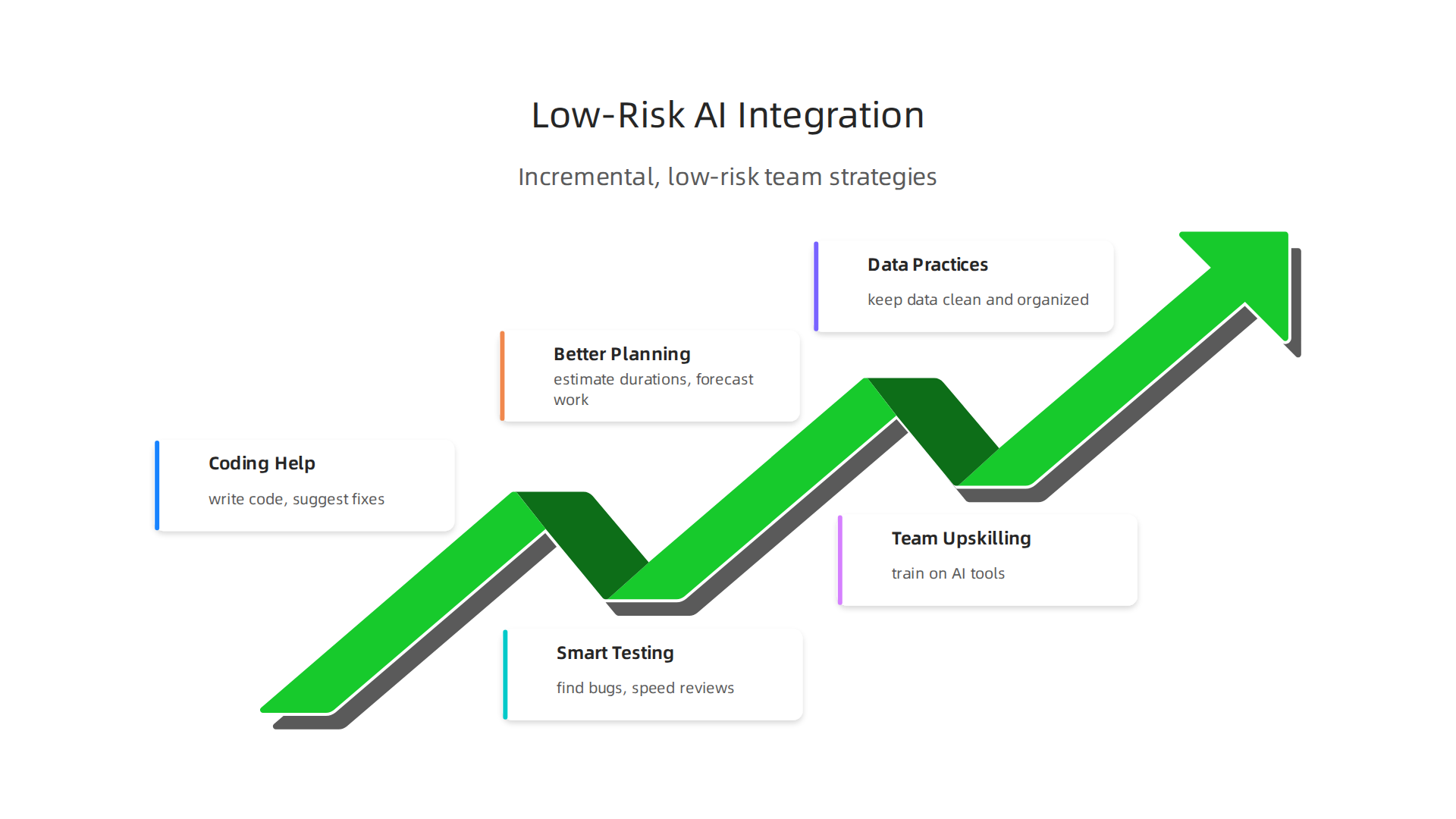
- AI for Coding Help: Many tools can help write parts of your code, suggest improvements, or even fix simple errors. This saves time and helps reduce mistakes. About 84% of developers now use AI coding tools, showing how common this is becoming, though trust can sometimes be low AI at 84%, Trust at 3%.
- Smart Testing: AI can help find bugs or check if new code works right much faster than people can alone. This makes software more dependable.
- Better Planning: AI can look at past projects and help teams guess how long new tasks might take. This makes planning more accurate.
- Upskilling Your Team: Since AI is so widespread, it’s important for everyone on the team to learn how to use these tools properly. More than half of all workers see training as key to making AI work better SHRM Report Warns of Widening Skills Gap as AI Adoption. You can find programs that help your team master AI skills with an AI-powered learning platform.
- Thinking About Data: AI tools work best with good data. So, teams should also focus on making sure their data is clean and organized. This helps even with advanced things like multimodal AI that use different kinds of information.
By adding AI to your workflow in these simple ways, your team can get more done and make better software without big risks. It’s all about making smart choices for today and for the future.
For more deep insights into how AI is changing the tech world every day, make sure you don’t miss out on what’s happening.
The AI Newsletter Worth Reading
Evaluating claims, sources, and who to trust about AI history and influence
After learning how AI can help our work every day, it’s also really important to know how to tell good information from bad. With so much talk about AI, from past stories to new tools, it’s easy to get confused. You might hear big claims about the "godfather of ai" or whispers about "top secret technology." But how do you know what’s real and what’s just hype? It’s like finding your way through a maze of facts and feelings.
To make smart choices about AI, especially as we move deeper into 2026, you need to be a careful checker of facts. This means looking closely at what people say, where they get their information, and if their claims make sense.
Here’s a simple checklist to help you decide if AI information is trustworthy:
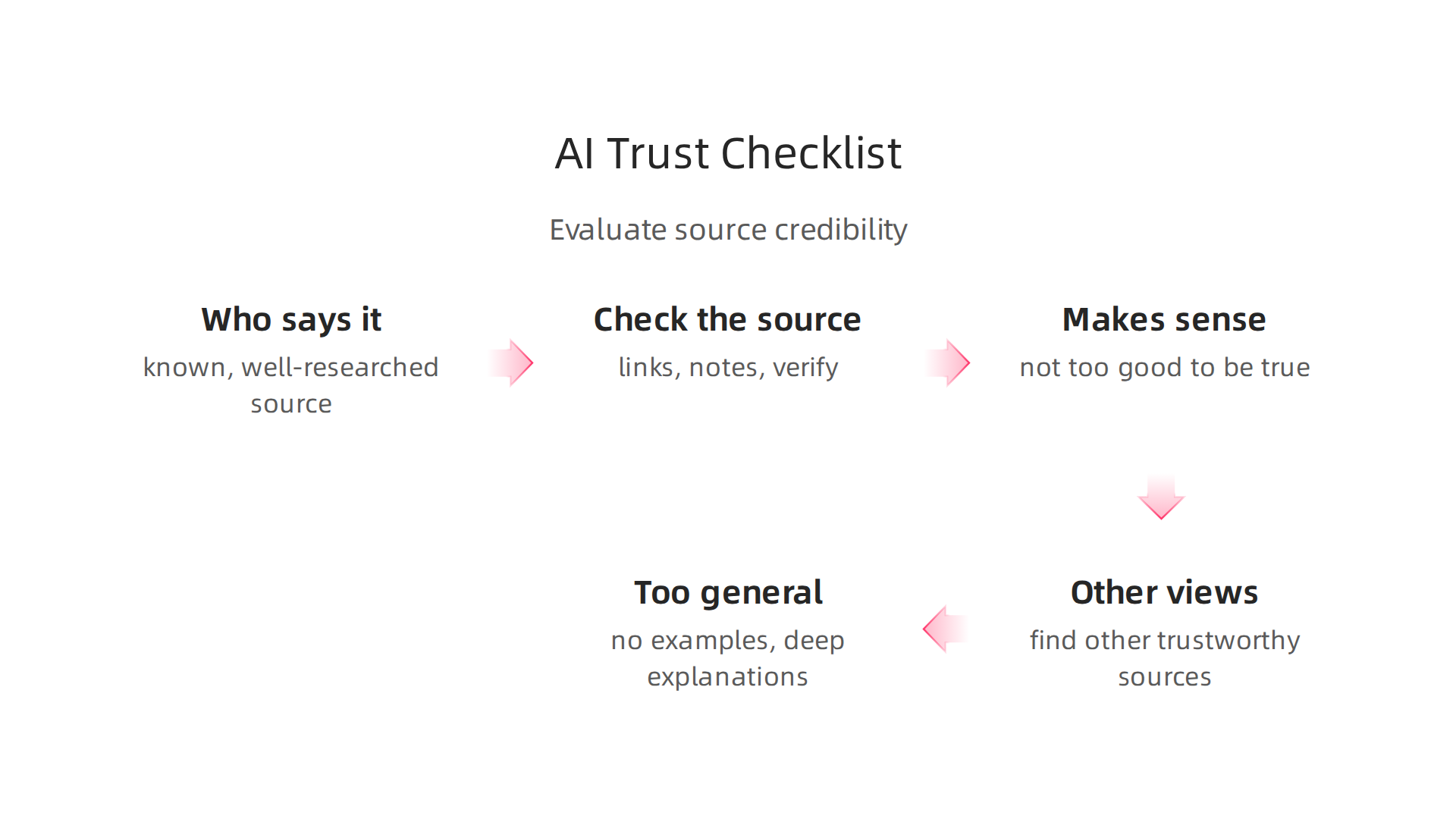
- Who is saying it? Is the person or group known for honest, well-researched information? Are they experts in the field, or just repeating what they heard? Look for authors with a strong background or articles published in trusted places How to evaluate AI research credibility.
- Check the source: Does the information have links or notes showing where it came from? If someone mentions a study or a report, can you go find it yourself? Always try to investigate the source to verify what’s being said.
- Does it make sense? Some claims can sound exciting, but if they feel too good to be true, they probably are. Does the explanation follow a logical path? You should also think about if the information is still current, as AI changes quickly How To Fact Check AI, According To Tech Experts.
- Look for other views: If only one person or group is saying something, it might not be the whole truth. Try to find other trustworthy sources that talk about the same topic. If many different, reliable places say the same thing, it’s more likely to be true Evaluating AI Generated Content.
- Is it too general? If an article or person talks a lot about "the elements of ai" but never gives examples or deep explanations, it’s a red flag. Real experts usually share clear details.
Red Flags to Watch Out For
When evaluating AI content, some things should make you pause. Be careful if someone uses overly strong words without real proof, or if they claim secret knowledge that no one else has. If you hear a lot of talk about how complex "multimodal AI" is, but no one explains it clearly, that’s a sign to dig deeper. Also, be wary of people who say AI will solve all problems or cause all problems without showing how. Learning to spot these warning signs will help you get the most out of AI without falling for false promises or scary stories. This critical thinking is also important for building systems that are fair and safe, echoing the need for AI ethics for software teams.
To truly use AI well, it is not enough to just know what is real and what is not. You also need to know how to bring AI into your daily work. This means learning new skills and finding smart ways for your team to use AI tools.

It is about moving from simply understanding AI to actually doing things with it.
Many people are already doing this. In 2026, about 90% of professional developers use AI tools regularly for their work AI Coding Tools Adoption 2026: JetBrains Survey, GitHub Stats…. This shows that learning about AI is no longer just a nice-to-have; it is a must-have for teams who want to stay ahead.
Learning Paths for Engineering Teams
For engineering teams, learning about AI means more than just knowing what AI is. It means learning how to use AI tools in their daily tasks.
- Prompt Engineering: This is about learning how to talk to AI tools so they give you the best results. It is like learning how to ask the right questions. Engineers need to know how to write clear instructions for AI to generate code, find bugs, or help with testing.
- AI-Assisted Coding: This involves using AI to help write code faster and better. It is important to know which tools to use and how to check the AI’s work to make sure it is correct and safe. You can learn more about how to use these tools in your workflow by reading this guide on how to use AI for software development in 2026.
- Code Review with AI: Even when AI helps write code, a human still needs to check it. Engineers should learn how to review AI-generated code carefully, understanding its limits and strengths.
Companies are investing in training to help their teams get these skills. Many are offering specific programs to turn skeptics into "AI-native" developers AI Training for Technical Staff: From Skeptics to AI-Native Developers.
Skills for Product Managers
Product managers also need to understand AI, but in a different way. They do not need to write code with AI, but they need to know what AI can do for their products.
- Understanding AI Capabilities: Product managers need to know what AI is good at and what its limits are. This helps them find new ways to use AI to make products better or create new ones.
- Identifying Opportunities: They should look for chances to use AI to solve customer problems, make things easier, or create new value. This could involve using AI for smarter features or to improve how the product works behind the scenes.
- Measuring AI Impact: Product managers need to know how to check if AI features are actually helping users and if they are worth the effort.
To stay on top of all the new AI trends and tools, it is helpful to have a reliable source of information.
To get clear daily AI updates, consider subscribing to The AI Newsletter Worth Reading.
Incremental Projects and Building Confidence
The best way for teams to learn about AI is by doing. Instead of trying to use AI for a huge project all at once, start with small steps.
- Pilot Projects: Begin with small, non-critical projects. This lets your team try out AI tools without big risks. For example, use AI to help with simple tasks like writing basic code snippets or summarizing documents.
- Measure Results: After each small project, look at what happened. Did AI help? Did it save time? Learning from these small steps helps teams build confidence and see the real value of AI. This also helps show a good return on investment (ROI) for using AI Why Ai Tools Don’t….
- Share Learnings: Talk about what worked and what did not. This helps everyone on the team learn faster and get better at using AI. Many organizations are already finding success with this step-by-step approach to AI upskilling Supporting case studies: What works for AI upskilling in the UK.
Summary
This article examines why the question