
When to Use n in C Programming and When to Avoid It
· 19 min read

Let’s be honest: if you’ve written even a few lines of C code, you’ve used the variable name n. It shows up everywhere. As a counter. As a size. As a simple loop index. And that’s exactly the problem. The same two letters mean different things depending on the context. For a newcomer, that’s confusing. For an experienced developer, it can hide bugs.

Naming is serious business. As the C Coding Standard from CMU puts it, “Names are the heart of programming.” When you pick a name like n, you’re trading clarity for convenience. Sometimes that trade works. Other times it invites errors.
A naming convention is simply a set of rules that helps everyone on a team read and understand code faster. In C, conventions vary. Some projects use n for a count, i for an index, and sz for a size. Others use longer names like num_items. The discussion on Codidact about C naming shows that even within the C community, there’s no single “right” way.
But here’s the thing: understanding when and how to properly use n can make your code much easier to read and maintain. It also helps you avoid silly mistakes that cost hours of debugging.
In this article, we’ll explore the history of using n in C, look at real-world best practices, and walk through common pitfalls. You’ll learn how to spot when n is a good choice and when it’s better to pick a more descriptive name. If you’re coming from a learning platform like Edhesive (and maybe searching for edhesive 3.2 code practice answers or 4.2 code practice question 1), the lessons here will help you write cleaner, more professional C code.
Ready to get a deeper understanding of one of the smallest but most powerful names in programming? Let’s dig in. And if you want a broader framework for understanding code deeply, check out our guide on grokking code with a science-backed framework.
The Ubiquity of ‘n’ in C: A Historical Perspective
Ever wonder where the tradition of using n in C code actually comes from? It’s not just a lazy shortcut. The letter n has deep roots in mathematics and early computer science. In math, n has long stood for an unspecified integer, like in “n items” or “the nth element.” When Dennis Ritchie and Brian Kernighan created C at Bell Labs, they carried that math shorthand into their code. The result? n became the default name for array sizes, loop counts, and general numbers.
Look at early UNIX source code, the very system C was built for. You’ll see n everywhere. In the first edition of The C Programming Language (K&R), Kernighan and Ritchie used n in examples like int n; for the number of elements. This wasn’t random. It was practical. Terminals were slow, and every character saved mattered. Short names like n made code fit on small screens and reduced typing. Over time, this practice became a habit, then a tradition.
Today, the use of n in C is so common that many developers don’t think twice. But understanding its origin helps you see both its strengths and its hidden dangers. As the CMU C Coding Standard reminds us, “Names are the heart of programming.” A name like n carries the weight of decades of usage, but it also carries ambiguity. When you see n in code, do you know if it means the count of items, the size of an array, or something else entirely? That’s where confusion starts.
The discussion on Codidact about C naming shows that even experienced developers argue about when n is okay and when it’s not. Some projects have strict rules: n means count, i means index, sz means size. Others leave it loose. The key is knowing the history so you can make an informed choice.
If you’re new to C, maybe coming from a course like Edhesive where you work on exercises like 4.2 code practice question 1 or search for edhesive 3.2 code practice answers, understanding this history will help you write code that others can read easily. Naming well is a skill that starts with understanding where the common names come from. For a broader look at how coding skills are built from the ground up, check out our guide on coding for kids game-based learning that builds real skills. It shows how naming conventions and clear thinking start early, even in simple games.
Common Contexts for Using ‘n’
Now that you know where n comes from, let’s look at the three places you’ll bump into it most often in real C code.
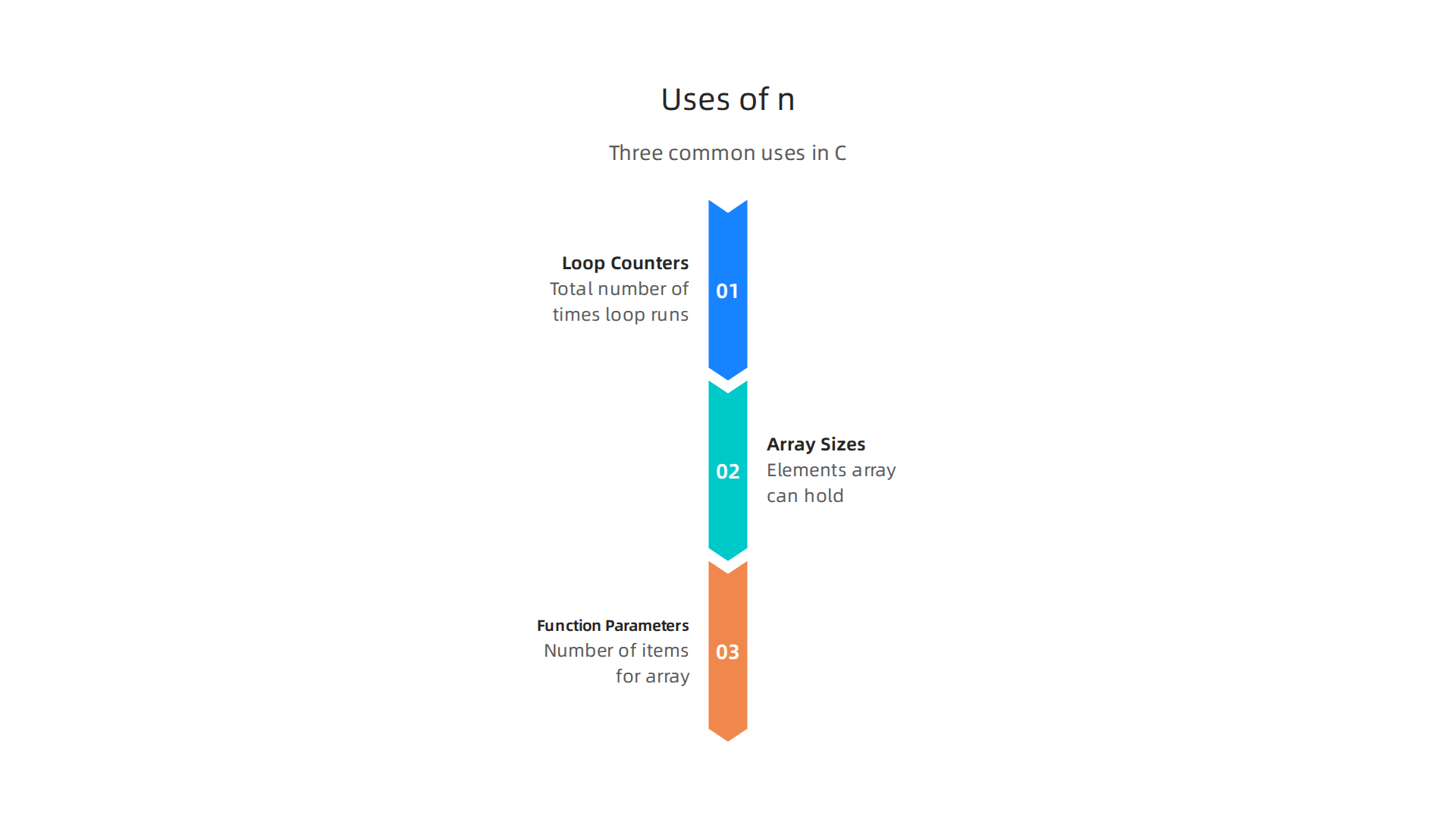
These contexts are so common that they almost feel like rules of the language.
1. Loop counters. This is the big one. You’ve probably written something like this a hundred times:
for (i = 0; i < n; i++) {
    // do something
}
Here n holds the total number of times you want the loop to run. It’s short, it’s clear, and every C programmer recognizes it instantly. When you’re working on a class assignment like 4.2 code practice question 1 in Edhesive, this pattern shows up again and again. That’s not an accident. Teachers use n because it matches the math notation students already know.
2. Array sizes. Another super common use is declaring the size of an array or buffer. For example:
int scores[n];
Here n tells you how many elements the array can hold. It might be a compile-time constant like #define N 100, or a variable set at runtime. The Linux kernel coding style allows this kind of short name for local, obvious variables. But it warns against using n in complex functions where the reader might lose track of what it means.
3. Function parameters. Lots of C functions take a count parameter named n. A typical function signature looks like:
void sort_array(int data[], int n);
This tells you the array comes first, and n is the number of items. It’s a clean convention. But here’s where ambiguity creeps in. If you have a function like void process(int a, int b, int n), is n the count of something related to a or b? That’s when you should pick a more descriptive name like num_elements.
Understanding these standard contexts helps you make smart choices when you see n in code. If you’re looking for 4.2 code practice: question 1 solutions or edhesive 3.2 code practice answers, watch how the instructors use n in those patterns. It will help you read and write the code faster.
When the context is obvious, n works fine. When it’s not, a clearer name saves future head scratching. Sticking to these three roles loop counter, array size, function parameter keeps n safe and predictable. For more on reading code with confidence, check out our guide on grok code with a science-backed framework for deep comprehension. It shows how small naming choices affect how easily you understand the whole program.
Readability and Code Quality: When ‘n’ Works and When It Doesn’t
So far we’ve looked at the places where n shines. But here’s the honest truth: not every use of n is a good one. Sometimes it makes your code harder to read, and that can lead to real bugs.
Let’s talk about the trade-off. Short names like n make your code shorter. That’s great for simple loops where the reader can see the whole context in one glance. Think about a loop like for (i = 0; i < n; i++). You know n is the limit, and you’re done.
But the moment your code gets more complex, n starts hiding information.

Imagine a function that sorts a list, then filters duplicates, then counts results. If you call the size parameter n everywhere, your future self (or a teammate) will have to stop and ask: “Wait, which n is which?”
That’s why major coding standards push for clarity. The Linux kernel coding style says short names are okay for local, obvious variables like a loop index. But it warns against using short names in complicated functions where they lose their meaning. The GNU Coding Standards go further and recommend descriptive names for almost everything, especially when the variable’s purpose isn’t crystal clear.
So how do you decide? Here’s a simple rule of thumb.
Use n when:
- The variable is used in a small block of code (under 10 lines).
- The reader can see its definition and all its uses without scrolling.
- The purpose is obvious, like a simple loop counter or an array size in a tiny function.
Don’t use n when:
- The function is long or has multiple parameters.
- The algorithm is complex (like sorting, searching, or graph traversal).
- You have more than one numeric count in the same scope.
In those cases, names like num_elements, array_size, or item_count save time and prevent confusion. Your team will thank you.
If you’re working through exercises like 4.2 code practice: question 1 or looking for edhesive 3.2 code practice answers, pay attention to how the example code uses n. In simple problems, it’s fine. But when the problem gets harder, notice how the provided solutions often switch to longer names. That’s a hint.
The best n in c programming practice comes down to one idea: know your audience. If you’re writing a quick one-off script that only you will see, n is fine. If you’re building software that others will read or maintain, lean toward clarity. Your future self will be grateful.
For a deeper look at how small naming choices affect how easily you understand code, check out our guide on grok code with a science-backed framework for deep comprehension. It shows exactly why names like n can trip you up in larger programs and how to fix that habit.
Pitfalls to Avoid with ‘n’
Even when you think you’re following the rules for using n, things can still go wrong.

Here are three common pitfalls that can sneak into your n in c programming work.
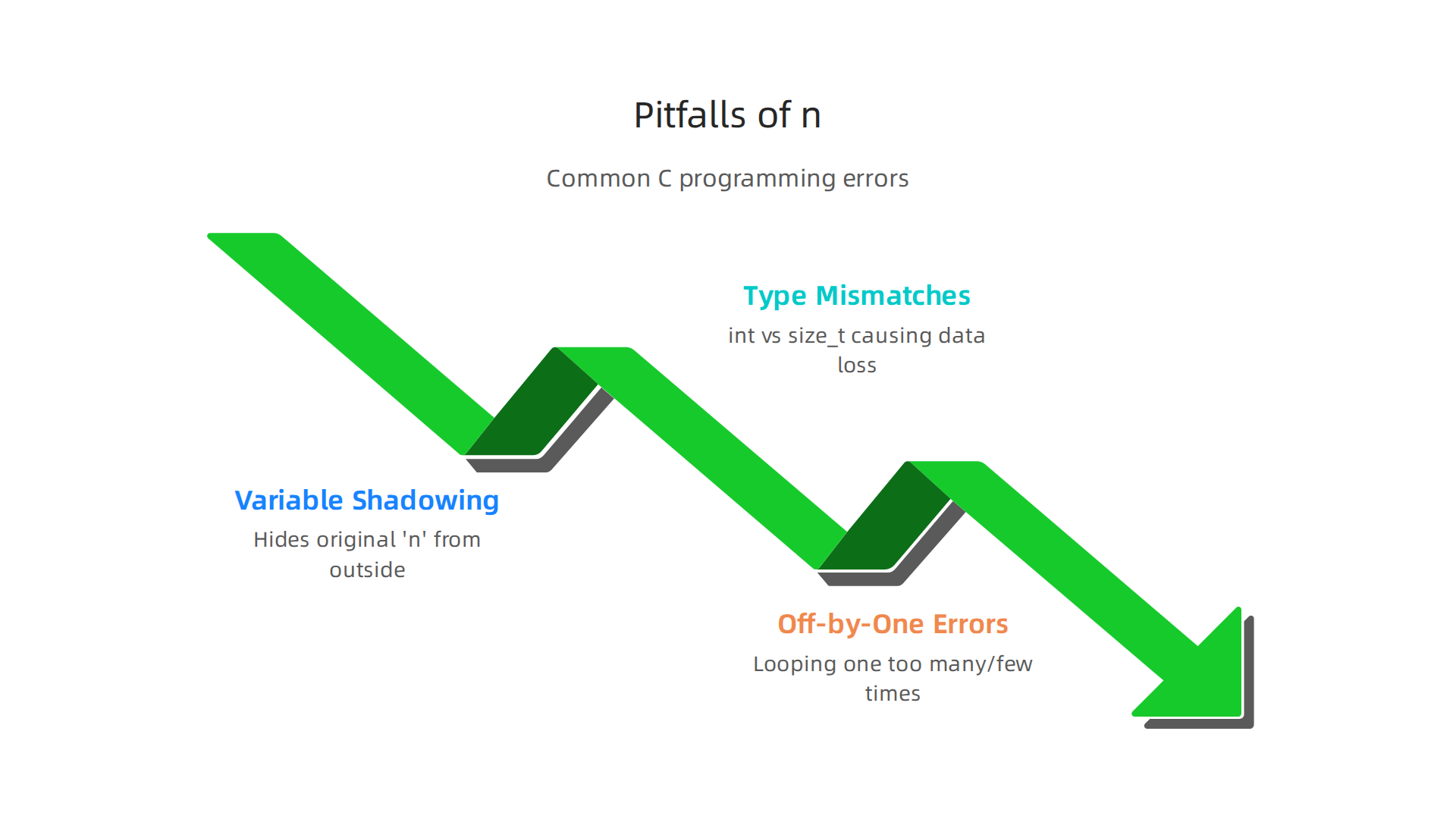
Variable Shadowing
This happens when you declare a new n inside an inner scope, hiding the original n from the outside. Imagine you have a function that uses int n for the total count, then inside a loop you write int n = 0;. Now the loop talks to a different n. The original n is hidden, and you might read or write the wrong one.
Variable shadowing is a well-known bug pattern. One real-world story from Temporal.io shows that a single shadowing bug in Go caused data loss in their production system. The dev.to article calls it "a sharp edge" that catches even experienced developers. Even in C, reusing n inside nested blocks can lead to subtle logic errors.
Watch for this especially when working through exercises like 4.2 code practice: question 1. If you reuse n inside a nested block, the results may surprise you.
Type Mismatches
In C, n is often assumed to be int. But many standard library functions and array indexing actually expect size_t, which is unsigned. If you declare n as int but use it with size_t parameters, the compiler may warn you, or worse, you could silently lose data when n is negative or too large.
Static analysis tools like FindBugs (which also work on C code) catch many type mismatch bugs. A paper on experiences using static analysis found that type-related defects are among the most common. Always check that the type of n matches its actual use. When you see edhesive 3.2 code practice answers, notice how they often use int for n but sometimes switch to size_t for safer comparisons.
Off-by-One Errors
This is the classic mistake. Using n as a loop bound without careful validation leads to iterating one too many or one too few times. Writing for (i = 0; i <= n; i++) when it should be < n is an easy slip. A recent survey of bugs in AI-generated code lists off-by-one errors as one of the most common logical bugs.
In practice, always double-check your loop conditions. When solving problems like 4.2 code practice question 1, write the loop bounds clearly and test with small values of n. This simple habit prevents hours of debugging.
How to Stay Safe
The best way to avoid these pitfalls is to be deliberate. Use n only in short, obvious contexts. When the code gets complex, switch to descriptive names. And always lint your code. Catching shadowing, type mismatches, and off-by-one errors early saves time later.
For a deeper understanding of how naming choices affect your ability to read and fix code, check out our guide on grok code with a science-backed framework for deep comprehension. It shows exactly why these pitfalls happen and how to avoid them.
Performance and Compiler Optimizations
Now that we have covered the common pitfalls with n, let’s look at the upside. The way you use n in c programming can actually help your code run faster. Here is the thing: the name itself does not change the compiled machine code. But the meaning behind n can be a big clue for the compiler.
How Semantics Help the Compiler
When you use n as a count or a loop bound, the compiler sees a clear pattern. It knows this variable is likely used to control a loop. That information allows it to apply powerful optimizations like loop unrolling. In loop unrolling, the compiler duplicates the loop body to reduce the number of iterations. This works best when the loop bound, your n, is known at compile time or is easy to predict.
For example, if you write for (int i = 0; i < n; i++), and n is a small constant, the compiler might unroll that loop completely. But if n is declared as a plain int with no extra information, the compiler has to be more cautious. On the other hand, if you tell the compiler that n will not change, it can trust that information and optimize more aggressively.
Using const and the Right Type
The simplest way to help the compiler is by adding the const qualifier. When you write const int n = 100;, the compiler knows n will never change inside that scope. That opens the door for optimizations like constant propagation and dead code elimination. It also prevents accidental modification, which is a safety bonus.
Choosing the right type also matters. If n is a loop bound, using size_t instead of int avoids signed/unsigned mismatch warnings and helps the compiler generate faster code on some platforms. In exercises like 4.2 code practice: question 1, you will often see n used as a size. Making it size_t and const where possible makes both the compiler and your future self happier.
The Big Picture
When you solve problems from edhesive 3.2 code practice answers, notice how they use n as a simple counter or bound. Those patterns are exactly what modern compilers expect. By keeping n clean and well-typed, you let the compiler do its job better.
Understanding the deeper logic behind your code helps you write faster programs. For more on how naming and structure affect your ability to read and optimize code, check out our guide on how to grok code with a science-backed framework for deep comprehension. It shows you exactly why these small choices matter.
Remember, a little thought about what n means can lead to big performance gains. And that is a win for everyone.
Modern C and Alternative Naming Conventions
So you have seen how using n the right way can help the compiler make your code faster. But the C language itself has not stayed still. The latest standards, like C11, C17, and C23, bring new features that can change how you think about naming. The C23 standard is the newest major revision, and it includes better support for const and new library functions. These updates give you more precise ways to describe what n really means.
New Types for Clarity
Modern C now has a native bool type, thanks to <stdbool.h>.
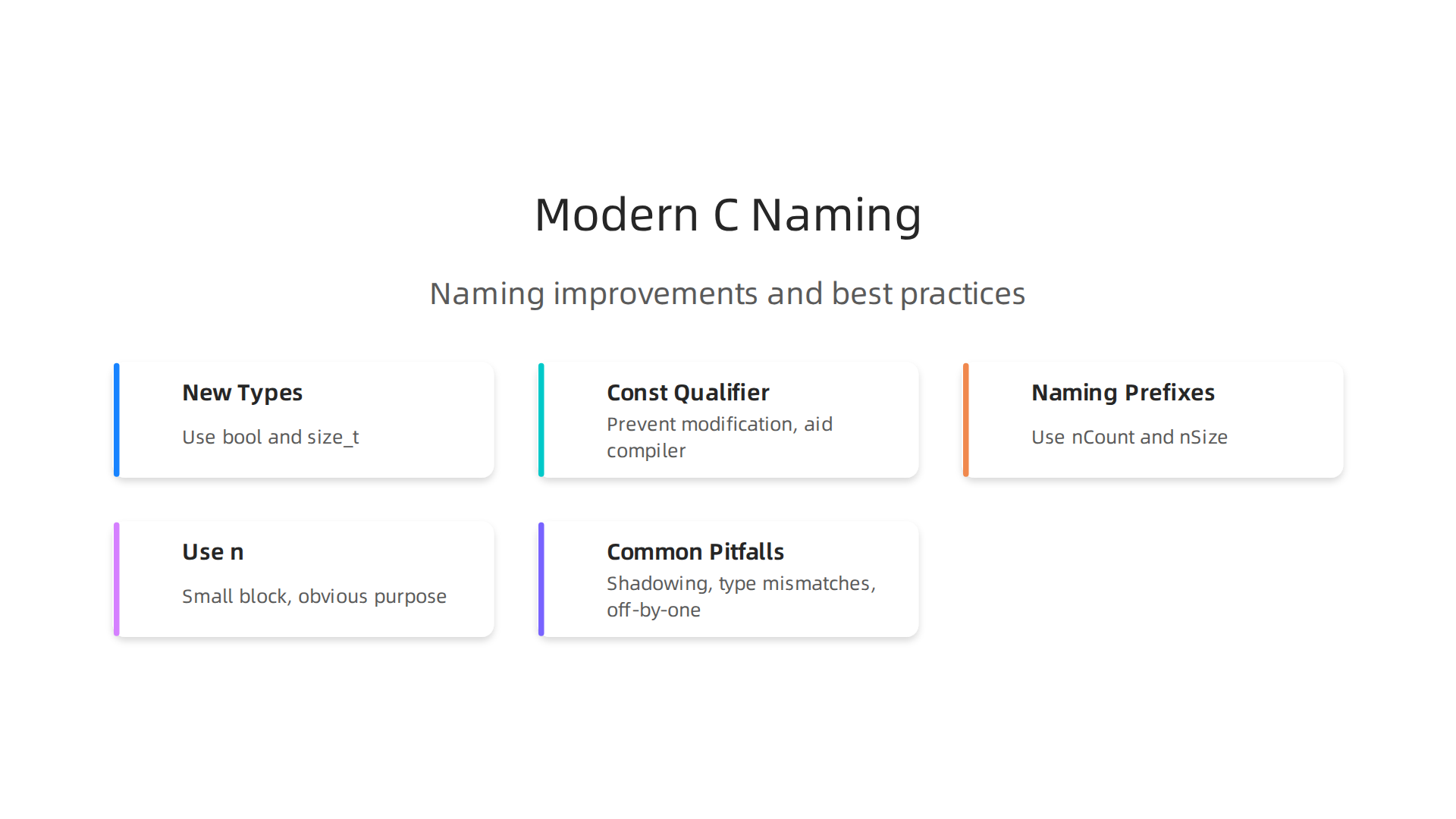
Instead of using a plain int as a flag, you can use bool. This makes it clear that a variable can only be true or false. If you see bool is_done, you instantly know its purpose. The same goes for sizes. The standard type size_t is made for sizes and counts. When you use size_t n for the number of elements, you avoid signed/unsigned issues and help the compiler generate cleaner code.
The C23 standard also adds static_assertand better support forconstexpr-like behavior (via constexprin C23? Actually C23 introducesconstexpr? The GeeksforGeeks article mentions better support for constqualifier, notconstexpr. But the point is: modern C gives you tools to be more precise. When you solve problems like **4.2 code practice: question 1**, using size_t` for the loop bound makes the code safer and easier to read.
Avoiding Generic Names in Big Projects
In a small function, n is fine. But a large codebase with hundreds of files can become confusing. Imagine searching for all uses of n and getting hundreds of results. That is where a naming convention from C++ can help. Using prefixes like nCount or nSize tells you the type and role at a glance. The n prefix stands for "number" or "count". It is short but still descriptive.
For example, in the edhesive 3.2 code practice answers, you often see n used as a simple counter. If that counter appears in a bigger function, renaming it to nItems or nAttempts makes the code self-documenting. You do not have to read the whole function to know what n holds.
The Bottom Line
Modern C gives you better types and features to express your intent. By using them and adopting small naming improvements, you write code that is both safe and easy to understand. These practices are especially helpful when learning or teaching, as shown in resources like our guide on coding for kids with game-based learning, which emphasizes clear naming habits from the start.
So next time you write n in c programming, ask yourself: can I make this more specific? A small change now can save hours of confusion later.
Cross-Language Comparisons: ‘n’ in C vs. Other Languages
You have seen how n works in C. Now let us look at how other languages handle short names like n. Every language has its own set of naming conventions, and understanding them can make you a better C programmer.

Java and Python: More Words, Same Shortcuts
In Java and Python, developers usually prefer longer, more descriptive names. They use camelCase or snake_case to make variables self-explanatory. But even in these languages, n still shows up in loops. You will see for (int i = 0; i < n; i++) in Java or for i in range(n): in Python all the time.
The difference is that Java and Python give you stronger warnings or linting rules against naming without context. For example, in a Java code review, using n for anything other than a simple loop count might raise questions. That same mindset can help you when you write C. If you find yourself using n for something complex, consider giving it a better name.
A good rule is: use n only when the meaning is obvious from a few lines of code. For assignments like 4.2 code practice question 1, n is fine because the code is short. But for a 50-line function, edhesive 3.2 code practice answers might show more descriptive names like numStudents or itemCount.
C++: Same Letter, Safer Types
C++ uses n in much the same way as C. You see int n = 10; and loops with n all the time. However, C++ has better type safety and overloads. The standard template library (STL) often uses size_t for container sizes. In C++, when you write std::vector<int> v(n), the n is clear because the function parameter name is already part of the interface.
C++ also lets you use Hungarian notation more easily. Some shops use an n prefix to mean "number" or "count." For example, nItems or nAttempts. This comes from naming conventions that cross language boundaries. The Wikipedia article on naming conventions explains that different communities prefer different styles.
What C Can Learn From Others
Here is the key takeaway: other languages do not ban n. They just put boundaries around it. You can bring that same discipline into your n in c programming habits.
When you use n, ask yourself:
- Would a developer reading this code instantly know what
nmeans? - Can I use a standard type like
size_tto add meaning? - Is this code part of a larger project where
nwill be hard to find later?
The CMU C coding standard suggests that names should reveal intent. Even a simple counter can be i or n, but if you need more context, use a descriptive name like numElements.
By borrowing ideas from Java, Python, and C++, you can write C code that is both fast and friendly. For more on building these good habits, check out our guide on a science-backed framework for deep code comprehension. It will help you think about naming from the start.
Summary
This article examines the tiny but influential variable name n in C, tracing its mathematical and historical roots and explaining why it remains ubiquitous. It covers the common places you’ll see n—loop counters, array sizes, and function parameters—then lays out clear rules for when n is appropriate and when a more descriptive name is safer. The piece highlights frequent pitfalls such as variable shadowing, signed/unsigned mismatches, and off-by-one errors, and shows how types (int vs size_t) and const qualifiers affect both safety and compiler optimization. You’ll also learn modern C practices and how conventions in other languages can inform better naming in C. By the end, readers will know how to pick names that improve readability, avoid subtle bugs, and let the compiler optimize more effectively, with practical guidance for classroom exercises and real projects like Edhesive examples.