
Transform Corporate Training with AI-powered Homework Help
· 23 min read
Why AI-powered homework help matters for modern L&D teams
Imagine trying to teach many people new skills, but each person learns a little bit differently.

Some people grasp things quickly, while others need more time and practice. In today’s busy world, learning and development (L&D) teams face a big challenge: how do you give everyone the right amount of personal help and feedback? It’s tough for human coaches to be everywhere at once, offering endless practice sessions and checking every bit of work. This often means learners don’t get all the one-on-one attention they need to truly master new topics.
This is where AI-powered homework help steps in. Think of it as having a smart, tireless assistant ready to help every learner, any time of day. This type of AI tool is changing how L&D teams work. It promises to make learning much more personal and effective.
Here’s how AI-powered homework help can make a big difference:
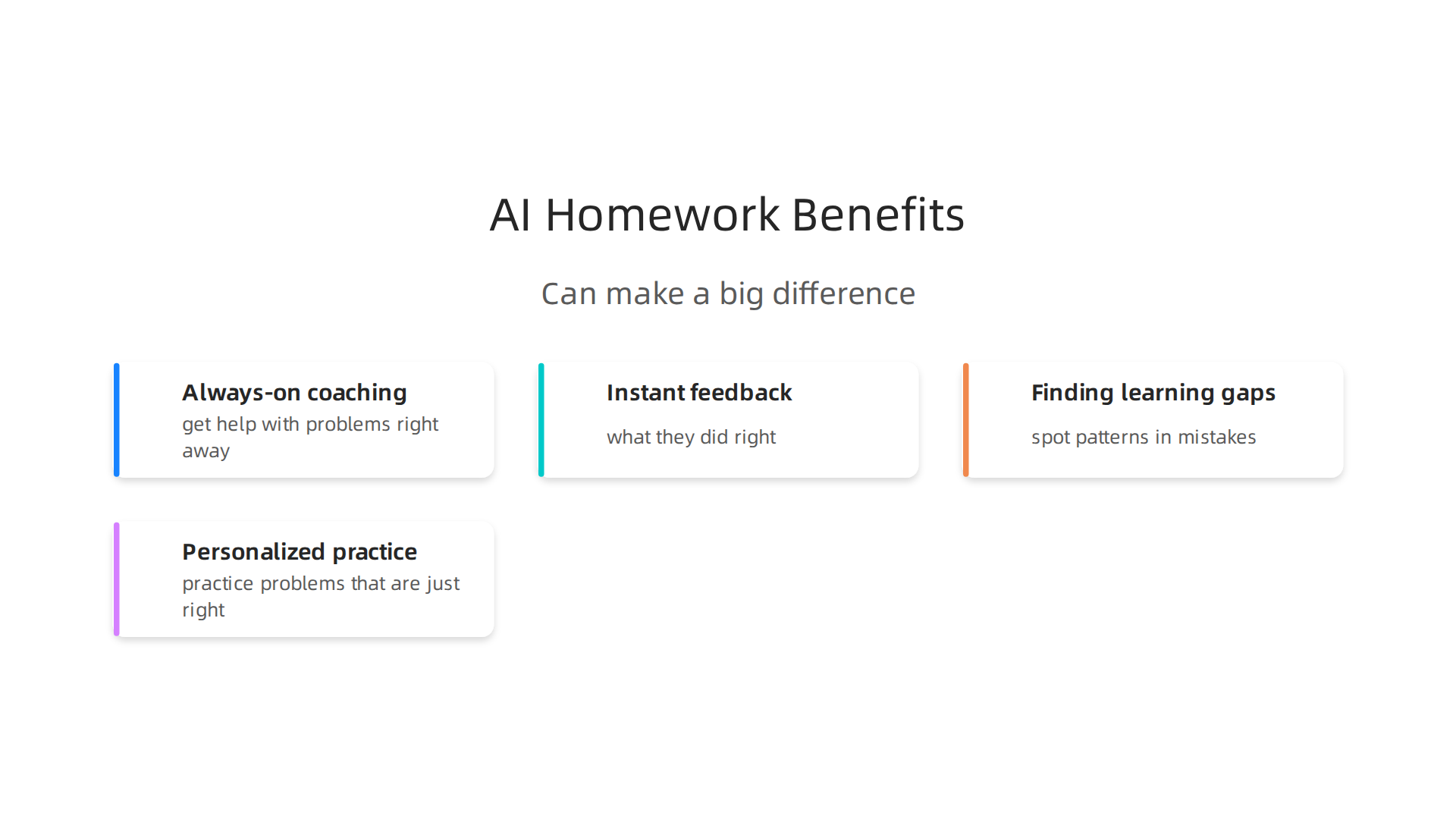
- Always-on coaching: Learners can get help with problems right away, without waiting for a teacher or a scheduled session. This means they can practice whenever it suits them, making learning fit into their lives more easily.
- Instant feedback: When a learner completes a task, the AI can tell them what they did right and where they went wrong, instantly. This quick feedback helps people learn faster because they can fix their mistakes on the spot. Studies even show that AI tutoring outperforms in-class active learning in some cases, helping students learn more in less time.
- Finding learning gaps: AI tools are good at seeing where a learner is struggling. They can spot patterns in mistakes and point out exactly what topics need more work. This helps L&D teams understand where their training might need to be stronger.
- Personalized practice: Instead of giving everyone the same homework, an AI system can give practice problems that are just right for each person’s skill level. This way, no one feels left behind or bored. L&D teams can help their employees master AI skills with an AI-powered learning platform in 2026 in a way that truly fits them.
In short, AI-powered homework help extends the reach of L&D teams. It makes learning more engaging and effective, helping everyone from new hires to experienced professionals build their skills faster. By using these smart tools, L&D teams can ensure that their training truly covers AI and other complex subjects, leading to better outcomes for everyone.
Want to stay informed about the latest advancements in AI and technology that can benefit your team?
The AI Newsletter Worth Reading
Now, let’s look at how AI-powered homework help actually works. It’s like having a smart brain behind the scenes, using different methods to help learners. These tools make learning smoother and more useful.
Core AI models at play
AI homework help systems use a few main types of smart programs to do their job:
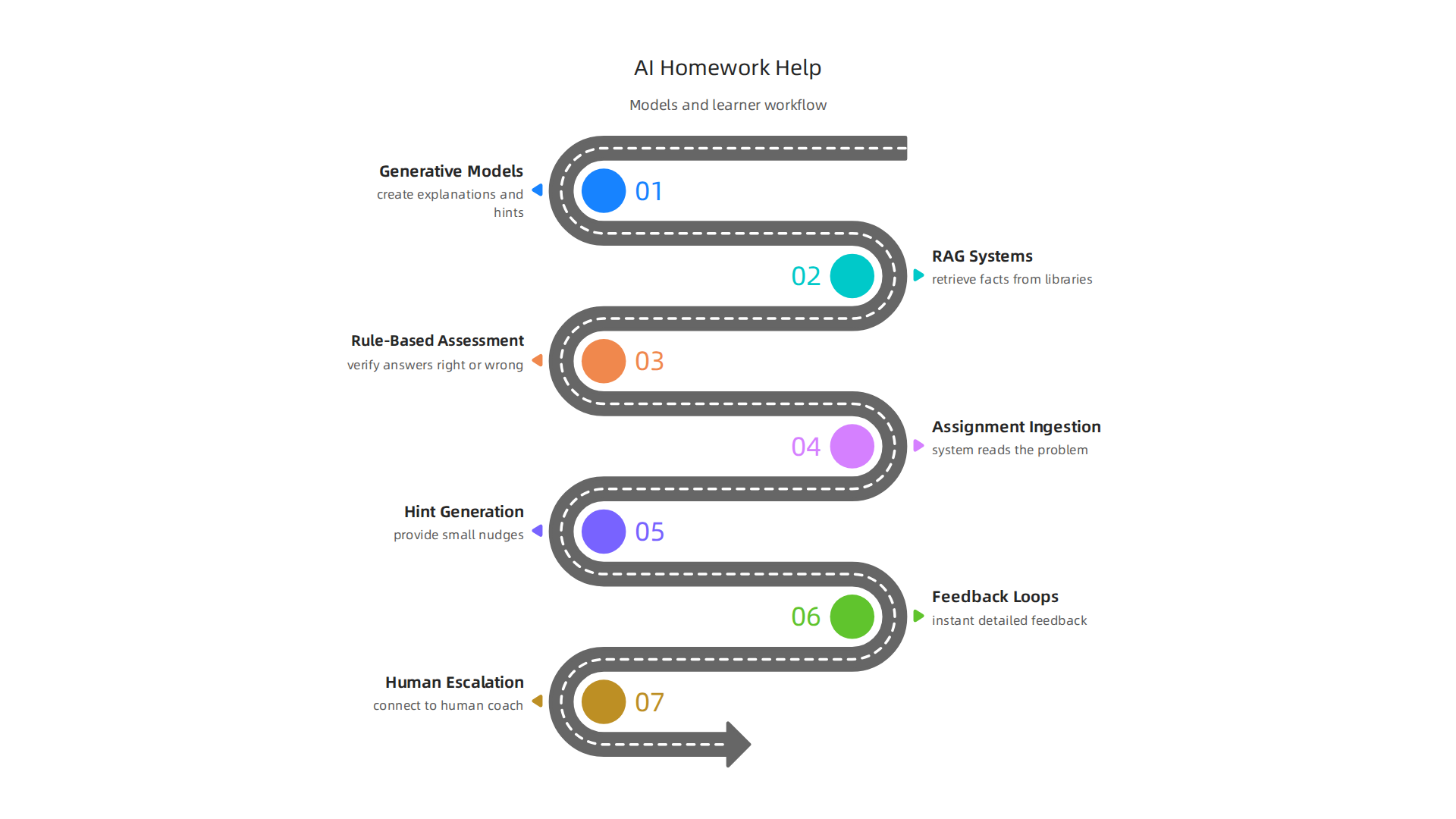
- Generative Models: These are like creative writers. They can make up new sentences, explanations, and hints. When you ask for help, a generative model can create a clear explanation or a hint that guides you without giving the answer away. Think of systems like those based on large language models (LLMs) that can understand your question and generate a helpful response.
- Retrieval-Augmented Systems (RAG): Imagine having a super-fast librarian. A RAG system pulls information from a huge library of facts, textbooks, or course materials. When it gives you an answer or hint, it makes sure the information is correct by checking its "books." This helps the AI avoid making things up and keeps the learning accurate.
- Rule-Based Assessment: Some parts of homework are straightforward, like checking if an answer is right or wrong, or if code follows certain rules. Rule-based systems are good at this. They follow a set of strict rules to check your work and give quick feedback. This helps with tasks where there’s a clear right or wrong.
These different models work together. For example, a generative model might give a hint, while a RAG system makes sure that hint uses facts from the course material, and a rule-based system might quickly grade a quiz.
How learners get help
The way a learner uses these AI tools follows a typical path:
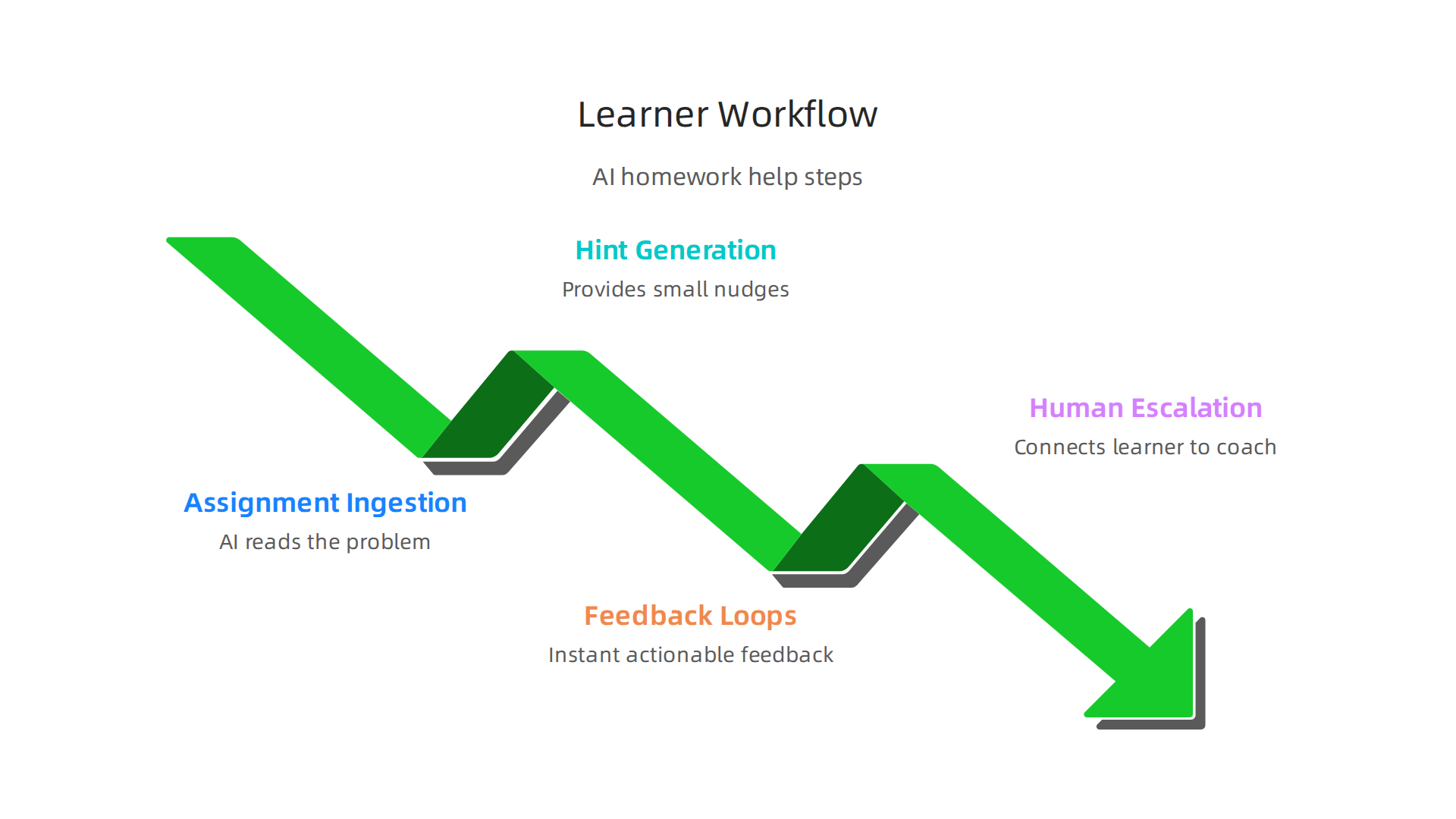
- Assignment Ingestion: First, the AI system "reads" the homework problem or question. It understands what the task is about, what kind of answer is needed, and what subjects it covers. This could be anything from a math problem to a coding challenge or a writing prompt.
- Hint Generation: If a learner gets stuck, they can ask for a hint. The AI uses its models to give a little nudge in the right direction. It doesn’t just give the answer. Instead, it offers clues or asks guiding questions to help the learner think through the problem themselves. Studies show that merely providing access to AI tutors is not enough; the way they interact truly matters for student engagement and learning gains, as found in a Stanford University study on human support improving engagement with AI tutoring.
- Feedback Loops: Once the learner submits their work, the AI provides instant feedback. This is more than just a "right" or "wrong." It explains why something is wrong, points to the specific part that needs fixing, and suggests how to improve. This quick back-and-forth helps learners fix mistakes right away, making the learning stick better. This kind of adaptive feedback improves engagement, as noted in research on AI Tutoring Systems and Their Influence on Student Engagement.
- Escalation to Human Coaches: Sometimes, a problem is too complex, or a learner needs a deeper level of support than the AI can give. In these cases, the AI system can flag the issue and suggest connecting the learner with a human coach or instructor. This ensures that no one is left struggling alone and that human experts can step in when needed, providing a complete support system.
By using these advanced AI models and a clear workflow, AI-powered homework help ensures that L&D teams can truly offer personalized support. This helps everyone, from beginners to experienced developers, in mastering AI skills and understanding complex topics more deeply. For more on how these smart tools can transform your team’s skills, consider learning about mastering the software development lifecycle with AI.
AI-powered homework help isn’t just for students in school. It’s also a powerful tool for companies and their Learning & Development (L&D) teams. L&D groups use these smart tools to train employees, help them learn new skills, and make sure everyone understands important topics. In 2026, companies are finding many helpful ways to use AI for training.
How AI helps in corporate training
Let’s look at the main ways AI-powered homework help is used in company training programs:
- Practice: Just like a sports team practices drills, employees need to practice new skills. AI tools create practice problems and scenarios. For example, a new developer might practice coding challenges, or a sales team member could practice responding to customer questions. The AI gives instant feedback, helping them get better faster. Studies show that people learn much more in less time when using an AI tutor compared to traditional classroom active learning, and they also feel more engaged and motivated AI tutoring outperforms in-class active learning. This helps people master AI skills faster.
- Formative Assessment: This is about checking understanding as learning happens, not just at the end. AI can give quick quizzes and puzzles. If an employee is learning about new software, the AI might ask them to identify parts of the interface or explain a step in a process. This helps L&D teams see what employees understand well and what needs more work. It’s a key part of mastering AI concepts effectively.
- Just-in-Time Remediation: Sometimes, an employee gets stuck on a small part of a lesson. Instead of waiting for a trainer, the AI can offer immediate help. If someone struggles with a specific coding concept, the AI provides extra examples or a different explanation right away. This "just-in-time" support prevents frustration and keeps learning on track. This direct help also boosts learning outcomes, as seen in research on AI Tutoring Enhances Student Learning Without Crowding.
- Manager/Coach Augmentation: AI doesn’t replace human coaches; it helps them. AI tools can tell managers where their team members are struggling. This way, managers know exactly what kind of extra help to offer. The AI can handle the basic questions, letting human coaches focus on more complex problems or personal guidance.

This is especially helpful for mastering AI development practices or advanced programming. Actually, human support can greatly improve how much people use and engage with AI tutoring systems, even if the initial use is low Human Support Improves Engagement with AI Tutoring.
Who benefits most from AI homework support?
AI-powered homework help is great for different kinds of learners and goals:
- New hires: Learning all the ropes at a new job can be tough. AI can help them quickly understand company policies, tools, and processes.
- Employees learning new technology: With how fast technology changes, everyone needs to learn new tools. AI is perfect for teaching new programming languages, cloud systems, or advanced AI concepts.
- Teams building complex products: For software developers, AI-powered homework help can offer support on specific coding problems, help them understand complex system designs, or even review snippets of code. This is very useful for engineers working on projects that require deep knowledge, such as those that cover AI principles or involve advanced frameworks. You can even use tools like everything-claude-code github to enhance coding workflows.
- Anyone needing continuous skill upgrades: In 2026, staying current means continuous learning. AI provides a flexible way to keep skills sharp, offering endless practice and immediate feedback.
For L&D teams, the goal is clear: make learning effective, efficient, and engaging for everyone. AI-powered homework help supports these goals by providing personalized paths for employees to master AI and other critical skills.
Staying on top of the latest AI trends is crucial for any L&D team. Get clear daily AI updates and more with The AI Newsletter Worth Reading.
After seeing how useful AI-powered homework help can be for training, it’s really important to pick the right tools. Not all AI is built the same. When choosing vendors and their AI models for your company’s training, you need to think about big things like data privacy, how accurate the AI is, and if it might show unfair biases. In 2026, making smart choices here means protecting your company and making sure your employees get the best learning experience.
How to Pick AI Tools Carefully
Here’s what to look for when choosing AI-powered homework help for your team:
- Protecting Employee Data: Your employees’ learning data is private. It’s vital to know how an AI vendor will keep this information safe. Ask clear questions about their data protection rules. Make sure the AI system doesn’t share personal data without permission or use it in ways you don’t agree with. Keeping data safe and being clear about how AI uses information is key to building trust A Comprehensive Review of AI-based Intelligent Tutoring.
- Knowing Where the AI Comes From: Understand what data the AI models were trained on. This helps you know if the AI might have certain built-in ways of thinking. A good vendor should be open about their AI’s "provenance," meaning its origins and training data. This helps you understand its strengths and weaknesses.
- Checking How AI Gives Feedback: You need to be able to look at the feedback the AI gives. Can your L&D team easily review if the AI’s answers are helpful and correct? Being able to audit the AI’s advice helps you keep quality high and step in if something seems off. Regular checks and changes are important Artificial Intelligence in Instructional Design: A Systematic Review.
- Making Sure AI Is Fair: AI can sometimes learn unfair biases from the data it was trained on. This could mean it treats different groups of people differently or gives unfair advice. It’s really important to choose tools that have ways to lessen these biases. Vendors should tell you how they check for bias and what they do to fix it FairAIED: Navigating Fairness, Bias, and Ethics in Educational AI. This is part of mastering AI response design evaluation and safe implementation. There are even ways to automatically check for bias in AI-generated learning materials Automated Bias Assessment in AI-Generated Educational Content Using CEAT Framework.
- Accuracy and Avoiding Made-Up Answers: Sometimes, AI can "hallucinate," meaning it makes up facts or gives wrong information with confidence. You need to pick AI tools that are very accurate and have systems in place to catch these errors. Ask vendors about their quality checks and what happens if an AI gives a bad answer. Is there a way for a human expert to step in and fix things?
Picking the right AI partner is a big decision. It’s like finding a trusted guide for your team’s learning journey. Many companies use a checklist to help them choose the best tools for their needs AI Vendor Due Diligence Checklist 2026: 50+ Questions. By focusing on privacy, fairness, and accuracy, you can make sure your AI-powered homework help genuinely benefits everyone.
Staying informed about how AI is changing is a big part of making good choices. Get clear daily AI updates and more with The AI Newsletter Worth Reading.
After choosing the best AI tools, the next big step is making sure they can talk to all your company’s other learning systems. Think of it like making sure a new helper can work well with the rest of your team. This is called "integration," and it’s how AI-powered homework help fits into your daily training.
How AI Tools Connect to Your Learning Systems
AI tools need to plug into your existing Learning Management System (LMS). Your LMS is where employees go to find their courses and track their learning. Here’s how these connections usually work:
- LTI Connectors: One common way AI tools connect is through something called LTI. LTI stands for "Learning Tools Interoperability." It’s like a special language that lets different learning tools work together easily inside your LMS. This means an AI tutor can show up right in your Canvas, Moodle, or Blackboard system, almost as if it’s built-in. LTI 1.3 is the newest standard for these connections, making them safe and smooth How to Integrate AI Agents with Your LMS.
You can even see how AI plugins for systems like Moodle work through videos EduGears AI LTI Plugin for Moodle — One-Click Setup (Works Behind Firewalls). Many AI learning systems support LTI to connect to your current setup without needing to replace anything AI Integrations: Connect OpenEduCat AI to Any LMS.
- API-based Services: Sometimes, you need a deeper connection than LTI. This is where APIs come in. API stands for "Application Programming Interface." It’s like a secret handshake that lets different software programs talk to each other in a very specific way. Using APIs means your AI tools can share more detailed information, like how well an employee is doing or what questions they struggled with. This helps your LMS and the AI work together even better How to Enhance Your LMS With API Integrations in 2026.
- SDKs: For developers, SDKs (Software Development Kits) are like toolkits. They provide all the parts and instructions needed to build custom connections between AI and other systems. This helps create solutions that fit your company’s exact needs.
- Content Import and Export: AI can also help create new training materials or improve existing ones. These materials can then be moved into your authoring tools or directly into your LMS. This helps make sure your
ai powered homework helpcan use the best and most current content.
Keeping AI Running Smoothly
Once your AI tools are connected, your team needs to manage them. This means paying attention to a few key things:
- Model Updates: AI models get better over time. They learn more and become smarter. Your team needs to make sure the AI tools get these updates so they always work at their best.
- Monitoring: It’s important to watch how the AI is performing. Is it giving good answers? Is it helping employees learn? Monitoring helps you catch any problems early.
- A/B Testing Feedback: You can try different ways the AI gives homework help to see which one works best. This is like trying two different teaching styles to see which one helps students learn more. This process is part of
mastering aiwithin your organization. - Developer Workflows: For the technical team, managing AI involves setting up these connections and keeping them running. It
covers aitools from the first setup to everyday use, making sure everything works together without a hitch. Learning how to best use AI for software development is a key skill in 2026 for any team How to use AI for software development in 2026 a developers workflow guide.
After setting up and managing your AI tools, the real test is seeing how well they work. This means measuring their impact. You want to know if your AI-powered homework help is truly helping employees learn better and faster.

This is how you figure out the value or "return on investment" (ROI) of your AI tools.
Measuring impact: metrics, experiments, and ROI for AI homework helpers
To truly understand if your AI tools are making a difference, you need to look at specific numbers, or "metrics." These metrics show you how useful the AI is and where it can get better.
Key Ways to Measure Success
When you use AI for learning, here are some important things to track:
- How Much Learners Use It (Engagement): Are employees actually using the AI homework help? How often do they ask it questions? How quickly does the AI respond to them? Quick responses can keep learners focused and interested, making the AI feel like a natural helper [How Khan Academy Is Building a Better AI Tutor: Our Most Recent Learnings
](https://blog.khanacademy.org/how-khan-academy-is-building-a-better-ai-tutor). If they use it a lot, that’s a good sign.
- How Fast They Learn (Time-to-Proficiency): Does the AI help employees learn new skills or topics quicker? This metric looks at how much time it takes for someone to become good at something after using the AI.
- Fewer Mistakes (Error Reduction): Is the AI helping employees make fewer errors in their work or answers? We can look at things like how successful they are at fixing mistakes after the AI gives them feedback AI tutoring can safely and effectively support students: An exploratory RCT in UK classrooms.
- Less Need for Human Help (Coach Intervention Rates): If the AI is doing a great job, employees might need less help from human trainers or coaches. This frees up your human experts to focus on harder tasks.
- Looking at Behavior, Not Just Feedback: It’s not enough to just check if the AI’s answers look good. You should also see if employees change their work based on the AI’s feedback. Did they actually use the advice to improve? These actions show if the AI is truly helpful Evaluation Shifts from Artifact Quality to User Behavior.
Trying Out New Ideas (Experimental Designs)
To really know what works best, you can run experiments. This helps you prove that the AI is making a positive impact.
- A/B Testing: This is like trying two different ways the AI gives homework help to see which one performs better. For example, you might have one group of employees get AI help in one style, and another group get help in a slightly different style. Then, you compare their learning results. This helps you find out what changes cause the best learning outcomes Evidence from 12 randomized A/B tests optimizing tutoring for scale. This kind of testing gives you clear facts about what’s working A/B Testing in AI Education: Optimize Learning Outcomes.
- Cohort Analysis: This means watching a group of employees who use the AI over a longer time. You compare their learning journey and results to a group that did not use the AI, or used it differently. This helps you see long-term effects.
By doing these tests, you can measure things like how much more engaged learners are or how much better their performance is. You can also see if the AI is leading to more focused thinking How Khan Academy optimizes AI tutoring with experimentation.
Getting Your Money’s Worth (Return on Investment)
When you measure the impact of your AI-powered homework help, you’re looking at its ROI. This means comparing the cost of the AI tools to the benefits they bring. If employees learn faster, make fewer mistakes, and need less human support, that saves the company time and money. This shows the real value of mastering AI in your organization. Learning how to check if AI is accurate and useful is a big part of this, as AI technologies can greatly improve learning if used correctly THE STANFORD JOURNAL ISSN. You can explore how to improve outcomes through measuring feedback impact with AI tools to ensure you are truly mastering AI in education How can measuring feedback impact improve learning outcomes?.
Want to stay on top of the latest in AI and how it can help your business? Get clear daily AI updates from The AI Newsletter Worth Reading.
After figuring out how well your AI tools are working and the value they bring, the next big step is putting a plan into action. This means having a clear map for your Learning & Development (L&D) team to follow. This roadmap will help you bring AI-powered homework help into your company smoothly and make sure it keeps getting better over time.
Implementation roadmap and best practices for L&D teams
Setting up new AI tools needs a thoughtful plan. You can’t just flip a switch and expect everything to work perfectly. Here’s a step-by-step guide to help your L&D team put AI into practice effectively.
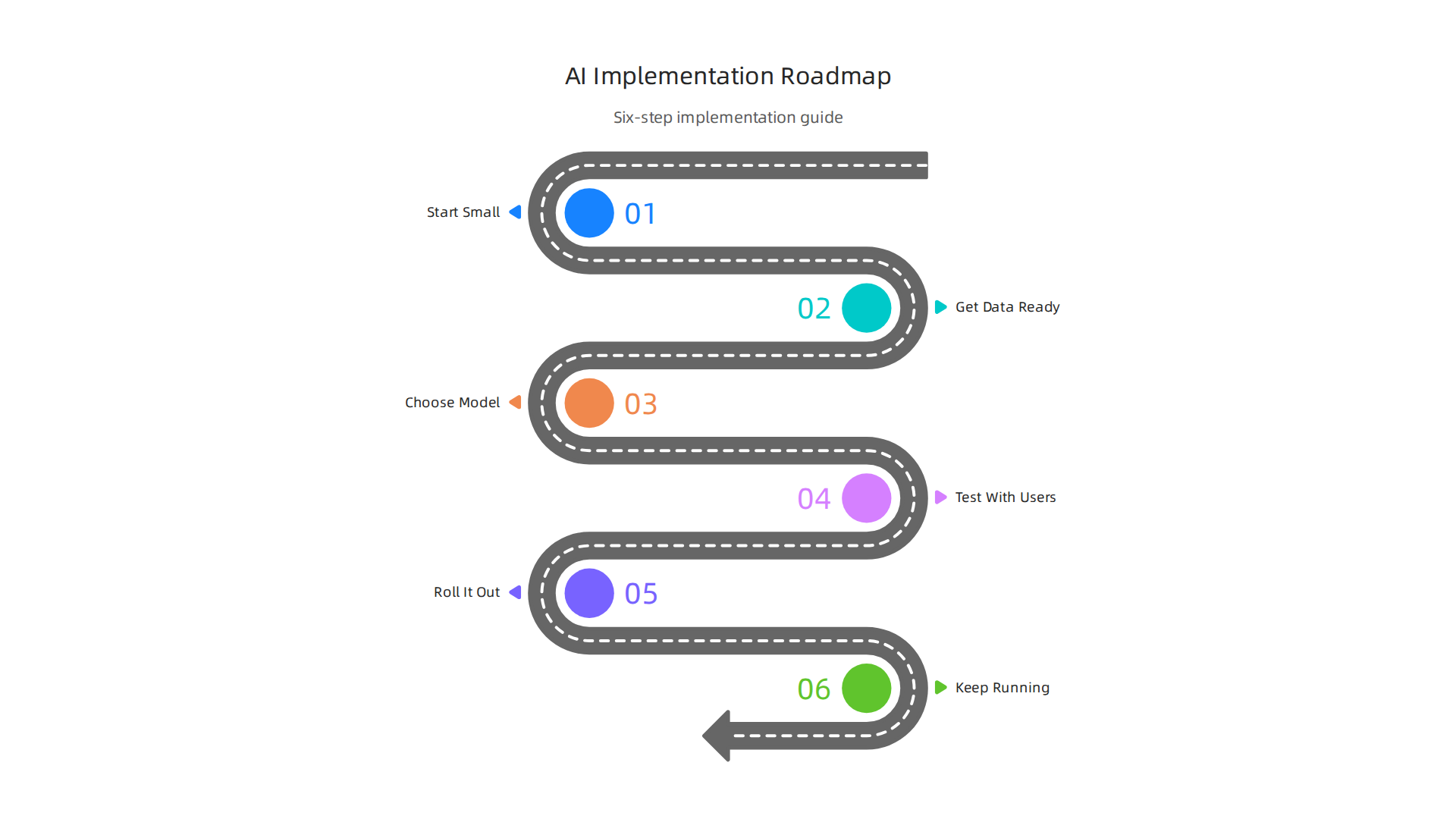
Step-by-Step Roadmap for L&D Teams
Think of this as your guide to making AI work for your learners.
- Step 1: Start Small with a Pilot
Don’t roll out AI to everyone at once. Pick a small group or a specific learning program to try out the AI-powered homework help first. This "pilot" lets you see what works and what doesn’t without big risks. It’s a chance to learn and fix things early on. - Step 2: Get Your Data Ready
AI tools need good information to learn from. Make sure your learning materials, questions, and answers are well-organized and easy for the AI to understand. Clean and well-prepared data is key for the AI to give helpful feedback. - Step 3: Choose the Right AI Model
There are many AI models out there. You need to pick one that fits your company’s learning needs. This might mean looking at different AI options, like tools that cover AI across many subjects or even specific code like everything-claude-code github for coding help. For L&D teams, it is important to find the right AI tools for 2026 to ensure the best learning results The Educator’s Decision Guide to AI Tools in 2026. - Step 4: Test with Users
Once you have your AI model, let your pilot group try it out. Get their thoughts and see how they use the AI. This user testing is very important. It helps you find problems and make the AI easier and more useful for everyone. Remember, learners should also be encouraged to check the AI’s answers, making sure they understand and can confirm the information AI Literacy. - Step 5: Roll It Out
After a successful pilot and making changes based on feedback, you can slowly bring the AI-powered homework help to more employees. Make sure everyone knows how to use it and why it will help them learn better. - Step 6: Keep Things Running Smoothly (Governance)
Think about how you will keep the AI system updated and working correctly. This means having clear rules and people in charge to oversee the AI, making sure it stays fair, accurate, and helpful.
Best Practices for Success
Beyond the roadmap, some important tips can help your L&D team make the most of AI in learning.
- Help People Change (Change Management)
Bringing in new AI tools can feel different for employees. Help them understand why these tools are being used and how they can benefit. Offer training and support to make the switch easy. Showing them that AI makes learning more personal and effective can help 25 AI in Education Statistics to Guide Your Learning. - Train the Trainers (Upskilling Trainers)
Your human trainers and coaches will still be very important. Help them learn how to work with the AI. They can teach employees how to get the most out of the AI homework help and step in for more complex needs. This means mastering AI response design evaluation and safe implementation is key for your team. - Always Make It Better (Continuous Improvement)
AI learning tools are not "set it and forget it." Keep watching how employees use the AI and how well they learn. Use this information to keep improving the AI, making it smarter and more helpful over time. This ongoing effort is part of mastering AI skills with an AI powered learning platform. By constantly refining your approach, you ensure your AI investments truly benefit your workforce.
Summary
This article explains how AI-powered homework help can transform corporate learning by delivering always-on coaching, instant feedback, and personalized practice at scale. It describes the main AI approaches—generative models, retrieval-augmented systems, and rule-based assessment—and walks through a typical learner workflow from assignment ingestion to escalation to human coaches. The piece outlines concrete L&D uses (practice, formative assessment, just-in-time remediation, coach augmentation), plus vendor selection criteria like data privacy, provenance, bias mitigation, and accuracy. It also covers integration methods (LTI, APIs, SDKs), measurement approaches (engagement, time-to-proficiency, error reduction, A/B tests), and a practical roadmap for piloting and scaling AI homework tools safely and effectively.