
How to Choose Enterprise IT Services in 2026 A Practical Guide for Business Leaders
· 16 min read

Introduction
You know that feeling when you sit down to pick an IT services provider and suddenly have fifty tabs open?

It happens to everyone. The options seem endless. Every tech company says they are the best. Big IT companies promise world class support. Small shops offer personal attention. And somewhere in the middle, your business just needs something that works.
The truth is, enterprise IT services have never been more important or more confusing. The global IT services market is massive right now. In 2026, it is valued at roughly $1.5 trillion and is expected to climb past $2.6 trillion by 2034, according to the latest IT Services Market report. That is a lot of growth. And it is being driven by three big forces: cloud migration, artificial intelligence, and cybersecurity.
Almost every organization is racing to move to the cloud. AI is changing how software is built and how decisions are made. And cyber threats are getting more advanced every day. That means IT services are no longer just about keeping the lights on. They are about keeping your business competitive and safe.
This guide is built to help you cut through the noise. Instead of getting lost in marketing speak or endless comparison charts, you will get a straightforward framework to evaluate and choose the right IT service partner for your organization. No fluff. Just practical steps.
And because the tech world moves fast, staying informed matters. If you want clear daily updates on AI and technology, check out The AI Newsletter Worth Reading from The Deep View. It is a great way to keep your finger on the pulse without getting overwhelmed.
Let us start by looking at what IT services really include and how to match them to your needs.
What Are Enterprise IT Services? A Comprehensive Overview
Enterprise IT services are the technology solutions that big organizations rely on to run their daily operations, protect their data, and stay competitive. They cover everything from keeping your email servers running to building custom AI tools. But the term "enterprise IT services" is broad. If you are trying to pick a provider, you need to understand what is actually included.
At the highest level, enterprise IT services break down into several main categories.
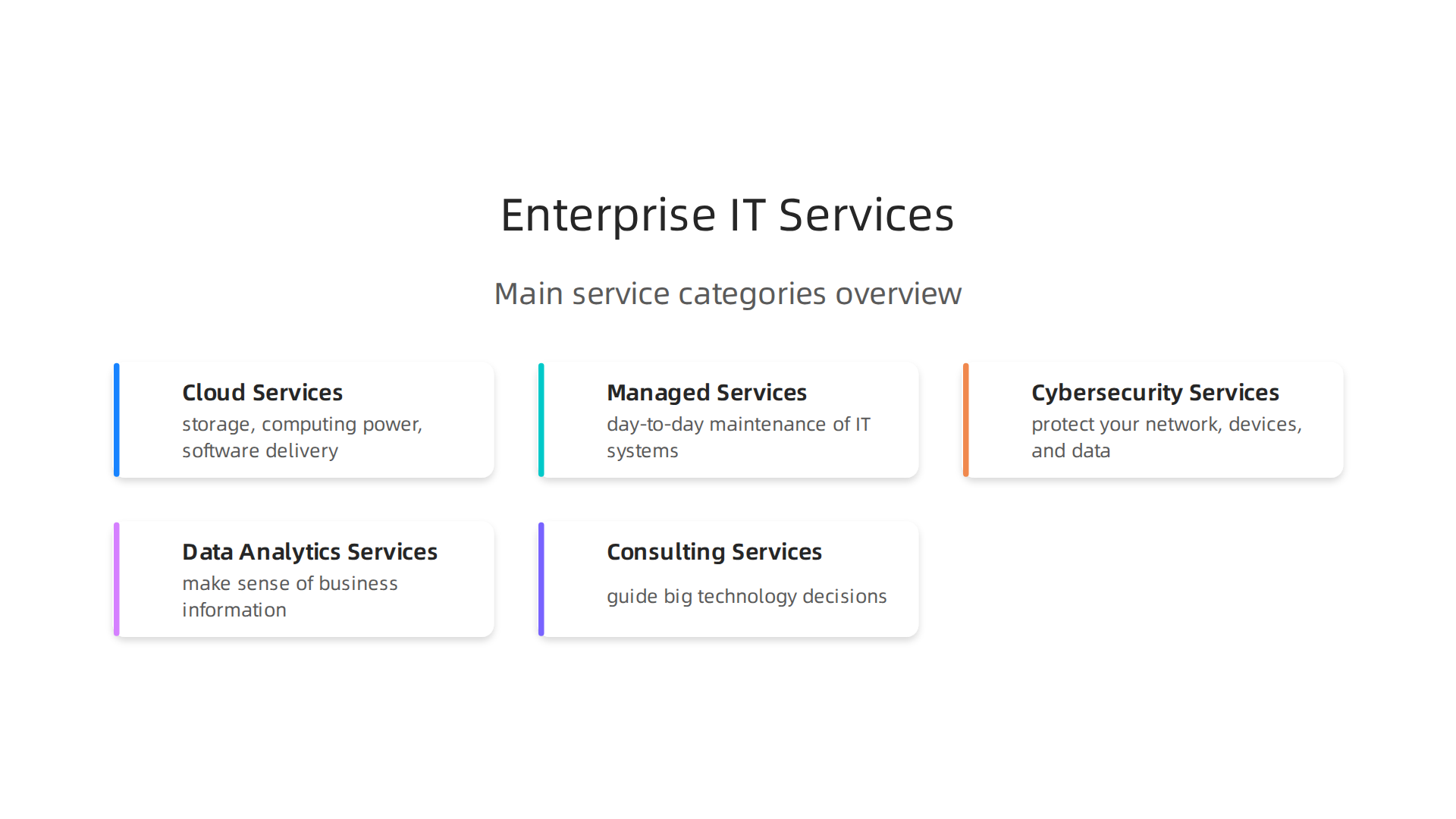
Cloud services handle storage, computing power, and software delivery. Managed services take over the day-to-day maintenance of your IT systems. Cybersecurity services protect your network, devices, and data. Data analytics services help you make sense of all the information your business collects. And consulting services guide you through big technology decisions like digital transformation or cloud migration.
According to a detailed analysis from Grand View Research, the IT Services Market Size, Share & Trends Report for 2026-2033 shows that the market is broken into segments like managed services, cloud services, and security services. Each segment serves a different need. Managed services, for example, accounted for roughly 23% of the market in 2026. Cybersecurity is one of the fastest growing parts, driven by rising threats.
So why does this matter to you? Because the right provider for your business depends on which of these categories you need most. A company that specializes in cloud migration might not be the best fit if your top priority is cybersecurity. A managed services provider that handles help desk support might not have the deep AI expertise you need for a data analytics project.
Understanding these categories helps you ask better questions when you talk to potential partners. You can say, "We need a provider that excels in cloud infrastructure and has proven experience in our industry." That narrows down the field fast.
Enterprise IT services also come in different deployment models. Some providers deliver everything on-site. Others work fully in the cloud. Many offer a mix. Your choice depends on your company’s size, budget, and compliance needs.
As you explore options, keep in mind that the best provider will align their offerings with your specific goals. If you are curious how AI is reshaping software development in this space, check out this guide on AI software development in 2026 transforms how you build and ship code. It shows how even traditional IT services are evolving to include smarter, automated tools.
Next, we will look at the different types of IT service providers so you can understand who is who in this crowded market.
The Evolving Landscape of IT Services in 2026: AI, Cloud, and Cybersecurity Trends
Before we jump into the different types of IT service providers, let’s first take a look at the big trends changing the industry in 2026.
Understanding these shifts will help you ask smarter questions and pick the right partner.

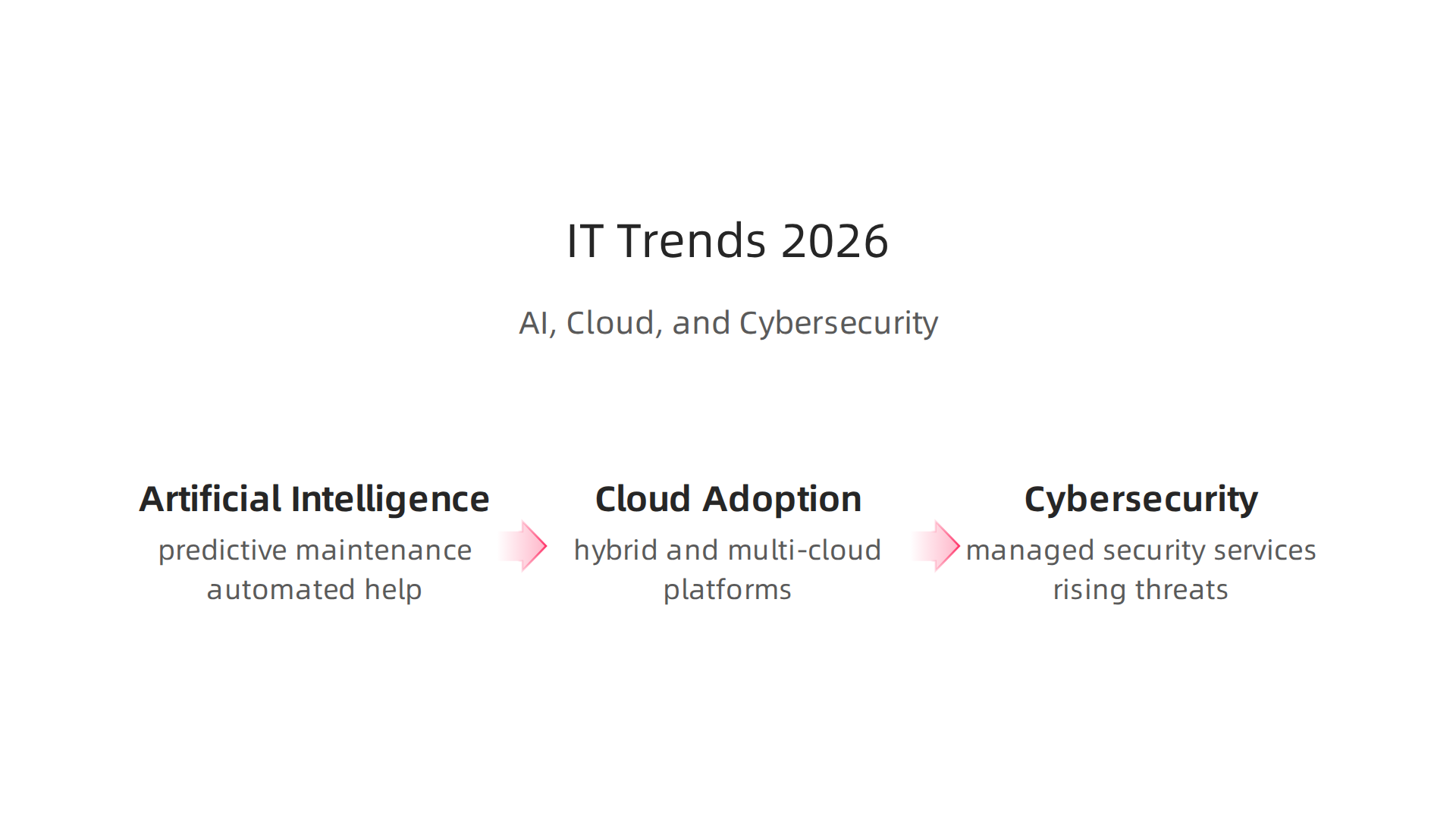
Artificial intelligence is no longer a futuristic add-on. It is being built directly into IT service offerings. Providers now use AI for predictive maintenance, automated help desks, and even to detect security issues before they cause damage. According to a recent enterprise IT services market analysis for 2026, the integration of AI and automation is one of the main drivers behind the growth of the sector. This shift allows tech companies to deliver faster, smarter support with fewer errors.
For developers and engineering teams, this means learning new workflows. If you are a coder or technical leader, you can check out this AI software development workflow guide for 2026 to see how top teams are adapting.
Cloud adoption continues to speed up, too. More businesses are moving to hybrid and multi-cloud setups. They want the flexibility to run some workloads on public cloud while keeping sensitive data on private servers. Industry cloud platforms are also on the rise, designed specifically for sectors like healthcare, finance, and manufacturing. In fact, the same market analysis highlights cloud computing adoption as a major force reshaping enterprise IT.
Cybersecurity has moved from being a nice extra to a must-have in every IT service agreement. With ransomware and data breaches on the rise, companies are investing heavily in managed security services. The US cybersecurity services market alone is growing at over 16% per year, according to US business services market trends 2026. This makes security a top priority when selecting an IT partner. You should expect every provider to have a clear security plan built into their offerings.
Want to stay ahead of how AI is changing the game? Get clear daily updates from The AI Newsletter Worth Reading. It breaks down the latest AI developments in a way that’s useful for tech professionals like you.
With these three trends in mind, you are ready to evaluate which type of IT provider best matches your company’s needs. Next, we will look at the main categories of providers and what each one does best.
Key Criteria for Evaluating IT Service Providers in 2026
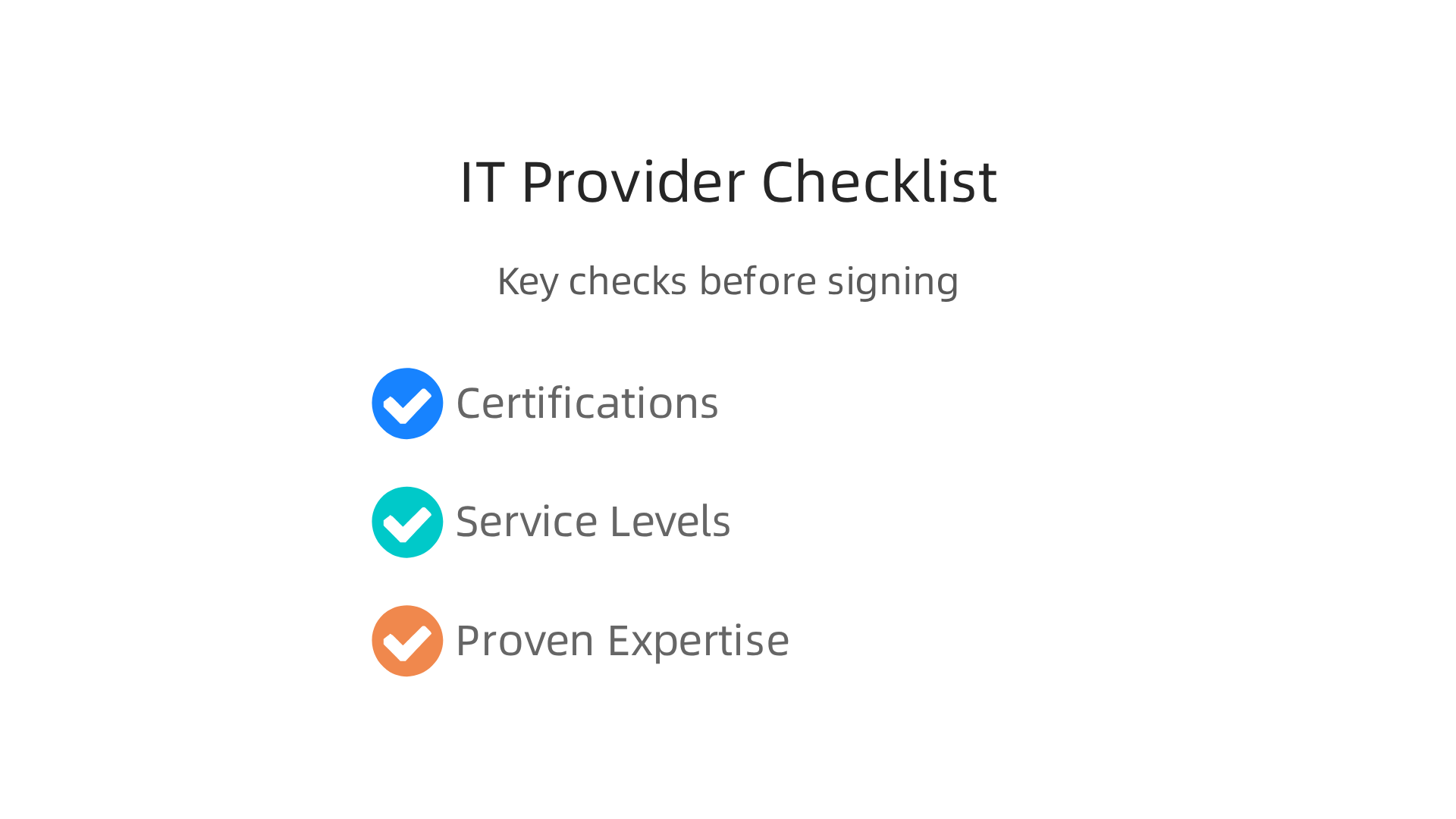
You know the big trends now. But how do you actually pick the right partner? Finding a good provider is not just about price or a friendly sales call. You need to look at concrete evidence that they can deliver. Here are the three most important things to check before signing any agreement.
Certifications and Compliance Matter
Trust starts with credentials. Any serious IT services provider should hold certifications like ISO 27001 or SOC 2. These prove they follow strict security and quality standards. If they handle your data, you need to know they protect it properly.
Different certifications matter for different focus areas. For example, providers that manage cloud infrastructure often carry AWS Certified Solutions Architect or Microsoft Azure certifications. Those focused on cybersecurity should have credentials like CISSP or CompTIA Security+. A provider that invests in the right certifications shows they take their craft seriously. You can learn more about which credentials to look for by reading about the best MSP certifications to grow services in 2026.
Compliance also depends on your industry. If you work in healthcare, your provider must understand HIPAA rules. Finance companies need partners familiar with SOX or PCI DSS standards. Ask directly how they handle compliance for your sector. A good provider will have clear answers ready.
Service Level Agreements Are Your Safety Net
An SLA is the part of your contract that guarantees performance. Read it closely before you sign. Look for three specific things:
- Uptime guarantees. Most providers promise 99.9% or 99.99% uptime. That small difference matters a lot over a year.
- Response times. How fast do they answer when something breaks? One hour for critical issues is standard in 2026.
- Penalties for failure. What happens if they miss their targets? Good contracts include service credits or refunds.
Never skip this step. The SLA is your protection when things go wrong. If a provider avoids explaining their SLA clearly, that is a red flag.
Real Proof of Expertise
Certifications look good on paper. But you also want proof that the provider can handle your specific needs. Ask for case studies from clients in your industry or with similar technical challenges. Read client testimonials on third-party review sites, not just the ones on the provider’s own website.
You can also run a technical assessment. Give them a real problem your team faces and ask how they would solve it. A strong provider will walk you through a thoughtful approach. If you are evaluating a provider that helps with staffing or technical hiring, you might also find it useful to read about how to evaluate individual talent, like this guide on how to hire a full stack developer in 2026.
Take your time with this step. The right provider will welcome your questions. The wrong one will rush you. Listen to your gut as much as you listen to the data.
Now that you know what to look for, let us walk through the main types of IT providers and what each one offers.
Managed IT Services vs. Project-Based Consulting: Which Model Works Best?
You know how to spot a good provider. But now you have to decide what kind of engagement you actually need. Most businesses choose between two main models: managed IT services and project-based consulting.
Each solves a different problem, and picking the wrong one can cost you time and money.
Managed IT services are like having a dedicated team that handles your technology every single day. You pay a predictable monthly fee, and in return you get ongoing support, system monitoring, security patches, and maintenance. This model keeps your infrastructure stable and catches issues before they turn into emergencies. It is ideal when your internal team is stretched thin or when you want to offload routine IT work. According to one industry guide, managed services can reduce IT costs by 25 to 45 percent and boost operational efficiency by up to 65 percent. If you need consistent, worry-free operations, this is the way to go.
Project-based consulting is completely different. You bring in an expert to solve one specific challenge. Maybe you need a cloud migration, a security audit, a new app build, or help selecting an ERP system. The consultant comes in, delivers the work, and leaves. You pay for the project, not for ongoing service. This model works well when you have capable internal staff but need specialized skills for a short-term initiative. For tech companies launching a new product, project-based consulting often provides the focused expertise required.
So which should you choose? The best answer is often both. Many successful businesses use a hybrid model. They hire a consultant to design the right strategy or build a new system. Then they hand the ongoing operation to a managed service provider. This way you get expert guidance for big moves and reliable support for daily operations. If you are planning a major software project, you might also benefit from learning about modern development approaches, like in this guide on AI software development in 2026 and how it transforms the way teams build code.
The key is understanding your real need. Do you need a steady partner to keep things running? Go with managed services. Do you need a specialist for a one-time job? Hire a consultant. And when things get complex, combine both to get the best of both worlds. Staying current with the latest trends in technology can also help you make smarter decisions. Subscribe to The AI Newsletter Worth Reading for clear daily updates on AI and software innovation.
Industry-Specific IT Services: Compliance and Specialization
Not all IT services are built the same. If you run a healthcare practice, a banking firm, or a government agency, your technology needs come with strict rules.

General IT support just won’t cut it.
Industries like healthcare, finance, and government have to follow serious regulations. In healthcare, you have HIPAA, which protects patient data. In finance, PCI-DSS keeps payment information safe. Government agencies often require FedRAMP certification for cloud services. Breaking these rules can mean huge fines and lost trust.
That is why many IT companies now specialize in specific industries. They do not just fix computers. They understand the exact compliance requirements you face every day. A provider who knows HIPAA inside and out will set up your systems so that patient records stay private. They will also handle audits and security reports that regulators expect.
Vertical specialization makes a real difference. A generalist can keep your network running. But a specialist who works only with financial firms knows the common audit findings and how to fix them fast. They build solutions that match your workflows, not generic setups.
Certifications matter here too. A managed service provider that holds credentials like CISSP and ITIL shows they take security and service management seriously. According to one industry analysis, the right provider certifications help ensure your systems stay compliant and secure, which is critical in regulated environments. If you are in a high-stakes field, look for a provider with a proven track record.
For tech companies building products for these industries, understanding compliance early is key. You can learn more about how to design trustworthy systems in our guide on building reliable software for high-stakes industries.
The bottom line is simple. When your business faces unique rules, do not hire a jack-of-all-trades. Find an IT service provider that knows your industry. They will save you time, money, and a lot of headaches.
Measuring Success: KPIs and Metrics for IT Service Partnerships
So you found a great IT partner who knows your industry. Now comes the real question. How do you know they are actually delivering? You need clear numbers to measure success. That is where Key Performance Indicators, or KPIs, come in.
The most common KPIs focus on how well your IT services keep things running.

Uptime is a big one. It measures the percentage of time your systems are available. A good target is 99.9% or higher. Mean Time to Resolve (MTTR) tracks how fast your provider fixes issues once they know about them. Faster fixes mean less lost work. First Call Resolution (FCR) shows how often problems get solved on the very first contact. High FCR means your support team knows their stuff. And Customer Satisfaction (CSAT) measures how happy your employees are with the help they get. According to one guide, tracking these top IT help desk KPIs helps ensure your team stays productive and your support costs stay low.
But technical numbers are only part of the picture. You also need to track business outcomes. Does this IT services partnership save you money? Does it help you launch new products faster? Does it free up your team to focus on innovation instead of fire drills? These bigger results show whether your provider is truly adding value.
To keep everything transparent, set up regular performance reviews and dashboards. A good provider will share monthly or quarterly reports showing how they are doing against your goals. They should also use automation tools to catch problems early. For example, you can use monitoring tools to proactively avoid costly downtime before it affects your users.
Tracking these metrics keeps your IT partner accountable and helps you improve over time. And if you want to stay ahead of the latest tech trends that affect your IT strategy, you can get clear daily AI updates from The Deep View Newsletter. It is a great way to keep learning while your provider handles the heavy lifting.
Building a Long-Term Strategic IT Services Roadmap
Once you know how to measure success, it is time to look ahead. A long-term strategic roadmap for your IT services helps you stop reacting to problems and start building for the future.
The first step is tying every IT investment back to a real business goal. Maybe you want to grow into new regions. Maybe you need to reduce costs. Or maybe you want to ship products faster. Your roadmap should clearly show how your IT services serve those aims. And as your company scales, the roadmap must scale too. A setup that works for 50 people will not work for 500.
Flexibility matters just as much. The world of tech companies moves fast. AI, edge computing, and automation are changing the game every year. Your roadmap needs room for these emerging tools before they become urgent. One way to prepare is to watch how key technologies are converging. For example, many organizations are already combining AI, IoT, and blockchain to build smarter supply chains and improve customer experiences. Building in that flexibility now saves you from expensive rework later.
Do not let your contracts gather dust either. Revisit them at least once a year. Check that your service levels still match what you actually need. Compare your pricing with current market rates. A simple yearly review keeps your partnership competitive and your strategy relevant.
Want to stay current on the technologies that will shape your next IT services roadmap? Get clear daily AI updates from The Deep View Newsletter. It is a quick way to keep learning while your partner focuses on execution.
Summary
This guide explains how to evaluate and choose enterprise IT services in 2026, cutting through marketing noise to give practical steps you can use today. It defines the main service categories—cloud, managed services, cybersecurity, data analytics, and consulting—then lays out the key industry trends (AI, hybrid cloud, rising security needs) that shape vendor capabilities. You’ll learn what credentials and SLAs to demand, how to verify real expertise with case studies and technical assessments, and when to pick managed support versus project-based consulting (or both). The article also explains why vertical specialization and compliance matter, which KPIs to track to measure success, and how to create a flexible roadmap that aligns IT investments with business goals. After reading, you’ll have a clear checklist and questions to evaluate providers and keep your partnership delivering predictable, measurable value.