
Startup App Development Trends 2026 What Actually Works for Building Your Next App
· 18 min read

Introduction: Navigating the 2026 App Development Landscape
If you’re building a startup app in 2026, you’ve probably felt it. The rules change fast. New AI tools pop up every week. Frameworks evolve overnight. And user expectations? They keep climbing. It’s exciting. But it’s also overwhelming.

You’re not alone. Recent surveys show that 84% of developers now use or plan to use AI tools in their workflow. That’s up from 76% in 2024. And 88% of organizations say they use AI in at least one business function. These numbers come from multiple sources, including Stack Overflow and industry reports.
So here’s the thing: AI isn’t coming. It’s already part of how we build. But with so much adoption, a new problem appears. Information overload. How do you tell which trends are real and which are hype? Which tools help you ship faster? Which ones waste your time?
That’s exactly what this article solves. We dug into trusted surveys and expert analysis to give you a clear, no-fluff overview of the top app development trends and ecosystems for 2026. From the evolution of QR code technology to AI-powered prototyping, we cover what actually matters for your next project.
Whether you’re a solo founder or part of a product team, you’ll walk away knowing which directions to follow. For example, if you’re curious how AI assistants can boost your coding speed, check out our guide on Anthropic AI for Developers: How Claude Supercharges Your Coding Workflow.
It’s a great next step.
And if you want to stay ahead of every shift, subscribe to The Deep View Newsletter.

It delivers clear daily AI updates straight to your inbox.
Now let’s dive into the trends that will shape how you build, launch, and grow your startup app this year.
AI-Native Development: The New Status Quo for Startup Apps
Here’s the thing about building startup apps in 2026. AI isn’t a nice-to-have feature anymore. It’s the foundation. Users expect apps that learn from them, talk back in plain language, and generate content on the fly. If your app doesn’t feel smart, it feels broken.
And the numbers back this up. According to the Zoho survey, 59% of organizations now use AI extensively in app development, with another 29% using it moderately. That means nearly 9 out of 10 teams are baking AI into their workflows. For startup apps, this shift changes everything.
The biggest win? Speed. AI-native development lets you cut time-to-MVP by up to 50%.

Instead of spending months building basic features, you can generate entire code modules with a prompt. You can prototype a drawn app concept in hours instead of weeks. You can test a google store app download flow before you even have a finished product. The friction drops dramatically.
But let’s be real. Not everything is perfect. As more teams adopt AI, new problems surface. Cost adds up fast when you’re running large language models at scale. Latency can kill user experience if you don’t architect smartly. And data privacy? That’s a dealbreaker for any startup apps handling sensitive information. You need to make careful architectural choices from day one.
Agentic workflows are another game changer. These are AI systems that don’t just answer questions but take action. They book appointments, update databases, and manage your backend. Think of them as autonomous teammates that never sleep. Building this into your startup apps is now standard.
If you want to dive deeper into how specific AI tools can accelerate your coding, check out our guide on Anthropic AI for Developers: How Claude Supercharges Your Coding Workflow. It’s a hands-on resource that shows you exactly how to use these assistants.
The evolution of AI in development isn’t slowing down. And the evolution of QR code technology is just one small example of how even simple tools get smarter. But for now, the message is clear. Build AI-native or get left behind.
Want to stay ahead of every AI shift that impacts your builds? Subscribe to The Deep View Newsletter for clear daily updates straight to your inbox.
Cross-Platform vs. Native: The Ecosystem Decision in 2026
So you’ve decided to build a startup app that feels smart and fast. Now comes the big question: should you go cross-platform or native?
For years, that choice was mostly about performance. Native apps were faster. Cross-platform apps got you to market sooner but had trade-offs. In 2026, the gap has shrunk a lot. According to a detailed comparison from GroovyWeb, Flutter and React Native still lead the pack.
But new contenders are pulling ahead for specific needs.
Kotlin Multiplatform is gaining ground, especially if you need shared business logic across iOS and Android without a heavy UI layer. SwiftUI is another rising star, but it’s native to Apple devices. The AppZoro guide lists these alongside .NET MAUI and Ionic. The point is, you have real options now.
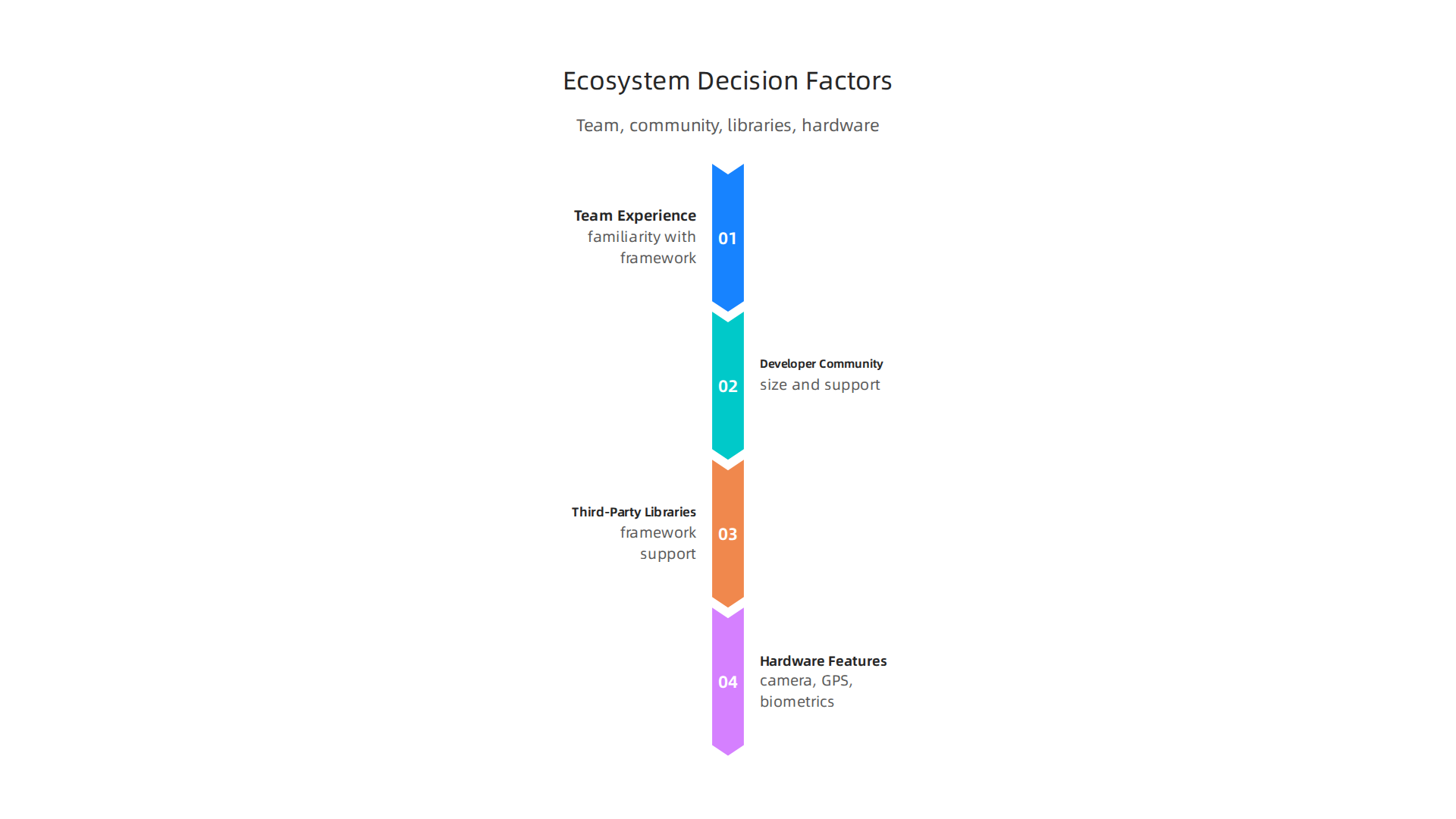
Here’s the thing. Performance differences between cross-platform and native code are barely noticeable in most startup apps today. What really matters is your team’s experience, the size of the developer community, and how well the framework supports third-party libraries. You also need to think about hardware features like camera, GPS, or biometrics.
Some frameworks handle native device access better than others.
A smart approach many startup teams use is a hybrid strategy. They build the core features, like login, payments, or heavy animations, using native code. Then they use a cross-platform framework for less critical screens like settings, onboarding, or content feeds. This gives you the best of both worlds. You get native performance where it counts and faster development everywhere else.
If you want to dig into the full list of frameworks and see which one fits your project, the Uno Platform article offers a clear breakdown of pros and cons.
Making the right ecosystem decision early saves you from painful rewrites later. And as your skills grow, you might also want to check out The 2026 Software Engineer Certification That Actually Pays Off to validate your expertise in these areas.
The tools keep evolving, and so should your strategy. Want daily insights on which frameworks and AI tools are winning? Subscribe to The Deep View Newsletter for clear, no-fluff updates every day.
API-First and Composable Architecture: Building Adaptable Ecosystems
Once you’ve settled on a framework, the next big question is how your startup app will connect to the outside world.

In 2026, the most adaptable teams are not just picking a frontend framework. They are designing their entire app around an API-first and composable architecture.
What does that mean? Simple. You design the API first, before you write a single line of UI code. This flips the old approach on its head. Instead of building the app and then figuring out how to connect it to a backend, you define how data flows from the start. This lets your frontend and backend teams work in parallel. It also makes A/B testing much easier. You can swap out a screen or a feature without touching the server. And because your API is the center of everything, you can plug in third-party services in hours, not weeks. For example, adding QR code scanning is now just an API call away, thanks to the evolution of QR code technology.
The modern startup apps that grow fast use a composable frontend. They decouple the UI from the backend using headless CMS platforms and Backend-as-a-Service (BaaS) solutions. A headless CMS like Strapi or Contentful handles content, while a BaaS like Supabase or Firebase manages authentication and data storage. This separation means you can change your frontend framework later without rewriting the backend. If you want to move from React Native to Flutter, you just swap the frontend layer. The API stays the same.
Non-technical team members can also contribute. Low-code and API glue platforms like Zapier and Make let anyone on your team connect services through drag-and-drop workflows. This speeds up internal integrations and frees your developers to focus on core features. According to the AppZoro guide on cross-platform frameworks, the top frameworks in 2026 are built to work seamlessly with these headless backends and third-party APIs.
To accelerate your API development even further, you can use AI tools that help generate endpoints and handle boilerplate. Check out this guide to AI-assisted code generation with GLM to see how teams are speeding up their workflow.
An API-first, composable approach is not just a buzzword. It’s the practical way to build startup apps that can pivot quickly, integrate new features, and survive platform changes. When you eventually publish your app on the Google Store for app download, having a flexible backend makes updates and maintenance much less painful. Build your architecture this way, and your app will adapt as your business grows.
Monetization and Growth in a Privacy-First Era
You built a flexible app with an API-first approach. Now comes the hard part: making money and getting users. In 2026, the old playbook is broken. Subscription fatigue is real. Privacy rules like iOS ATT and GDPR have shut down easy ad targeting. So how do successful startup apps survive and grow?
Smart Monetization Models
The days of slapping a $9.99/month subscription on everything are ending. Users are tired of paying for every single app. According to the Adapty mobile app monetization report, weekly subscriptions now bring in 55.5% of all app revenue. That sounds good, but annual plans retain users much better. The App Monetization Statistics page shows annual plans keep 28% of users after one year, compared to just 12% for monthly plans.
Smart startups are mixing things up. They offer:
- Usage based pricing: Pay for what you use. This works great for AI features or data heavy apps.
- Freemium with limited AI features: Give away a basic version, then unlock premium AI tools. The RevenueCat State of Subscription Apps report found AI apps start trials at a much higher rate, 8.5% compared to 5.6% for non-AI apps.
- One time purchases: Perfect for a drawn app or a simple utility. No recurring charges, no subscription stress.
In-app purchases and ads still work, but you need better targeting. The adjoe guide on app monetization notes global mobile ad spend is set to hit $390 billion. But you can’t rely on third-party data. Use first-party data from your own app. Ask users for preferences during onboarding. Build your own audience segments.
User Acquisition Without Third-Party Cookies
Getting a google store app download in 2026 is tougher than ever. Privacy regulations kill cheap ad targeting. So smart founders are shifting to content marketing, viral loops, and community driven growth. For example, create a free tool like a QR code generator (think of the evolution of QR code technology) and let users share it. That drives organic downloads without paying for ads.
Another tactic is building a community. Start a Discord or Slack group where users share tips. Word of mouth still beats paid ads. And if you have a viral feature, like a shareable result card, that growth compounds.
What Good Looks Like
You want a trial to paid conversion rate of 15-25% (30%+ is exceptional). Monthly churn should be under 5% for B2C apps, according to the Octy monetization guide. Track these numbers from day one with a tool like RevenueCat.
The best way to stay ahead of all these changes? Keep learning. The The Deep View Newsletter delivers clear daily AI updates that help you spot new monetization trends before your competitors. It’s a small habit that pays off big.
Privacy, Security, and Trust by Design
Making money is one thing. Keeping users is another. In 2026, people delete apps that feel unsafe. If your startup apps don’t protect data from day one, you will lose downloads. Trust is your new currency.
Build Zero-Trust From the Start
Users expect you to guard their information like a vault. That means using zero-trust architecture. Never assume anyone inside your system is safe. Verify every request. Encrypt data end to end. The Industry Validation Benchmarks show that SaaS startups with strong security practices hit product-market fit faster. Why? Because businesses and consumers both run from leaks.
A simple example: imagine a drawn app where users sketch ideas. If that app stores drawings in plain text and gets hacked, nobody will ever trust it again. Use encryption for everything. Store passwords hashed. Use HTTPS everywhere.
Compliance Isn’t Optional Anymore
Regulations like GDPR, CCPA, and the Digital Services Act are law. Ignoring them costs you fines and your reputation. Smart startups bake compliance into their development workflow. It’s cheaper to do it right the first time than to fix it later. Every feature you build should ask: “Does this respect user privacy?”
When you submit a google store app download request, Google checks your privacy policy. If it’s missing or weak, your app won’t get approved. That’s a hard stop.
Make Logins Both Safe and Easy
Biometric authentication and passkeys are becoming standard. They replace clunky passwords. The evolution of QR code technology makes passkeys even simpler. You scan a QR code on another device, and you’re logged in securely. No typing. No phishing risk. Users love that friction-free security.
For your team, invest in training. Encourage developers to get certifications that focus on secure coding. The 2026 Software Engineer Certification That Actually Pays Off covers exactly these skills.
Remember: when privacy is built in, trust grows naturally. And trust leads to higher retention rates. That’s the real competitive advantage for startup apps in 2026.
Developer Productivity and Tooling: CI/CD, Observability, and Low-Code
You have built a secure foundation for your startup apps. Now you need to ship features without breaking that trust. That is where developer productivity comes into play.
CI/CD pipelines are table stakes in 2026. You need a system that automatically tests and deploys your code. GitHub Actions is the most widely adopted CI/CD platform right now.
But Jenkins is still a major player with 28% adoption. The real game changer is AI driven test generation. Instead of writing every test by hand, AI can look at your code and create tests for you. This helps you ship faster with more confidence. You can learn more about integrating AI into your daily workflow with guides on how Claude supercharges your coding.
Once your app is live, you need to know what is happening inside it. That is observability. It combines logging, metrics, and traces. When something goes wrong, you want to know exactly which database query slowed things down. OpenTelemetry is the leading open source standard for this. It collects data from your entire stack. Many startups use open source tools like Prometheus and Grafana to visualize this data. Open source automation tools are top picks in 2026. Good observability helps you debug faster and understand how users really interact with your product.
Not every feature needs to be hand coded from scratch. Low code and no code platforms let your team build internal tools and MVPs quickly. A simple admin panel or a data dashboard can be built in hours instead of weeks. But here is the warning. You need careful governance. Without it, you end up with a tangled mess of scripts that nobody can maintain. Think of low code as a scalpel, not a chainsaw.
To keep up with all these fast moving trends in AI and software development, consider subscribing to The Deep View Newsletter. It delivers clear daily insights so you can make better decisions for your startup apps.
Testing, QA, and Reliability at Startup Speed
You have CI/CD pipelines running and observability in place. But none of that matters if your startup apps ship with bugs. The old way was to test everything at the end. That is a recipe for disaster when you release every week.
Shift-left testing changes that. You move testing earlier in the development cycle. AI powered test automation makes this possible. Instead of writing every test yourself, tools can look at your code and generate tests automatically. This catches problems before they reach production. Your CI/CD pipeline should include automated unit tests, integration tests, and even visual regression tests. GitHub Actions is the most widely adopted CI/CD platform in 2026, and it supports all these testing stages right out of the box.
Reliability engineering used to be only for big companies with dedicated SRE teams. Now, even small teams can use lightweight SRE practices. Automated incident response tools can detect failures and roll back changes instantly. Chaos engineering experiments run in staging environments to find weak spots before users do. Open source tools like Prometheus and Grafana help you monitor reliability without expensive licenses. Open source automation tools are top picks in 2026 because they give startups enterprise grade capabilities for free.
User acceptance testing has also evolved. In 2026, you don’t need a room full of testers. Build a beta testing community around your startup apps. Use tools like TestFlight for iOS or internal testing tracks on the Google Play store to manage a google store app download for testers. Feature flags let you roll out changes to a small percentage of users first. If something fails, you turn off the feature instantly without redeploying. This gradual rollout is how modern teams release with confidence.
To make the most of AI in your testing workflow, check out GLM Coding Plan: The Developer’s Guide to AI-Assisted Code Generation in 2026. It shows you how to integrate AI into your entire development process, including test creation.
Future Trends: What’s Next for the App Ecosystem?
The app world never stops changing. If you are building startup apps today, you need to keep one eye on tomorrow. 2026 is bringing shifts that will reshape how apps work, where they run, and what users expect. Let’s look at three big trends that matter most.
Edge computing and decentralized apps
Edge computing is booming. The market is expected to hit $317 billion by 2026 according to a recent analysis. Why does that matter for you? Edge computing moves data processing closer to the user instead of sending everything to a faraway cloud server. This cuts latency dramatically. For startup apps that need instant responses like gaming, AR, or real time collaboration, edge is a game changer.
Decentralized apps, or dApps, are also gaining ground. They run on blockchain or peer to peer networks. This makes them great for privacy focused use cases where users control their own data. Users are drawn app designs that feel fast and secure at the same time, and edge plus dApps deliver exactly that.
Wearables, IoT, and multi-surface experiences
Your app will not live only on phones anymore. Smartwatches, fitness bands, smart home devices, and even car dashboards are all becoming app platforms. This convergence creates new opportunities for multi surface experiences. A user might start a task on their phone, check progress on their watch, and finish on a smart display.
If you build startup apps for wearables and IoT, you need a smooth way to distribute them. The google store app download process for companion apps is becoming more streamlined, making it easier to manage multiple device types. And do not forget the evolution of qr code technology. QR codes now act as bridges between physical objects and digital apps. Tap a QR code on a smart fridge to reorder groceries, or scan one on a wearable to start a workout routine. Mobile app development trends in 2026 emphasize this kind of cross platform integration.
AI-driven code generation and the human touch
AI tools can already generate code from simple prompts. In the future, they may replace parts of traditional frameworks. But don’t worry about losing your job. AI is transforming the development process, but developer creativity and domain expertise will remain irreplaceable. The best apps come from understanding real user problems. AI can write boilerplate code fast, but you still need to decide what to build and why.
If you want to dive deeper into using AI in your workflow, check out Grok Code with a Science-Backed Framework for Deep Comprehension. It helps you understand code at a deeper level, which is exactly the kind of skill that stays valuable.
Staying ahead of these trends means staying informed. For daily updates on AI and tech that actually matter to developers, subscribe to The Deep View Newsletter. It gives you clear insights without the noise, so you can build startup apps that are ready for whatever comes next.
Summary
This article gives a practical roadmap for building startup apps in 2026, where AI is a baseline expectation and architectures must be flexible. It explains why AI-native development and agentic workflows cut time-to-market, how to choose between cross-platform and native approaches, and why API-first, composable backends make apps easier to scale and pivot. The piece covers modern monetization options that work in a privacy-first world, plus concrete security and compliance practices—zero-trust, passkeys, and encryption—that protect user trust. It also walks through developer productivity tools (CI/CD, observability, low-code) and modern QA techniques like shift-left testing and AI-generated tests. Finally, it looks ahead to trends such as edge computing, wearables, and AI-driven code tools so you can make decisions that last beyond launch.