
What a Code Zero Acquisition Means for Engineers and How to Survive It
· 26 min read

Introduction
You just got the news your company was acquired. Maybe you saw it coming. Maybe it came out of nowhere. Either way, your stomach drops. Why? Because you know what often follows. Rewrites. Merged systems. New bosses. And a sinking feeling that the code you spent years perfecting might get thrown out.
In the computer world, tech acquisitions happen every single day. A bigger company buys a smaller one for its talent, its users, or its technology. But here is the thing. What looks like a smart business move on paper can turn into a nightmare for engineering teams. This is where the concept of a code zero acquisition comes in.
A code zero acquisition is not an official term you will find in a textbook. Instead, it describes a situation where an acquired company’s entire codebase gets treated as a blank slate. The old code is discarded. The architecture is ripped out. The team is asked to rebuild everything from scratch inside the buyer’s existing systems.
Think about what that means. Months or years of work wiped away. Hard-won knowledge about the product’s quirks and edge cases lost. And the emotional toll on the engineers who built it all.
Modern acquirers are learning that software code diligence is essential before closing a deal to avoid these exact pitfalls. According to recent industry research, Corporate M&A teams embrace code diligence as a way to uncover risks in the target’s codebase before it is too late.

But even with diligence, the post-acquisition integration phase remains a minefield.
Engineers face three huge challenges during a code zero scenario:
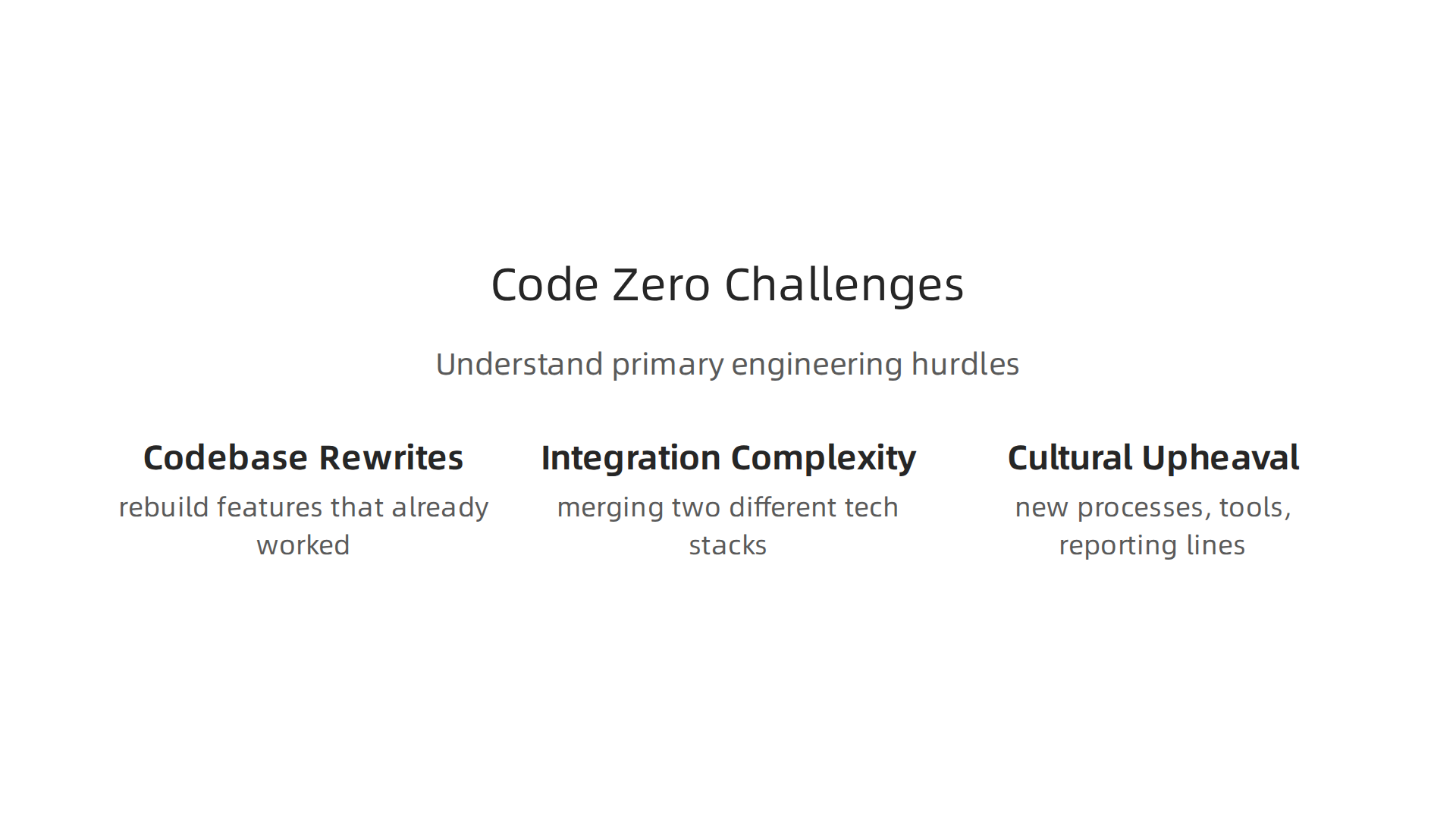
- Codebase rewrites – Having to rebuild features that already worked, often under tight deadlines.
- Integration complexity – Merging two completely different tech stacks without breaking things.
- Cultural upheaval – New processes, new tools, new reporting lines. Everything changes.
Whether you work on CACI apps for defense clients, build consumer software, or handle european engineering projects for a multinational, the impact feels the same. Your team’s momentum stalls. Productivity drops. And the frustration builds.
This article gives you a clear framework to understand what a code zero acquisition really means for the people writing the code. We will look at why it happens, what it does to engineering teams, and how to navigate the chaos.
If you want to stay ahead of the rapid changes in tech including how acquisitions reshape engineering priorities, consider subscribing to a resource that tracks these trends daily. The AI Newsletter Worth Reading delivers clear, daily updates that help you make sense of what is coming next.
Let us start by breaking down exactly what a code zero acquisition looks like in practice.
What Is a ‘Code Zero’ Acquisition?
A code zero acquisition happens when the buying company decides to throw away all the existing code from the company they just bought. They start over from scratch. Imagine buying a house and then tearing it down to build a brand new one on the same lot. That is what code zero feels like for engineers.
This is very different from a normal acquisition. Usually, the buyer takes the existing software and finds ways to merge it with their own systems. With code zero, none of that happens. The old code is ignored. The architecture is gone. The team rebuilds everything from nothing using the buyer’s preferred tools and platforms.
Where Code Zero Happens Most
You will see this play out in three main situations:
- Acqui-hires. The buyer wants the people, not the product. The startup’s code is seen as unimportant because the real goal is to bring smart engineers onto the acquirer’s existing projects. The old software gets left behind.
- Tech stack shifts. If the acquired company uses a completely different technology stack, keeping both alive can be expensive and hard to manage. Think of a Python shop being bought by a Java company. Often, it is simpler to rebuild using one standard stack.
- Divestitures. When a large company sells off a division, the new owner may decide the legacy code is too messy or risky. A clean restart feels safer than inheriting someone else’s technical debt.
Why Companies Choose Zero Over Integration
Throwing away code sounds wasteful. But many acquirers have solid reasons. The code is often called the "crown jewels" of a deal, but sometimes those jewels are full of problems. The secrets behind M&A source code analysis show that buyers check for quality, licensing issues, and security holes before deciding what to keep.
If the code is full of shortcuts, old libraries, or unclear licenses, it may be smarter to start fresh.
Other reasons include:
- Speed. A rewrite can be faster than trying to untangle years of messy code.
- Security. Avoiding inherited bugs and vulnerabilities from the old system.
- Unification. Moving everyone to one platform makes maintenance easier and costs lower.
The decision affects everyone on the engineering team. If you want to understand how modern teams build new products from the ground up, take a look at this guide on startup app development trends. It shows what actually works when you are building fresh.
Now that you know what a code zero acquisition is, let us talk about how it changes the daily life of the engineers caught in the middle.
The Immediate Aftermath: Codebase Integration Challenges
Not every acquisition goes the code zero route. Sometimes the buyer decides to keep the code and merge it with their own systems. That is where the real struggle begins. Engineers suddenly find themselves trying to make two very different codebases play nice together. And it rarely goes smoothly.

When Codebases Clash
The first wall you hit is dependency conflicts. The startup might use version 3.1 of a library while the buyer uses version 2.8. They both look similar on paper but break each other’s features. You end up with circular dependencies, missing packages, and build errors that take days to untangle.
Then there are tech stack mismatches. One team built their product in Python using Django. The other uses Java with Spring Boot. The databases are different. The messaging queues are different. Even the way they handle errors is different. Trying to stitch them together feels like connecting a garden hose to a fire hydrant.
Pipeline and deployment disruptions add another layer of pain. The startup might have used GitHub Actions for CI/CD, while the buyer relies on Jenkins with a custom deployment script. Your clean continuous delivery pipeline suddenly has to support two completely different workflows. Deployments that used to take 15 minutes now take hours, and rollbacks become nightmares.
As a practical guide for tech leaders on post-merger tech integration challenges explains, the biggest risks include broken integrations, unclear system ownership, hidden legacy dependencies, and patchy documentation.

The problem is never one single issue. It is a messy pile of old code, rushed decisions, and delivery pressure.
Common Pitfalls That Make It Worse
Two mistakes show up over and over.
Ignoring test coverage. When timelines are tight, teams skip writing proper tests for the merged systems. They just hope everything works. It does not. Bugs slip into production, and the team spends weeks firefighting instead of building.
Rushed timelines. Executives want to see value fast. They push engineers to finish the integration in weeks instead of months. The result is a fragile system held together with duct tape, a ticking time bomb of technical debt.
These challenges are real and they hit every role on the engineering team. If you want to see how teams handle integration at a smaller scale, check out this guide on API integration for modern apps. The principles of clean, tested integration apply no matter the size.
Staying ahead of these problems means keeping up with the tools and trends that make development smoother. For clear daily updates on AI and technology that can help your team work smarter, get the The AI Newsletter Worth Reading delivered to your inbox.
The Hidden Costs: Technical Debt and Pipeline Disruption
But the pain does not end when the acquisition closes. Even if the code is not thrown away, there are hidden costs that pile up silently over months and years. The two biggest silent killers are technical debt and broken CI/CD pipelines.
Why Technical Debt Explodes After an Acquisition
When a tech deal happens, the acquiring company inherits more than just code. It inherits every shortcut, every half-finished feature, and every quick fix that the startup rushed out the door. In the chaos of integration, teams rarely have time to clean things up. They just merge and move on.
That is how technical debt accelerates. Unfinished features get marked as "to be revisited later," but later never comes. Abandoned code sits in the repository, confusing new developers and slowing down every future change. The codebase becomes a pile of half-broken parts that no one fully understands.
As one expert in unifying technology after acquisitions explains, legacy systems are the silent budget eaters and innovation blockers.
They require rare skills to maintain and break easily when you try to change them. In a code zero acquisition, the buyer wipes the slate clean. But when the code is kept, that debt becomes the buyer’s long-term problem.
How CI/CD Pipelines Falter
The second hidden cost is pipeline disruption. Your CI/CD pipeline was likely tuned to your own codebase. After an acquisition, you now have a second codebase that needs to run through the same pipeline or a different one. The result is broken builds, failed tests, and deployments that miss their window.
Imagine this: you merge a startup’s code into your monorepo. Suddenly, your build time triples. Tests that used to pass now fail because of conflicting environment variables. Deployment scripts crash because they expect a different folder structure. Your team spends hours debugging pipeline issues instead of shipping features.
The computer world has seen many deals fail because teams underestimated how fragile their pipelines were. Even a well-run integration can hit these walls. That is why it pays to invest in proactive monitoring to avoid costly downtime from the start.
The Long-Term Maintenance Tax
Perhaps the worst hidden cost is the maintenance tax. Code that is thrown over the wall without documentation, without tests, and without a clear owner becomes a permanent drag on the team. Every new feature takes twice as long because developers have to figure out what the inherited code does. Every bug fix risks breaking something else.
European engineering teams often emphasize clean, well-documented code. But in the pressure of a merger, standards slip. The result is a codebase that costs more to maintain every quarter.
The smartest teams treat technical debt as a real cost from day one. They budget time for cleanup and they refuse to skip testing. Because in the end, the hidden costs of a messy integration can eat up all the value the deal was supposed to create.
Case Studies: Notable Acquisitions and Their Engineering Fallout
The hidden costs we talked about feel much more real when you look at actual companies. Let’s walk through three big tech deals. Each one shows a different kind of engineering fallout, and each one offers a lesson for teams facing their own merger.
Microsoft and Activision Blizzard: The Mega Merger
Microsoft bought Activision Blizzard for $68.7 billion. It was the biggest gaming deal in history. From an engineering view, this was a giant non-code zero acquisition. Microsoft kept the code. It had to plug a massive game studio into its own Xbox and cloud systems.
The scale is hard to picture. Game engines, backend servers for Call of Duty, publishing pipelines, and licensing systems all had to connect without breaking the games millions of people play every day. A detailed analysis of the Microsoft and Activision Blizzard case study shows how important operating synergy is when merging tech stacks that large. A year after the deal closed, Microsoft’s acquisition of Activision Blizzard a year later showed that integration challenges and pipeline issues persisted.
The lesson? Without a code zero acquisition, you need a clear technical roadmap from day one. Otherwise, your best engineers spend years just untangling inherited code instead of building new features.
Salesforce and Slack: Culture and Code Collide
Salesforce bought Slack for $27.7 billion in 2021. On paper, it looked perfect. Slack is a fast communication platform. Salesforce is a giant CRM. But the engineering reality was harder.
Slack was built as an independent, quick-moving platform. Salesforce runs on a very different, heavily customized enterprise architecture. The integration was slow and bumpy. Developers faced conflicting APIs, different data models, and deep cultural differences in how each company shipped software. The computer world knows this story well. Even when the code is clean, the cost of technical and cultural integration can drain your engineering team’s energy for years.
Facebook and Instagram: The Slow Boil
In 2012, Facebook bought Instagram for $1 billion. At first, Instagram ran almost completely on its own. It felt like a quiet deal. But over time, the integration came.
Facebook moved Instagram from Amazon Web Services to its own data centers. It connected the ad systems. It merged user accounts and backend services. Every migration created technical debt. Every API change risked breaking something.
The lesson here is that a delayed integration does not avoid the hidden costs. It just spaces them out. The engineering fallout from moving infrastructure and merging codebases eventually catches up with you.
Lessons Learned for Engineering Teams
These three stories share a common theme. Smart teams do not wait for the deal to close to think about the code. They plan the technical side as carefully as the legal side.
If you are on the buying side, ask yourself one big question: What is the end state? Are we doing a full code zero acquisition and building from scratch? Or are we keeping the code and integrating it over time? The answer decides your hiring needs, your budget for technical debt, and your timeline. You might need to learn how to hire a full stack developer in 2026 to handle the new complex codebase you are inheriting.
Staying ahead of these integration challenges requires constant learning. Subscribe to The Deep View Newsletter to keep your engineering team informed about the latest software trends and AI tools that make post-acquisition work smoother.
The Human Factor: Talent Retention and Culture Clash
The case studies show how hard it is to merge code, systems, and infrastructure. But the hardest part of any acquisition is often the people. You can rewrite every line of code, but you cannot rewrite a person’s sense of belonging.
Here is the uncomfortable truth. After an acquisition, a huge chunk of the acquired team walks out the door. According to research from MIT Sloan, acquired employees are 33 percent more likely to leave in the first year than regular hires. That is a third of the talented engineers you just bought. And the ones who stay often feel unsettled for months.
Why do they leave? It is rarely just about money. The reasons are deeper. Most engineers leave because they see no growth path ahead. They also leave because of poor management, equity that gets repriced lower, or a mission that no longer feels meaningful. A detailed breakdown of why senior engineers depart shows that around 35 percent leave due to a lack of growth or learning trajectory. Another 20 percent leave because their equity value drops after the deal closes. These are predictable patterns.
The Culture Clash
Startup engineers are used to autonomy. They own problems from end to end. They make decisions fast. When a big company buys them, they suddenly face layers of approval, rigid processes, and a different pace. That mismatch creates what researchers call organizational mismatch. The startup culture that attracted them is gone.
The clash gets even sharper in cross-border deals. For example, when a US-based company acquires a European engineering team, the differences in work style, communication norms, and expectations around flexible schedules can cause real friction. That is why offering flexible work arrangements and honoring the acquired team’s established habits is a proven way to reduce culture shock and keep top performers engaged. Strategies for team retention after a startup acquisition often highlight the importance of preserving the autonomy that made the team valuable in the first place.
How to Keep Your Best People
Retention does not start after the deal closes. It starts before the ink dries. Here are strategies that work in 2026.
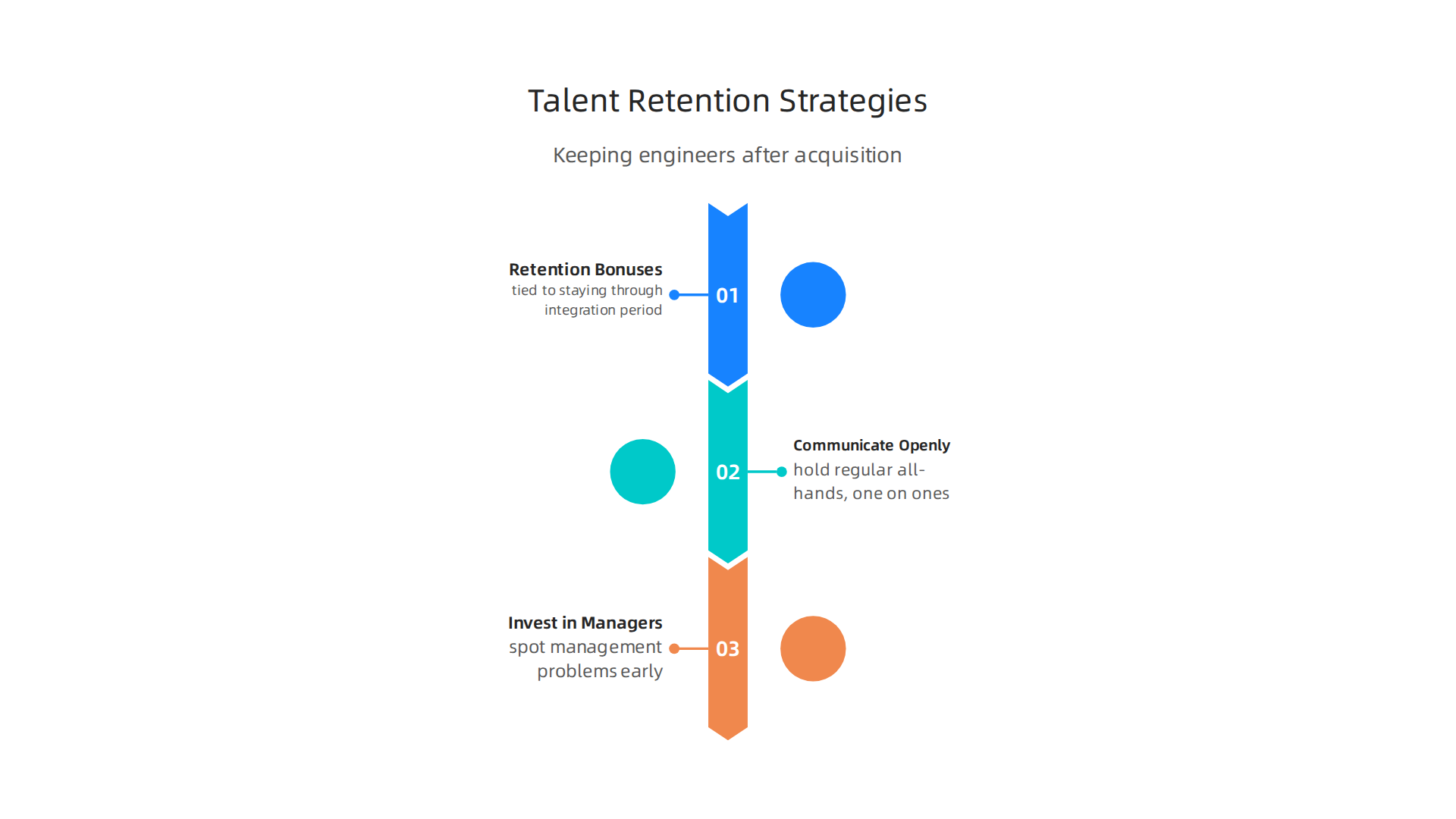
First, use retention bonuses tied to staying through the integration period. But bonuses alone are not enough. You also need to offer clear career paths and honest promotion timelines. Engineers who can see where they will be in two years are far less likely to look elsewhere. The best approach combines financial incentives with meaningful growth opportunities. This includes regular upskilling and reskilling programs that show your commitment to their future.
Second, communicate openly and often. People hate uncertainty. When they do not know if their role will change, they start looking. Hold regular all-hands meetings, one on ones, and open forums. Answer the hard questions directly. One expert puts it simply: "The key is to plan, be prepared, communicate early. A change management program needs to be in place that takes into account the human factor over the long term." Following that advice can dramatically improve how to retain employees after a merger.
Third, invest in managers. The single biggest predictor of engineering attrition is manager quality. Engineers do not leave companies; they leave bad managers. Conduct skip level conversations and 360 feedback early in the integration to spot management problems before they cause departures.
A code zero acquisition removes the technical debt problem, but it does not fix the talent problem. You still need to keep the people who built the product you just bought. That takes deliberate planning, honest conversations, and a real commitment to their growth. For teams looking to build long term engineering strength, driving software innovation through research and development is a great way to give engineers the meaningful work they crave. When engineers feel they are building something important, they stay.
Strategies for Navigating an Acquisition as an Engineer
Your company just got bought. Maybe it is a code zero acquisition, meaning the buyer plans to rewrite everything from scratch. Or maybe they want to keep your code and integrate it slowly. Either way, you feel the ground shift beneath your feet. You have more control than you think. Here are practical steps to protect your career and make smart choices during the transition.
Assess Your Code Ownership
First, figure out exactly what you own. Which parts of the codebase have your fingerprints on them? What modules, APIs, or systems do you understand better than anyone else? Write this down. Share it with your new manager. When an acquirer sees that you hold critical knowledge, your value goes up. This is especially true if your team’s software contains proprietary data or domain expertise that would be hard to rebuild. As one analysis of the 2026 M&A landscape points out, depth that cannot be replicated by a capable engineer with access to off-the-shelf tools is what makes a product defensible. That depth is your leverage.
Build Relationships Early
Do not wait for your new colleagues to come to you. Reach out. Schedule intro calls with engineers on the acquiring team. Ask about their tools, their priorities, their pain points. Strong relationships make the transition smoother and give you allies who can advocate for your ideas later. This also helps you understand the unwritten rules of the new organization.
Understand New Priorities
Every company has different goals. Maybe the acquiring company cares about speed over polish. Maybe they care about security certifications you never needed before. Ask your new manager directly: "What does success look like for our team in the next six months?" Then align your work to match.
When to Advocate for Rewriting vs. Integrating
If the acquirer wants a code zero acquisition a full rewrite you may feel your hard work is being erased. But do not fight every battle. Advocate for integration when your code has deep value. For example, if your system handles complex business rules or sensitive data, pushing to keep it can save months of rework. If your code is messy and full of shortcuts, a rewrite might actually be a fresh start. Pick your fights based on impact, not pride.
Protect Your Career Trajectory
Uncertainty is dangerous for your career if you let it freeze you. Instead, stay visible. Document your wins. Ask for stretch assignments that let you learn new skills. The best engineers use acquisition periods to explore what they really want. If you want to move into a different role or team, this is the time to ask. And keep learning. Understanding the drivers behind why senior engineers leave can help you avoid common traps like equity cliffs or lack of growth. Look for upskilling opportunities that keep your skills relevant. If you want to dive deeper into where your career can go next, exploring computer science growth and learning paths can give you a clear roadmap.
One simple way to stay ahead is to stay informed about the big trends shaping the industry. AI is changing everything, especially in software development. Getting clear daily updates on AI can help you spot opportunities before others do. That is exactly what The AI Newsletter Worth Reading delivers. It keeps you sharp and aware of the tools and shifts that will define the next phase of your career. Subscribe today and stay ahead of the curve.
Long-Term Effects on Innovation and Architecture
A code zero acquisition might feel like a clean slate. But the reality is often different. When an acquirer decides to rewrite everything from scratch, it can trap the combined team in years of rework. During that time, new features slow down or stop completely. Innovation takes a back seat to recreation. This is one of the biggest hidden costs of a code zero acquisition.
The Innovation Slowdown
When engineers spend months or years rebuilding what already exists, they have no bandwidth left for experiments, improvements, or new ideas. The team becomes a maintenance crew for a system that does not even exist yet. Legacy systems already act as the biggest blockers to progress. As one CTO explains, legacy systems are the silent budget eaters and innovation blockers. They demand constant attention and prevent teams from scaling or adopting modern approaches. A code zero acquisition amplifies this problem because it adds a massive rebuild project on top of normal integration work.
Monorepo vs Microservices After a Merger
One of the most important architectural decisions you will face after an acquisition is how to structure code repositories. Should you combine everything into one giant monorepo? Or keep a set of microservices that communicate through APIs? The wrong choice can haunt your team for years.
A monorepo can make code sharing and refactoring easier across teams, but it also creates a single point of failure and slows down builds. Microservices give each team independence, but they add complexity around data synchronization, API versioning, and cross-service testing. Choosing the right approach depends on your team size, deployment frequency, and how much the two codebases actually overlap.
The key is to make this decision based on long-term goals, not short-term convenience. Many teams rush into one approach and later regret it. Taking time to map dependencies and test integration strategies early can save you from a painful migration later. For a deeper look at how major architectural choices shape product development, check out our guide on driving software innovation through strategic R&D.
How Acquisitions Shape Roadmaps for Years
Once the integration plan is set, it becomes the de facto roadmap for the next one to three years. Every engineering decision gets filtered through the lens of that plan. New feature requests get deprioritized because "first we need to finish the merge." Security upgrades get delayed because resources are tied up. Even hiring decisions change: teams start looking for people who know the new stack instead of the old one.
This means the acquisition does not just change your day-to-day work for a few months. It reshapes the entire technology trajectory of the combined company. If the plan is poorly designed, you could be paying for that mistake in lost innovation for half a decade.
Understanding these long-term effects helps you advocate for smarter decisions during the transition. Do not let a code zero acquisition turn your team into a rebuild factory. Push for a balanced approach that preserves your ability to innovate while still cleaning up the technical debt that truly matters.
How to Assess Acquisition Risks Before Joining a Company
When you are interviewing for a role at a tech company, the last thing on your mind might be what happens if the company gets acquired. But the reality is that mergers and acquisitions happen all the time. And if you join the target company, your job security, engineering culture, and daily work could change overnight.
So how do you spot a risky acquisition before you sign the offer letter? You need to ask the right questions and do a little homework.

Red Flags to Watch For
Not all acquisitions are bad. But some carry much higher risk than others. Look for these warning signs:
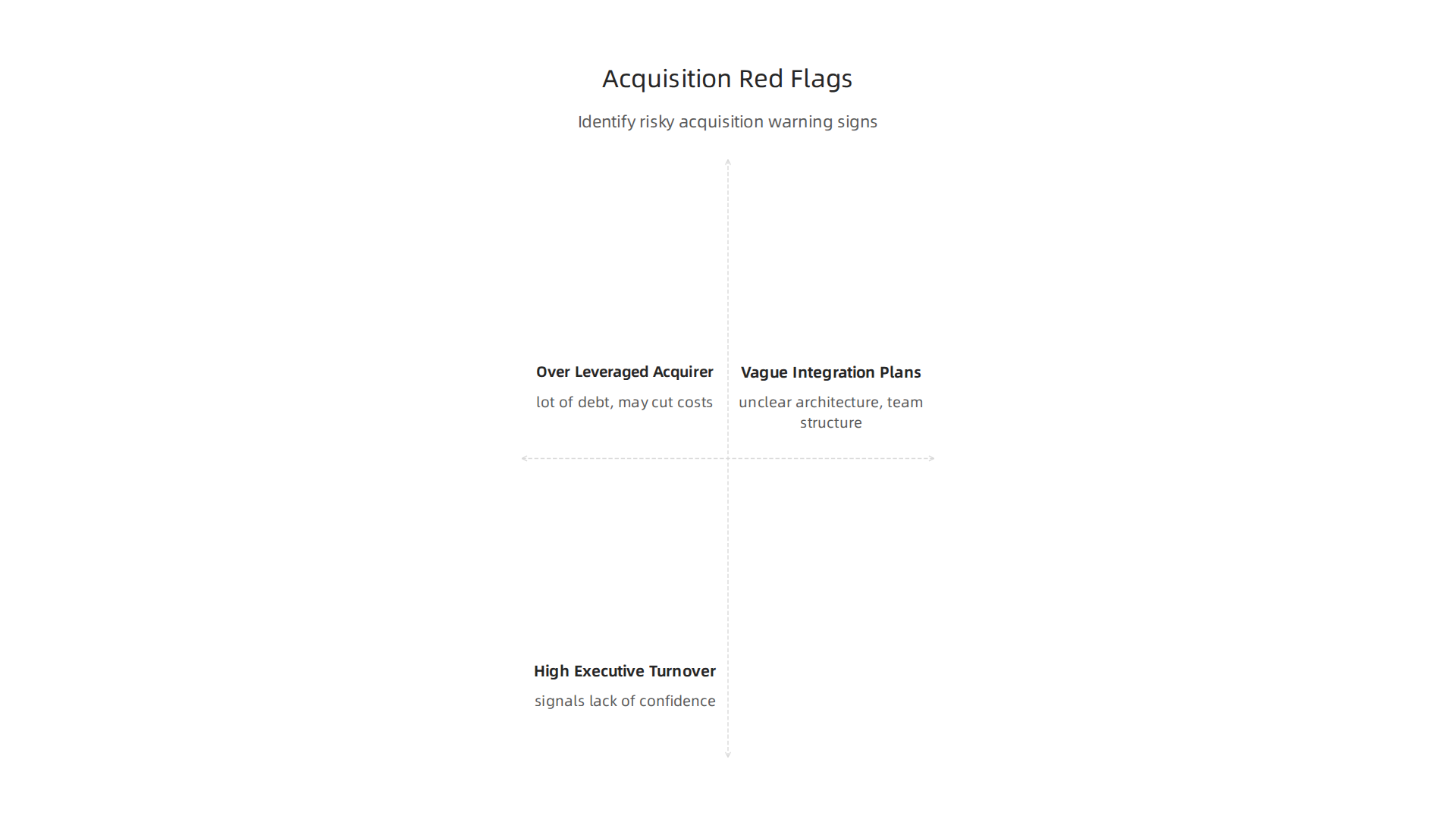
Over leveraged acquirer. If the company buying your potential employer has taken on a lot of debt to fund the deal, it may need to cut costs quickly. That often means layoffs, reduced engineering budgets, and pressure to ship features fast instead of building solid code.
Vague integration plans. Ask the hiring manager or the team lead: "What is the plan after the acquisition? How will our codebase and team be integrated?" If the answer is unclear or sounds like "we will figure it out later," that is a red flag. A clear plan suggests the acquirer has thought through the architecture, team structure, and timeline. A vague plan often leads to a messy code zero acquisition where everything is rewritten from scratch.
High executive turnover. If key leaders have left the target company recently, it may signal a lack of confidence in the deal’s outcome. Check LinkedIn for recent departures.
Questions to Ask During Interviews
You have a right to understand the engineering culture you are walking into. Use these questions to dig deeper:
- "What is the company’s history with acquisitions? How many have happened in the past five years? How were the engineering teams handled?"
- "How does the engineering team make decisions about architecture and tooling? Is there a documented process?"
- "What is the current product roadmap? Are there major integration projects planned for the next year?"
- "How long have most engineers been on the team? Are there people who joined through a previous acquisition?"
These questions help you gauge whether the team is stable and whether the engineering culture is collaborative or dictated from above.
Due Diligence for Engineers
Before you accept the offer, do your own research. Review the target company’s codebase if it is open source. Look at the quality of the code, the presence of comments, the use of modern practices. If the code is messy and undocumented, that is a sign of tech debt that could become your problem after an acquisition.
Also check the product roadmap. If the roadmap is dominated by "integration milestones" rather than new features, you are likely looking at a long rebuild phase.
Industry analyses like a cracking the code of digital M&A report from Boston Consulting Group show that acquirers who fail to articulate a clear vision for the combined business often destroy value. That same lack of clarity can derail your career and leave you rebuilding old systems for years.
European engineering teams, for example, often prioritize sustainable code practices and long term maintainability. If you value that approach, ask about the acquirer’s stance on code quality and technical debt.
Stay Informed to Make Better Decisions
Understanding the landscape of tech acquisitions is not easy. But by asking the right questions and doing a little due diligence, you can avoid joining a team headed for a painful code zero rebuild.
To stay ahead of these trends and make informed career decisions, consider subscribing to The AI Newsletter Worth Reading from The Deep View. It delivers clear daily updates on AI and technology shifts that can help you spot industry trends early and avoid risky moves.
You can also explore related resources on evaluating codebases for long term viability to sharpen your ability to assess a company’s technical health before you join.
Summary
A code zero acquisition describes when an acquirer discards an acquired company’s codebase and rebuilds from scratch, a choice driven by speed, security, or tech unification. This article explains where code zero scenarios most often arise (acqui-hires, tech stack shifts, divestitures), why buyers sometimes prefer rewrites, and the immediate engineering pains—dependency conflicts, broken pipelines, and cultural upheaval. It also covers hidden costs like exploding technical debt, fragile CI/CD systems, and a maintenance tax that can erode deal value. Through examples from major tech acquisitions, the piece shows how poorly planned integrations stall innovation and create long-term architecture trade-offs (monorepo vs microservices). Practical advice for engineers includes documenting ownership, building relationships, and choosing which fights to pick, while leaders are urged to plan retention, communication, and roadmap trade-offs. Finally, the article offers interview questions and red flags engineers can use to assess acquisition risk before joining a company.