
Select the Most Accurate AI Detector for Your Engineering Team
· 20 min read

Why AI detection matters now (and what this guide will help you do)
In 2026, it’s getting harder to tell the difference between what a person wrote or created and what was made by a computer. You see AI-generated content everywhere now. It’s in articles, pictures, sounds, and even code. This fast growth means we really need good ways to figure out if something is synthetic or human-made.
For people who build software, lead product teams, or manage engineering projects, this is a big deal. You need to know if the content you are working with or putting out into the world is real. Why? Because using AI-generated content without knowing can cause problems. It can affect how much people trust your products or even cause issues with rules and laws. You need reliable ways to govern your work and make sure everything is right.

This is where finding the most accurate ai detector becomes super important.
This guide is here to help you understand the best ways to detect AI content. We will look at different tools and methods so you can choose what works for your team. From spotting AI in writing to understanding how to use AI for better coding, we’ll cover it all. You can also explore how AI coding assistants in 2026 are changing how software is built. Our goal is to give you the knowledge you need to make smart choices in a world full of AI.
To keep up with all the new AI trends and tools every day, you’ll want to stay informed. Get clear daily AI updates from The AI Newsletter Worth Reading.
Before we dive into the latest tools, it helps to know a little about how we got here.

Figuring out if something was made by a computer didn’t just pop up overnight. It’s been a journey of clever ideas and new challenges as AI itself grew smarter.
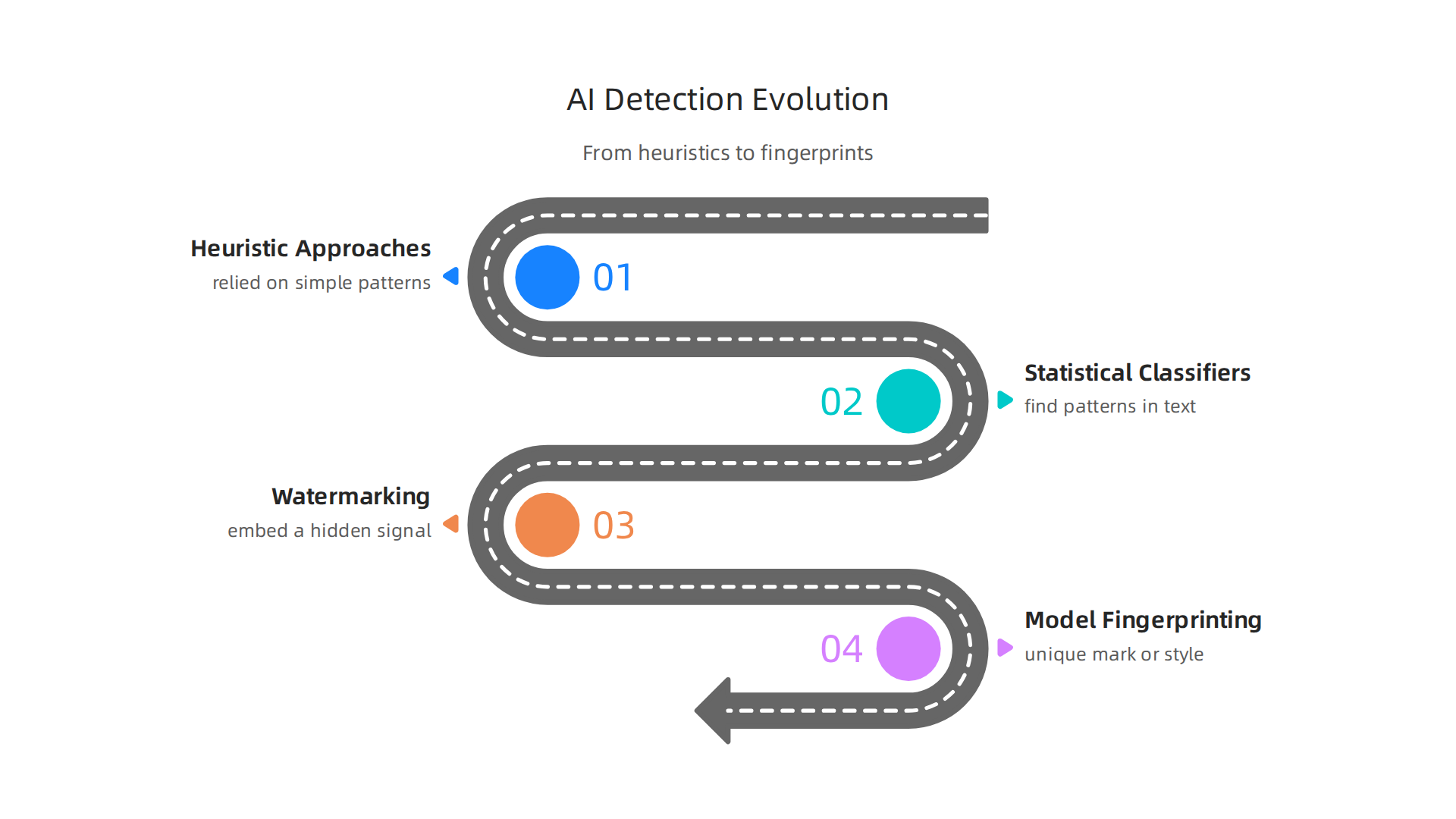
In the early days, when AI was simpler, detecting computer-made content was mostly about looking for basic rules. Think of it like a checklist: does the text use strange words? Does it repeat phrases too much? These were called "heuristic" approaches. They relied on simple patterns that people thought computers would always follow. If a piece of writing broke these rules, it might be flagged as AI-generated. This worked okay when AI was just learning, but as AI got better, these simple rules became less helpful.
Then, as AI models grew more complex, like the big language models we have today, those old rules didn’t work anymore. AI started to write and create in ways that looked very much like human work. This led to a big change in how we thought about finding AI content. Experts started looking at more scientific ways, using math and data to find hidden signs that a computer was at work.
This is where ideas like "model fingerprinting" and "watermarking" came in. Imagine a painter who always uses a special brushstroke that only they can make. That’s kind of like a model fingerprint. It’s a unique mark or style that an AI model leaves on the content it creates, even if it’s not obvious to us. Researchers found ways to spot these tiny, hidden clues.
Watermarking is a bit different. It’s like an artist purposely signing their work, but in a secret way. When an AI system creates content, it can be designed to embed a hidden signal or "watermark" inside it. This signal is usually invisible to people but can be picked up by special detection tools. This method began to be explored more deeply around the early 2000s, with many advancements made in the last few years, as outlined in A Brief Chronology Of AI Watermarking Development. The goal of watermarking is to make it easy to tell if content came from a specific AI model or not. Companies that build AI, sometimes called an "AI foundry," are often interested in using watermarks to make their content traceable.
In 2026, many different techniques are used to build the most accurate ai detector. We’re moving beyond simple rule-following to really understand the deep patterns AI leaves behind. For example, if you’re trying to understand how an AI like the Grok app creates code or text, knowing about these detection methods can help you Grok Code with a Science Backed Framework for Deep Comprehension. The need for reliable detection only grows as AI tools become more powerful and common.
How Modern AI Detectors Work: Methods and Trade-Offs
As AI gets smarter, figuring out if content was made by a human or a computer has become more tricky. Today, finding the "most accurate AI detector" means using several smart methods, each with its own good points and tough parts.
Let’s look at the main ways these detectors work:
1. Statistical Classifiers
Imagine a computer that learns what human writing looks like and what AI writing looks like. Statistical classifiers do just that. They study tons of text to find patterns. For example, AI might use certain words more often, or structure sentences in a way that’s slightly different from a person. These tools look for these small differences in style, grammar, and word choice. If a piece of writing matches the "AI style" more closely, the detector flags it.
2. Watermarking
This is like a secret signature that an AI leaves on its work. When an "AI foundry" or company creates an AI, they can build it so that it always adds a hidden mark to the text or images it makes. This mark is usually invisible to people but special tools can find it. Watermarking makes it easier to tell if content came from a specific AI model or not, helping to prove where content came from. For more details, you can learn about Understanding AI Watermarking: Definition and Significance.
3. Model Fingerprinting
Just like every person has a unique way of doing things, each AI model also has a unique "fingerprint." This is not a secret sign added on purpose, but rather a pattern or style that comes naturally from how the AI was built and trained. Think of it like a specific artist’s unique brushstrokes. These subtle clues can be found and used to identify AI-generated content. You can explore this further in a guide to Detecting AI fingerprints: A guide to watermarking and beyond.
4. Metadata Analysis
Sometimes, the way a file is saved can give clues. Metadata is "data about data," like when a file was made, what program made it, or who changed it last. While this isn’t always foolproof, looking at this information can sometimes help find AI-created content, especially for images or other digital files.
The Trade-Offs: Why It’s Hard to Be Perfect
Even with these smart methods, building the "most accurate AI detector" comes with challenges:
- Precision vs. Recall (Getting it Right): This is a big one.
- Precision means that when the detector says something is AI, it’s usually right. You don’t want it to falsely accuse human work.
- Recall means the detector finds most of the AI content out there. You don’t want it to miss AI content that it should have found.
- It’s hard for a detector to be perfect at both. Sometimes, if you make it very good at catching all AI (high recall), it might also make mistakes and flag human work (low precision). In 2026, many detection tools are still unreliable, as highlighted in AI Content Detection and Watermarking in 2026.
- Runtime Cost (Time and Money): Checking every piece of content with complex AI detectors takes computer power and time. This can be expensive and slow, especially for big websites or many files.
- Integration Complexity (Fitting It In): Adding these detectors to existing systems can be tricky. They need to work smoothly with other tools and not cause problems. For developers, understanding how AI coding assistants fit into workflows is key, as explored in AI coding assistants 2026 how Cluely AI and prompt engineering solve the trust problem.
- Susceptibility to Adversarial Tactics (People Trying to Trick It): As detectors get better, some people try to make AI content that can fool them. This constant back-and-forth makes detection an ongoing challenge. For example, AI models like the Grok app are always evolving, which makes detection a moving target.
Modern AI detectors use clever strategies, but they’re always in a race to keep up with new AI developments. Staying informed about these changes is key.
Get clear daily AI updates from The AI Newsletter Worth Reading.
Knowing how AI detectors work and the challenges they face is just one part of the puzzle. To truly find the "most accurate AI detector," we also need to know how to measure if it’s actually good. It’s like judging a game; you need clear rules to keep score.
Understanding Key Performance Metrics
When someone says an AI detector is "accurate," what does that really mean? There are several important ways to measure how well these tools perform. Thinking about these helps us understand how a detector earns the title of "most accurate AI detector."
-
Precision and Recall Revisited
In simple terms, precision asks: "When the detector says something is AI, is it usually right?" You want a high precision score so that human-written work isn’t falsely flagged as AI.
Recall asks: "Does the detector find most of the AI content out there?" You want a high recall score so that real AI content doesn’t slip through.
It’s a tricky balance, as improving one can sometimes hurt the other. -
F1-Score: A Balanced View
Since precision and recall are both important, the F1-score helps combine them into one number. It’s like an average that gives equal importance to both. This score is really helpful because it gives a better overall picture of a detector’s performance, especially when there’s not an even mix of human and AI content in the test samples Is your AI Model Accurate Enough?. -
AUC (Area Under the Curve)
The AUC score is a fancy way to see how well a detector can tell human and AI writing apart across many different situations. A higher AUC means the detector is better at sorting content correctly, no matter how sensitive it’s set. These metrics, including accuracy, precision, recall, and F1-score, are common ways to evaluate AI systems A Systematic Analysis of Performance Evaluation Metrics in Machine Learning. -
Calibration
Imagine a weather app that says there’s an 80% chance of rain. If it truly rains 80% of the times it gives that forecast, then it’s well-calibrated. For an AI detector, calibration means that if it says it’s 90% sure a text is AI, it should be correct about 90% of the time. This builds trust in the detector’s confidence levels, not just its "yes" or "no" answer.
The Problem with Test Data: Dataset Bias
Even with these smart metrics, evaluating the "most accurate AI detector" runs into a big problem: the test data. Detectors learn from examples. If an AI detector is trained and tested only on certain types of AI writing, like short articles on specific topics, it might seem very accurate for those specific tasks. However, it might fail completely when faced with different kinds of AI-generated content, such as creative stories or complex technical reports.
This means that a detector that seems "most accurate" in one test might perform poorly in another, simply because the testing material was different. The kind of dataset used to evaluate a detector can strongly affect its reported accuracy, sometimes making it look better or worse than it really is.
The Need for Fair Play: Standardized Benchmarks
To truly compare AI detectors and identify the "most accurate AI detector" for general use, we need fair tests. This is where standardized benchmarks come in. These are agreed-upon testing methods and materials that everyone can use.
When researchers and companies use the same, publicly available test sets, called reproducible datasets, they can compare results directly. This helps show which tools are genuinely better at detecting AI across a wide range of content. In 2026, establishing these fair testing grounds is vital for driving progress and helping people trust AI detection tools. Such rigorous testing is part of the broader effort to Drive Software Innovation with Strategic Research and Development.
Finding the best AI detector is not just about its clever methods, but also about how we measure its success. By understanding these key metrics and demanding fair, standardized testing, we can better judge which tools are truly the "most accurate AI detector" today.
Even with good ways to measure AI detector performance and the push for fair tests, finding the "most accurate AI detector" is still really hard. That’s because these tools have certain weaknesses. They can make mistakes, get tricked, or just not work well in some situations.
Common Problems and False Alarms
One big problem is domain shift. This happens when an AI detector is trained on one type of writing, like news articles, but then asked to check something very different, like a poem or a technical report. The detector might get confused and not perform well. It’s like asking a baker to fix a car. They might be great at one thing, but not the other.
Another issue is ambiguous content. Sometimes, text is written in a simple, straightforward way that could easily be human or AI. Short pieces of text, like a sentence or two, are also much harder for detectors to judge accurately. The less information there is, the tougher it is for the detector to find patterns that tell human from AI apart. As AI writing gets better and sounds more human, the line between high-quality AI text and human-written text becomes very blurry, making it hard even for the most accurate AI detector to be sure.
Tricking the System: Adversarial Risks
Beyond just making mistakes, AI detectors also face something called adversarial attacks. This is when someone purposely tries to trick the detector. Think of it like a game of cat and mouse. People who want to hide that they used AI will change their AI-generated text in small ways. These tiny changes might not be noticeable to a human reader, but they can be enough to fool an AI detector into thinking the text is human-written What Are Adversarial AI Attacks on Machine Learning?.
These attacks can make even the "most accurate AI detector" less useful. Attackers might add extra words, change a few letters, or rephrase sentences in ways that throw the detector off. This is a big concern in 2026, especially as more advanced AI models become available. To truly trust these tools, we need to understand how they can be fooled and work on making them stronger. Learning about these challenges is crucial for anyone relying on AI for tasks, or even when thinking about the future of AI-assisted coding and how we can trust the outputs. For more on navigating trust with AI tools, you can read about AI coding assistants 2026 how Cluely AI and prompt engineering solve the trust problem.
Understanding these limits and risks shows us that finding a truly flawless AI detector is an ongoing challenge. Even the best tools will have their blind spots and vulnerabilities that need constant attention.
Get clear daily AI updates from The AI Newsletter Worth Reading.
Even though we’ve seen that AI detectors have some weak spots, that doesn’t mean they’re not useful. Actually, these tools are becoming super important for many smart uses. They help us in ways that go far beyond just telling if a piece of writing was made by a person or an AI.
Practical Ways We Use AI Detectors
Think of AI detectors as helpful assistants that work behind the scenes. They help make sure things are fair, safe, and honest. Here are some key ways they are used in 2026:
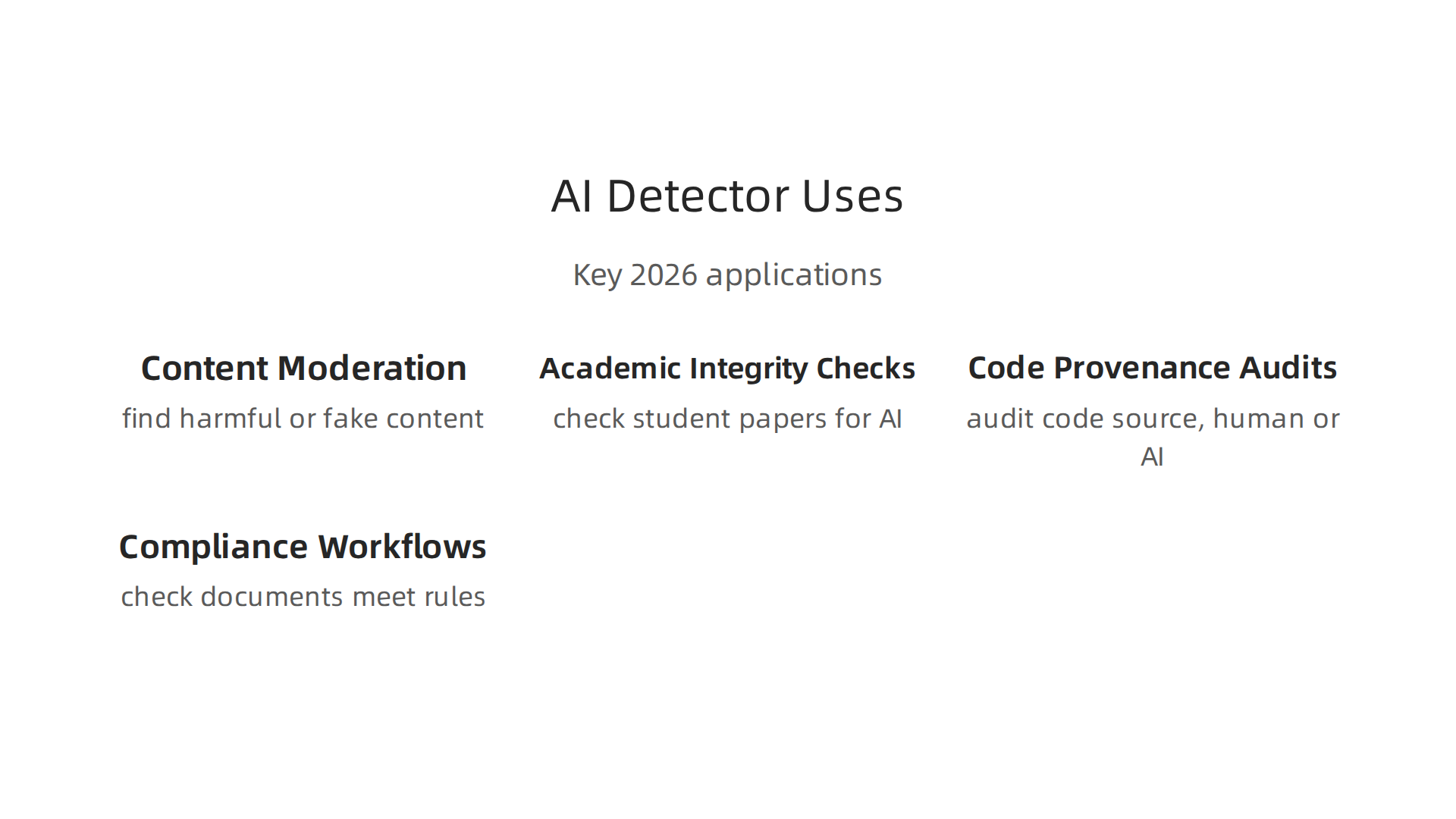
- Content Moderation: On social media and online forums, tons of new posts show up every second. AI detectors help find harmful or fake content quickly, making these online places safer for everyone. They flag things that might go against community rules, helping human moderators decide what stays and what goes.
- Academic Integrity Checks: Schools and colleges use these tools to check student papers. This helps ensure that students are doing their own work and learning properly, rather than simply turning in AI-generated essays. This helps keep learning fair for all.
- Code Provenance Audits: In the world of computer programming, AI can now write code. Tools like an "AI foundry" can create new programs. But it’s important to know where that code came from. Was it written by a human or an AI? AI detectors can help audit code, making sure businesses understand its source. This is vital for trust and quality, especially for complex projects or new apps like the
grok app. - Compliance Workflows: Many industries have strict rules they must follow. AI detectors help companies check if their documents, reports, or communications meet these important rules. This helps prevent mistakes and keeps businesses in line with laws and standards. For example, AI governance tools help manage these rules for AI systems themselves AI governance tools: Selection and security guide for 2026. This helps make sure AI is used safely and fairly, which is a big topic in 2026.
Making AI Detection Even Better
For the best results, even the "most accurate AI detector" should not work alone. The smartest way to use these tools is to combine them with human checks and clear rules.
Imagine an AI detector flags a student’s essay. Instead of just failing the student, a teacher would review it. They’d look at the detector’s findings, but also use their own judgment and talk to the student. This mix of AI and human thinking helps avoid false alarms and makes sure decisions are fair. It’s about using technology to help people, not replace them. When it comes to managing how AI is used and making sure it follows rules, combining automated tools with human oversight is key for success. You can learn more about how tools and workflows are shaped by software innovation when thinking about these processes drive software innovation with strategic research and development.
Choosing the right AI detector for your team is a big step, especially in 2026, when so many new tools are available. You want to pick one that fits well with how your team already works. It’s not just about finding the "most accurate AI detector" but also about how easy it is to use and how it helps your team make smarter choices.
Selecting the Right Detector for Your Team
Before you pick an AI detector, it’s smart to think about a few key things. This helps you find the tool that will truly help, not just add more work.
- How Good is It? (Evaluation Criteria)
You need to know how well the detector actually works. Can it spot different kinds of AI writing? How often does it make mistakes, like saying human writing is AI, or missing AI writing? Also, think about how simple it is for your team to understand and use. A good tool is one that people actually want to use. - How Will You Use It? (Deployment Modes)
Some detectors are online tools you log into, while others might be programs you install on your own computers. Some can even connect directly to your own apps using an API, which is like a special link for programs to talk to each other. Think about what works best for your team’s setup. Do you need it built into your existing tools, or is a simple website enough? - How Fast and How Much? (Latency and Cost)
A detector needs to be quick, especially if you have a lot of content to check. Nobody wants to wait a long time. Also, consider the cost. Prices can be very different, so find one that fits your budget without giving up on quality. - Keeping Things Safe and Legal (Privacy and Regulatory Constraints)
This is super important. The detector you pick must keep your information safe and private. It also needs to follow rules and laws, like the EU AI Act, which is becoming very important for how companies use AI in 2026. Making sure your AI tools follow these rules is part of good AI data governance, which helps ensure fairness and trust in AI systems. You can learn more in this AI Data Governance in 2026: Guide for Engineering Leaders.
Integrating Your New AI Detector
Once you’ve picked an AI detector, the next step is to bring it into your team’s daily work smoothly.
- Try It Out (Testing)
Don’t just launch it for everyone at once. Start with a small test group. Let a few people use the detector and give feedback. This helps you catch any problems early and see if it truly helps your team. - Slow and Steady Wins the Race (Staged Rollouts)
After testing, roll out the detector to more people a little at a time. This way, if any issues pop up, they affect only a small part of your team, making them easier to fix. - Watch It Work (Monitoring)
Keep an eye on how well the detector performs over time. Is it still accurate? Is it helping your team work better? Just like you’d monitor other important systems, it’s good to keep track of your AI tools to avoid problems. Getting good at this kind of monitoring can help avoid bigger issues down the road. - People Still Matter (Human-in-the-Loop Fallbacks)
Remember, even the most accurate AI detector is a tool to assist people, not replace them. Always have a plan for when the detector flags something. A human should review those flags, use their own judgment, and make the final decision. This helps prevent mistakes and ensures fair outcomes.
To stay ahead in the fast-moving world of AI and software development, you’ll need reliable information. Get clear daily AI updates from The AI Newsletter Worth Reading.
Summary
This article explains why reliable AI detection matters in 2026 and guides engineering and product teams through the tools, methods, and trade-offs for identifying synthetic content. It covers how detection evolved from simple heuristics to statistical classifiers, watermarking, and model fingerprinting, and explains metadata analysis as an auxiliary signal. The guide also describes key performance metrics—precision, recall, F1 and AUC—while highlighting how dataset bias and lack of standardized benchmarks can mislead claims of accuracy. It reviews common failure modes, adversarial attacks, and practical uses like content moderation, academic integrity checks, code provenance audits and compliance workflows. Finally, the article gives actionable advice on choosing, integrating, and operating detectors—emphasizing staged rollouts, human-in-the-loop reviews, monitoring, and privacy/regulatory concerns so teams can pick tools that actually fit their workflows.