
How to Evaluate Quantum Computing Companies for Your Software Stack
· 18 min read

Introduction: The Quantum-AI Tipping Point
You have probably felt it. That nagging feeling that something big is happening in tech, but you cannot quite tell what is real and what is just hype.

Every day brings new headlines about quantum breakthroughs and AI tools that promise to change everything. The noise is deafening.
Here is the thing. We are not just talking about the future anymore. We are living in it. 2026 marks a real turning point. Research shows that the first computer capable of achieving quantum advantage is expected to hit the market this year, and companies realize they will soon be in a race to adopt this technology. That is not a prediction from a far-off decade. That is happening now.
So how do you separate the signal from the noise? How do you know which quantum computing companies are ready for real work and which ones are still years away from being useful? The truth is, most software teams do not have a clear answer. A recent survey of quantum computing companies lists 76 major players driving innovation, but only a handful of those are truly production-ready. The talent gap is real. There is a shortage of skilled quantum engineers and developers who can actually build with these tools.
This is where this article comes in. We are going to cut through the hype and give you a clear framework for evaluating quantum + AI opportunities. You will learn how to spot the difference between experimental projects and platforms you can use today. You will understand how AI overview tools can help you augment code and illuminate code in ways that were not possible even last year. And you will walk away knowing exactly which quantum computing companies deserve your attention.
The goal here is simple. Help you stay ahead without drowning in buzzwords. We will look at real use cases, real platforms, and real strategies you can apply to your modern workflow. No fluff. Just practical guidance for a rapidly changing landscape.
Ready to get clear on quantum computing? Let us start with the basics so you can build from there. If you want daily updates on AI and quantum trends delivered straight to your inbox, subscribe to The Deep View for free and never miss what matters.
Understanding the Quantum-AI Convergence in Software
You might think quantum computing and AI are two separate worlds. One lives in physics labs, the other in data centers. But here is the reality: they are starting to work together in ways that could reshape software development.
The core idea is simple. Classical computers use bits that are either 0 or 1. Quantum computers use qubits, which can be 0, 1, or both at the same time thanks to superposition. And qubits can be entangled, meaning the state of one instantly influences another, no matter the distance. You do not need to be a physicist to get this. Think of it as a new way to explore many possibilities at once instead of checking one path at a time.
Now combine that with AI. When you feed quantum outputs into machine learning models, you get something researchers call Quantum Machine Learning (QML). A 2026 review in IJSRP notes that QML has quickly become one of the leading interdisciplinary fields in computational sciences. The potential is huge. A recent study found that small quantum computers could process massive datasets more efficiently than exponentially larger classical systems. That is not a small improvement. That is a game changer for training AI models.
This convergence creates new opportunities for quantum computing companies that are building platforms you can actually use today. Instead of waiting for perfect error-corrected quantum computers, many of these companies focus on hybrid classical-quantum algorithms. These algorithms split tasks between traditional CPUs and quantum processors, and they are already outperforming classical-only approaches in specific areas like optimization, simulation, and cryptography.
For software developers, this means you do not need to master every qubit detail. What matters is learning how to augment code with quantum-powered insights. Think of it as giving your AI tools a new kind of hardware accelerator. Some teams are already using quantum-enhanced AI to illuminate code by finding patterns that classical methods miss. Others rely on AI overview tools to help them decide when a human or ai approach makes sense.
To stay ahead, start with the fundamentals. Understand how superposition and entanglement enable parallelism. Then explore how hybrid models work. Research from industry leaders like Quantinuum shows that quantum AI and machine learning will look very different from classical AI. The sooner you grasp these basics, the better prepared you will be.
If you want to keep learning without the noise, get free updates from a source that cuts through the hype. Subscribe to The Deep View newsletter and receive daily insights on AI and quantum trends straight to your inbox. It is one of the best ways to stay current without drowning in buzzwords.
Why Software Teams Should Track Quantum Computing Companies Now
The quantum computing market is not a distant promise anymore. It is growing fast. In 2026, the market is valued at around USD 2 billion and is projected to hit over USD 18 billion by 2034, according to Fortune Business Insights. Precedence Research gives a similar forecast, with the market reaching USD 19.44 billion by 2035. These numbers tell you one thing: this is not a niche experiment. It is an industry that is scaling quickly.
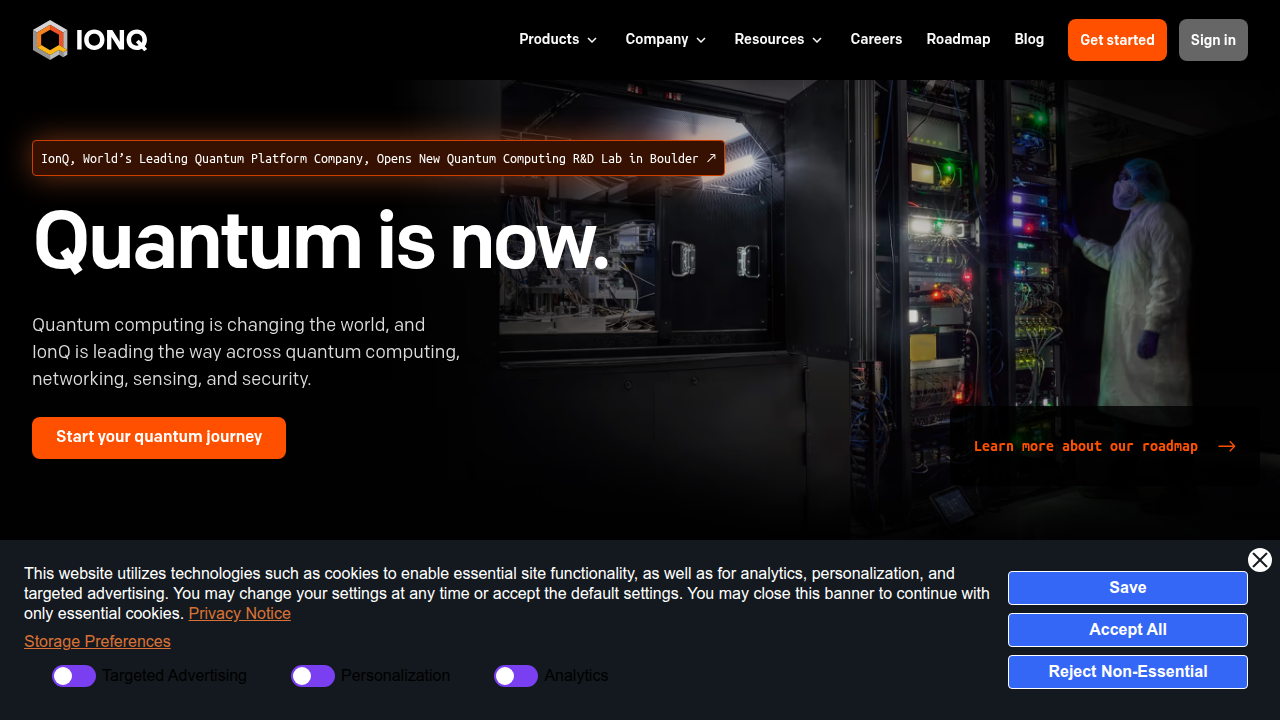
For software teams, the reason to pay attention is simple. Leading quantum computing companies are no longer keeping their hardware locked in labs. They are releasing cloud-accessible processors and developer kits that anyone can use today. Take IBM, IonQ, and Alphabet.
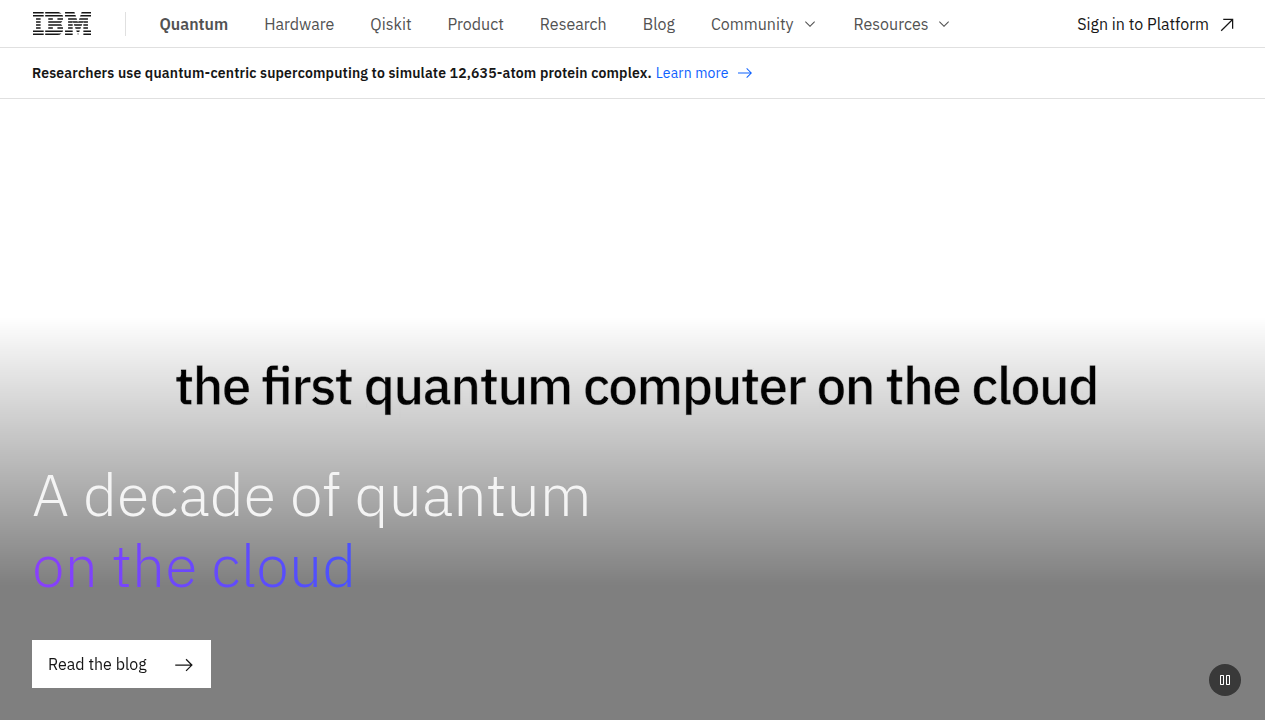
They are pushing technologies that you can access through cloud platforms right now. This lowers the barrier to experimentation. You do not need to own a quantum computer. You just need an API key and a willingness to learn.
The vendor landscape includes over 76 major players as of 2026, as tracked by The Quantum Insider. That includes companies like Rigetti, Xanadu, Quantinuum, and many others. Each one has a different focus. Some are strong on optimization. Others specialize in quantum chemistry or quantum AI. Understanding who does what helps you pick the right partner for your specific use case. It also helps you avoid lock-in. If you build a project around one vendor’s stack and later find out another is better for your needs, switching can be painful. Knowing the landscape early saves time and money.
Strategic partnerships with quantum vendors are becoming a competitive differentiator. Product teams and agencies that experiment with hybrid algorithms now will be ahead when the technology matures.

Some teams are already using quantum-enhanced AI to illuminate code by revealing patterns that classical methods miss. Others rely on an AI overview of the quantum landscape to decide when a human or AI approach makes sense. This is not about replacing classical software. It is about using quantum tools to augment code and solve problems that are too hard for classical computers alone.
Here is the thing: you do not need to become a quantum expert overnight. But tracking the key players gives you a roadmap. You can start small. Pick one cloud-accessible platform, run a simple optimization problem, and see how it feels. The experience will teach you more than any article can. For a deeper understanding of how to approach learning complex new topics, check out this framework on how to grok code with a science-backed method.
The market reports from IDTechEx and others show that quantum computing spending will grow steadily through 2046. The companies that start building quantum awareness now will be the ones that lead later. Whether you work at a startup, an agency, or a large product team, knowing the vendor landscape is a smart career move.
If you want to stay informed without getting lost in technical jargon, Get Free Updates from a newsletter that cuts through the noise. Subscribe to The Deep View for daily insights on AI and quantum trends that matter to developers.
Evaluating the Quantum Landscape: Key Players and Platforms
Alright, you know the top quantum computing companies exist and that they are growing fast. But how do you actually compare them? The landscape can feel messy at first. Different hardware types, different cloud platforms, different programming languages. Let me break it down so you can make informed decisions.
First, understand the three main hardware approaches. Each one has trade-offs:
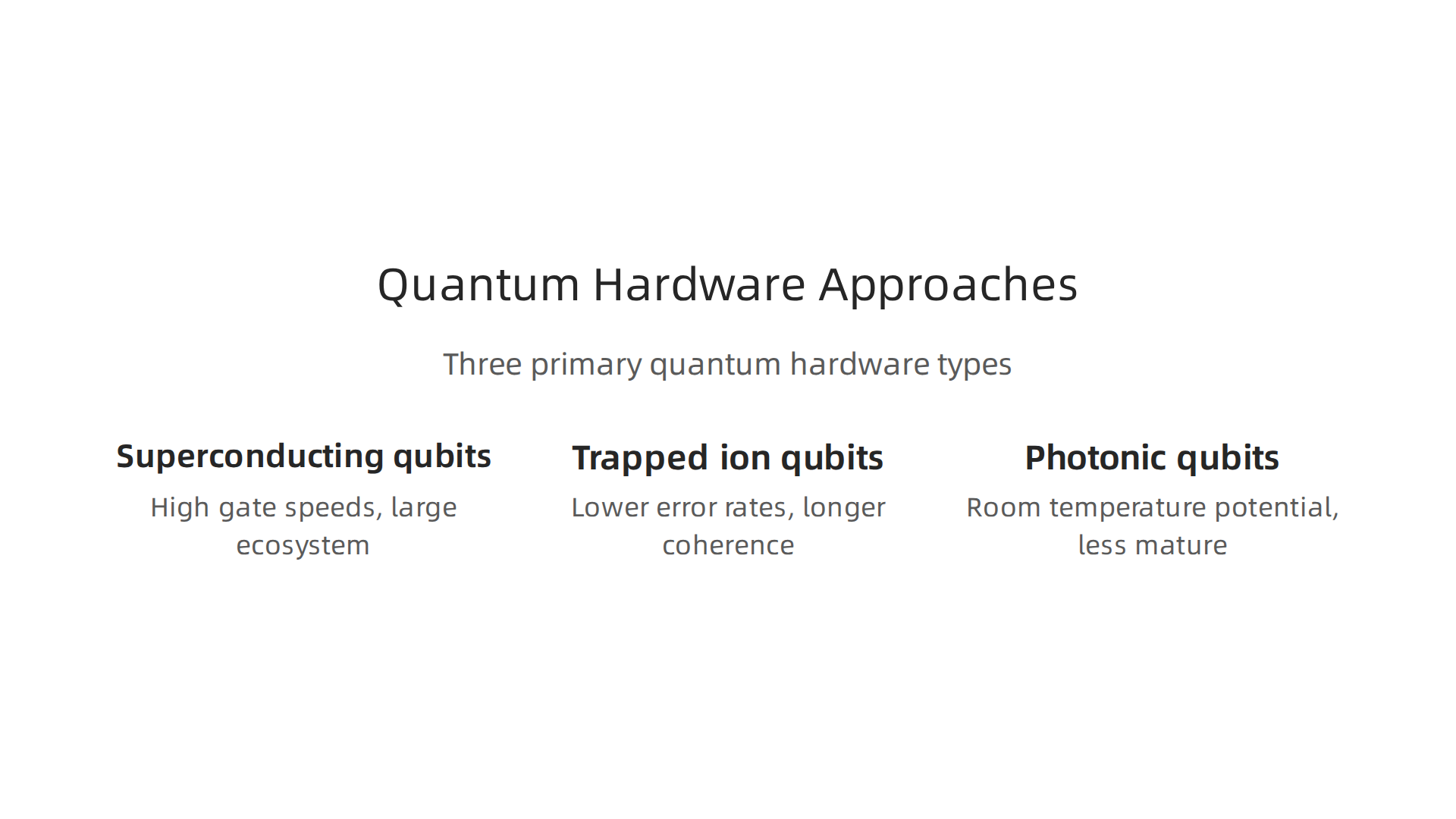
Superconducting qubits use tiny electrical circuits cooled to near absolute zero. IBM and Rigetti lead here. This approach has high gate speeds and a large ecosystem of tools. But it requires massive cooling systems and has higher error rates. Most of the quantum computing companies in this category offer cloud access through their own platforms.
Trapped ion qubits use individual atoms suspended in electromagnetic fields. IonQ and Quantinuum are the big names here.
Trapped ion systems have lower error rates and longer coherence times. That means your calculations stay accurate longer. The trade-off is slower gate speeds and more complex hardware.
Photonic qubits use particles of light. Xanadu and PsiQuantum specialize in this approach. Photonic systems can run at room temperature in theory, which is a big advantage. But the technology is less mature than the other two.
A full breakdown of the current vendor landscape is available from The Quantum Insider, which tracks over 76 major players as of 2026.
Factors That Actually Matter
When you evaluate different quantum computing companies, focus on these concrete factors:
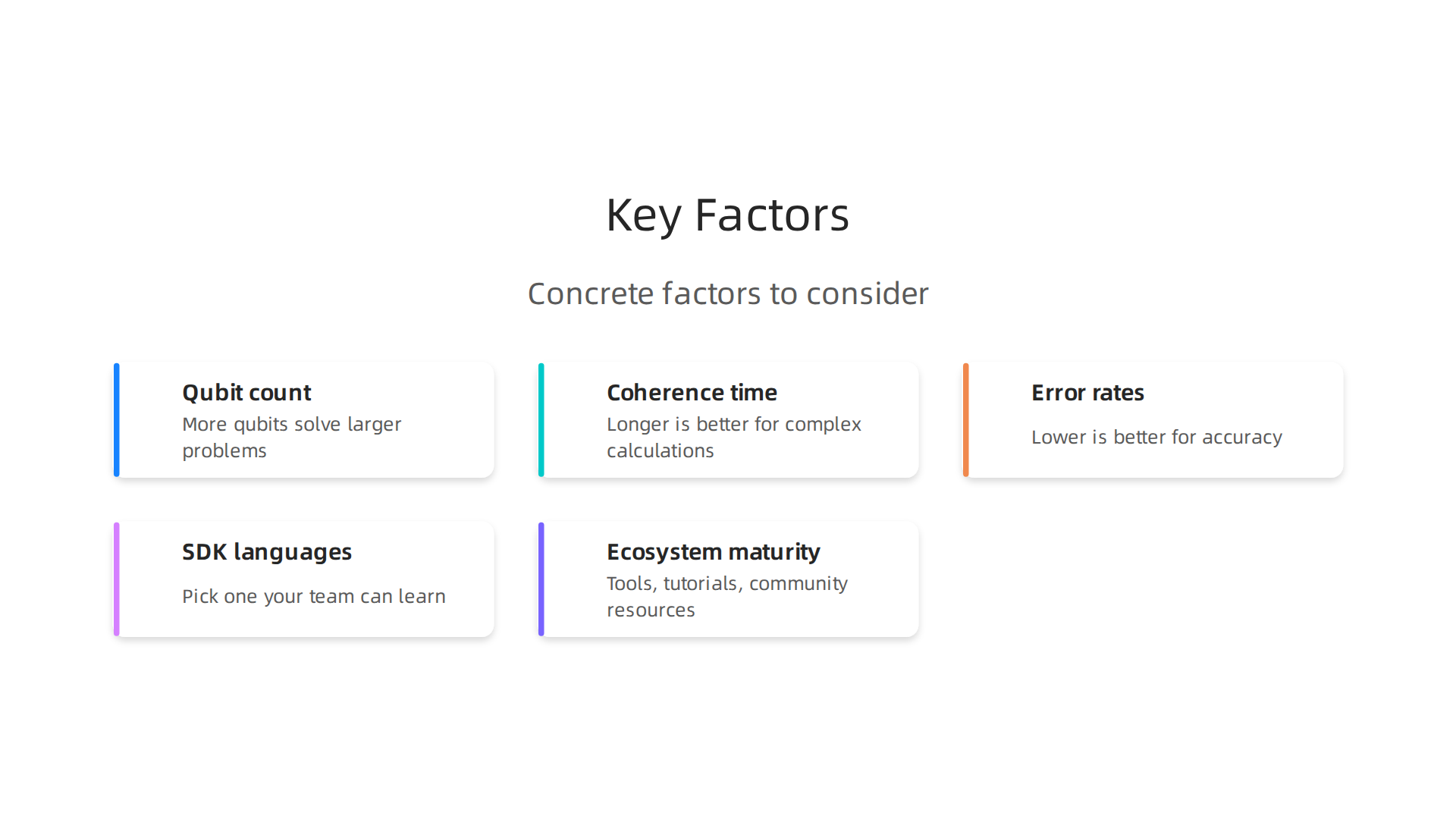
| Factor | Why It Matters |
|---|---|
| Qubit count | More qubits can solve larger problems, but quality matters more than quantity |
| Coherence time | How long qubits stay stable. Longer is better for complex calculations |
| Error rates | Lower is better. Fault tolerance is still a goal, not a reality |
| SDK languages | Qiskit (IBM), Cirq (Alphabet), Q# (Microsoft). Pick one that your team can learn |
| Ecosystem maturity | How many tools, tutorials, and community resources exist |
Most serious options today come with cloud access. You do not need to buy hardware. You just need an API key and a willingness to learn.
Start Prototyping Without Hardware
Here is good news. You can start building quantum skills today without touching a real quantum computer. Open-source emulators and simulators let you run quantum algorithms on classical hardware. Tools like Qiskit Aer and Cirq simulators work on your laptop. They give you a feel for quantum logic without the noise of real qubits.
This is where the concept of augment code becomes practical. You write quantum circuits in Python, simulate them, and combine results with classical algorithms. Your first projects will be small. A simple optimization problem. A random number generator. The goal is to build intuition.
For a deeper understanding of how to grok code with a science-backed method, check out our framework on deep comprehension. It applies directly to learning quantum programming.
Your Next Step
The ai overview of this landscape shows one clear truth: quantum computing companies are not a monolith. Each one has a different focus. Some excel at optimization. Others at chemistry simulation. Still others at quantum AI. Your job as a software team is to find the right fit for your specific use case.
Do not try to learn everything at once. Pick one platform. Run one simple experiment. See how it feels. That hands-on experience will teach you more than reading articles for a month.
If you want to stay informed without drowning in technical jargon, Get Free Updates from a newsletter that cuts through the noise. Subscribe to The Deep View for daily insights on AI and quantum trends that matter to developers.
Advanced AI Techniques Amplified by Quantum Capabilities
Now that you have a handle on the major players and platforms, let us talk about the real reason software teams are paying attention. Quantum computing makes AI dramatically more powerful for certain problems. This is not futuristic hype. It is happening now.
Quantum machine learning, or QML, has become one of the leading interdisciplinary fields in computational sciences. The basic idea is simple. Classical AI models struggle with problems that have huge numbers of variables. Think of analyzing thousands of features in a dataset. A classical model gets lost. A quantum model can explore all those possibilities at once using superposition and entanglement.
A 2026 study found that even small quantum computers could process massive datasets more efficiently than exponentially larger classical systems. This is a big deal for any team working on complex AI problems.
Where Quantum Changes the Game
The most practical area is augment code. You do not throw away your existing machine learning pipelines. You add quantum layers where they help most. Feature mapping. Kernel estimation. Optimization loops. These are the pieces that benefit from quantum speed.
Generative AI models also get a real boost from quantum sampling. Quantum computers are naturally good at generating new data points from probability distributions. Classical methods hit limits here. Quantum methods do not.
This leads to three real world applications you can start exploring today:
- Drug discovery simulations where quantum models explore molecular configurations faster than classical methods
- Quantum enhanced natural language processing that handles complex semantic relationships
- Supply chain optimization where quantum powered models find solutions that classical solvers miss
Major quantum computing companies like Quantinuum have dedicated research teams pushing this forward. Their team states that quantum AI will look a lot different from the classical AI we are used to. And they are right.
The Human Side of Quantum AI
You might wonder where human judgment fits in. Is this a human or ai decision? The answer is both. Quantum models can spot patterns humans miss. They can illuminate code and reveal hidden structures in your data. But humans must decide which problems to tackle and how to interpret findings.
To really understand these advanced techniques, you need the right mental models. Our guide on how to grok code with a science backed framework will help you build the foundation for quantum ML concepts. It applies directly to learning quantum programming.
Your Next Move
The ai overview of quantum AI is clear. This technology is moving toward production use faster than most developers realize. The teams that start learning now will have a serious competitive advantage.
Stay ahead of quantum AI developments without the hype. Get Free Updates from The Deep View Newsletter for daily insights that actually matter to software teams.
Overcoming Integration Challenges: From Noise to Production
You now know how quantum AI can amplify your work. But the road from theory to production is bumpy. Quantum hardware in 2026 is still noisy. Qubits are fragile. These machines are not perfect. They need error correction and special handling. As a recent survey on quantum computing points out, noise remains one of the biggest barriers to practical use (source: TechRxiv survey).
The good news? Many quantum computing companies are building hybrid approaches. You run the heavy parts on classical machines. Then you send only the quantum-friendly steps to a real quantum processor. This is smart. It works today. The first computers capable of real quantum advantage are expected to hit the market this year (source: QuEra press release).
Adapting Your CI/CD Pipeline
Your existing software delivery pipeline needs a tune up. Quantum jobs run asynchronously on remote QPUs. You cannot just compile and run locally. You need to build simulation steps into your test workflows. Then handle the async job submissions and result retrieval. It is a new kind of augment code that sits between your classical app and the quantum backend.
Think of it as adding a new stage to your pipeline. One that calls a quantum simulator for unit tests and a real QPU for final validation. The 2026 Global Industry Challenge highlights exactly these kinds of integration work for high impact sectors (source: PQIC Challenge).
The Talent Gap Is Real
Here is the hardest part. You need people who understand both quantum physics and software engineering. There is a serious shortage of skilled quantum developers right now

(source: SCQuantum talent gap). This is not a human or ai problem. It is a human capacity problem.
The solution is upskilling. Start with the fundamentals. Our guide on how to grok code with a science backed framework can help you build the mental models you need. Then add quantum specific training. Many organizations are running internal bootcamps. The teams that invest early will illuminate code faster than those who wait.
Your Next Move
These challenges are real but temporary. The ai overview of quantum integration is clear. Smart hybrid approaches, updated pipelines, and focused upskilling will get your team to production. Stay ahead of these changes without drowning in hype.
Subscribe Free to The Deep View Newsletter for daily, practical insights that help software teams navigate the quantum era.
Actionable Roadmap for Development Teams in 2026
You have seen the challenges. Now comes the practical part. How do you actually move forward without wasting time or money? The quantum computing landscape in 2026 is maturing fast. The window to build expertise is open right now. Here is a clear four step roadmap that any development team can follow.
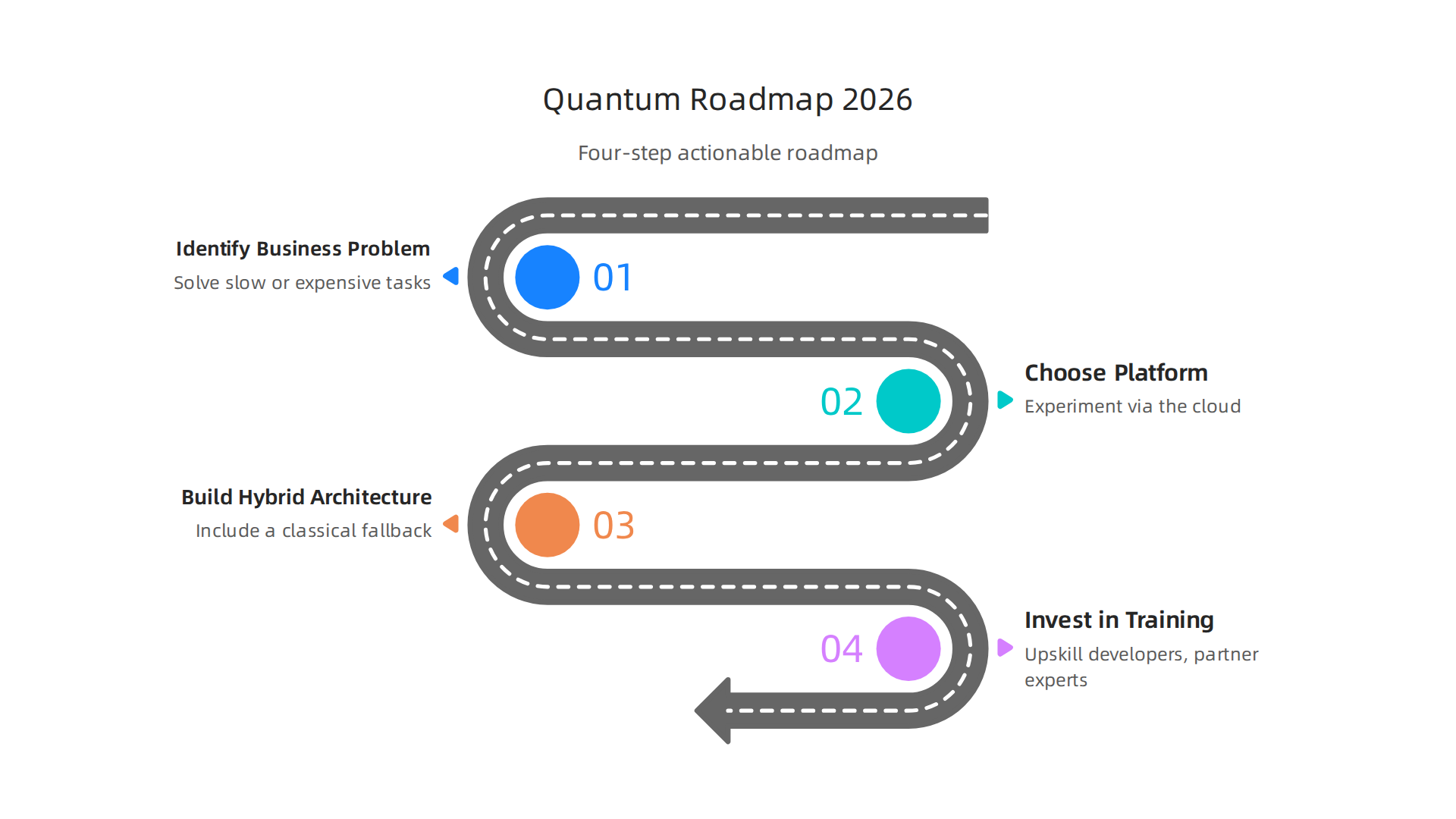
Step 1: Identify a Business Problem Worth Solving
Do not start with the technology. Start with the problem. Ask yourself what tasks in your current stack are painfully slow or expensive. Good candidates are optimization problems, large scale simulations, or machine learning workloads that classical computers struggle with. The SPE Quantum Computing Symposium 2026 emphasizes that teams should first understand quantum fundamentals and then identify pilot ready opportunities in their own operations (source: SPE symposium page). Focus on a single concrete use case. That is your entry point.
Step 2: Choose a Quantum Platform and Experiment via the Cloud
You do not need to buy a quantum computer. Every major quantum computing company now offers cloud access to real hardware and simulators. Pick one platform. Grab their SDK. Write a small proof of concept. Run it against a simulator first, then against a real QPU. This hands on experimentation will illuminate code paths that actually benefit from quantum. It also helps you separate hype from real potential. The 2026 market analysis shows that diversified maturation is happening now, so there is no better time to try (source: Quantum Computing 2026 Leaders and Strategies).
Step 3: Build a Hybrid Architecture with a Classical Fallback
Your production system cannot depend entirely on noisy qubits. Design a hybrid system where the quantum processor handles only the tasks it does best. Everything else stays on classical hardware. This is where you write augment code that bridges your existing services to quantum backends. Always include a classical fallback. If the quantum call fails or takes too long, the system should degrade gracefully, not crash. This layered approach is exactly what the ASC quantum strategy roadmap recommends for mission readiness (source: ASC Quantum Report 2026).
Step 4: Invest in Team Training and Partner with Experts
The talent gap is real, but you can close it internally. Start by upskilling your current developers. Use a structured approach to build deep understanding. Our guide on how to grok code with a science backed framework gives you the mental models to learn any new paradigm, including quantum. Then look beyond your team. Join hackathons run by quantum computing companies. Form partnerships with research labs. The OECD notes that many countries are investing heavily in quantum education and collaboration (source: OECD national strategies overview). If you wait for the perfect hire, you will fall behind. Build the skills you have now.
Do not let this roadmap sit on a shelf. Pick your problem, pick a platform, and start experimenting this week.

For clear, daily guidance on how to navigate the quantum era without the hype, get free updates. Subscribe to The Deep View Newsletter for practical insights that keep your team ahead of the curve.
Summary
This article cuts through the hype to give software teams a practical framework for evaluating quantum computing companies and adopting quantum‑augmented AI today. It explains the core quantum concepts developers need (superposition, entanglement, qubits), the three main hardware approaches (superconducting, trapped‑ion, photonic), and which vendor strengths to watch. You’ll learn how hybrid classical‑quantum algorithms work, where quantum actually helps AI (optimization, simulation, sampling), and how to prototype without buying hardware using simulators and cloud APIs. The piece also addresses real engineering challenges—noise, async QPU jobs, and CI/CD changes—and the current talent shortage, offering concrete upskilling and partnership strategies. Finally, it provides a four‑step roadmap: pick a business problem, choose a platform, build a hybrid architecture with fallbacks, and invest in training, so teams can start practical experiments this week and move toward production readiness.