
Coding for Kids Game Based Learning That Builds Real Skills
· 19 min read

Introduction
You want your child to learn coding. That makes sense. The world runs on software, and kids who start early get a huge head start. But here is the thing: the choices can feel overwhelming.
In 2026, the online coding for kids market is worth over $6.51 billion and is expected to nearly double by 2030, growing at more than 20% each year, according to a recent market report. Major initiatives like the UNESCO-CODEMAO Youth Coding Initiative are bringing programming skills to kids across Africa and Asia. Meanwhile, global organizations such as Code.org offer free K-12 computer science curricula, and groups like JetBrains host free competitive coding clubs for high schoolers. From Code Ninjas physical dojos to AI-powered tutors and platforms like CodaKid, the landscape is packed.
So where do you start? How do you know which program actually builds real skills versus just keeping kids busy?
This article cuts through the noise. We look at what works based on evidence, not hype. We explore how Code Ninjas fits into the bigger picture of computer science education, what to look for in an online learning platform, and how these early steps can lead to serious paths like a software developer apprenticeship or a job as an entry level software developer down the road.
If you want to understand the logic behind modern coding education, you may also find our deeper dive on how to learn code using a science-backed framework helpful. It explains the mental models that make new skills stick.
We are here to guide you, not sell you. By the end, you will have a clear, practical roadmap for your child’s coding journey. Ready to get started?
[Get Free Updates] from The Deep View Newsletter for simple daily insights on AI, coding, and tech trends that affect how kids learn today.
The State of Code Education for Youth in 2026
The coding world for kids has changed fast. Let’s look at where things stand in 2026.
The numbers tell a big story. The online coding for kids market hit $6.51 billion this year, and experts expect it to nearly double by 2030
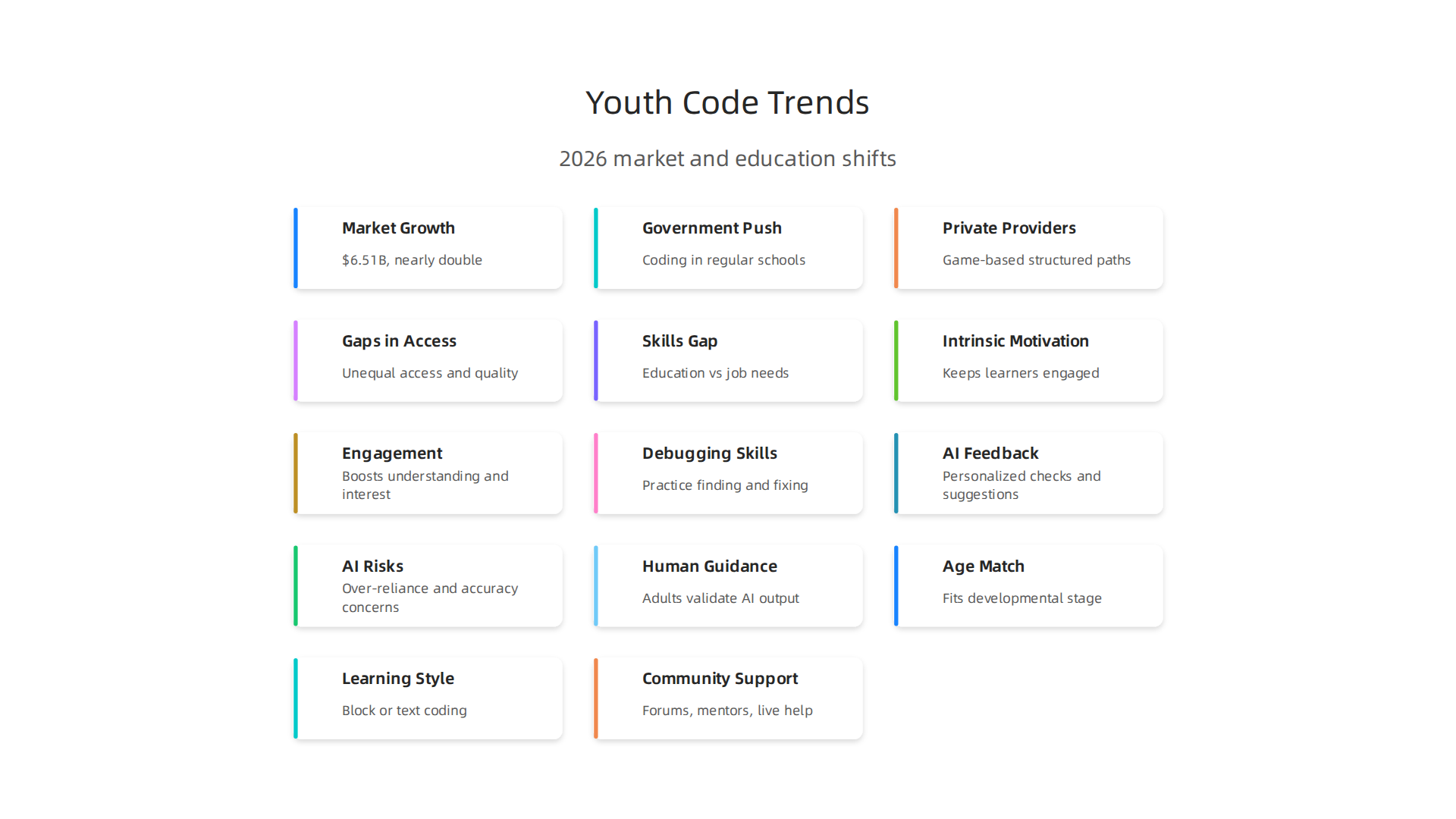
according to the Online Coding for Kids Market Report 2026. That growth is not random. Countries are pushing hard to make coding part of regular school learning.
Governments are stepping up in a real way. The UNESCO-CODEMAO Youth Coding Initiative is bringing programming skills to young people and teachers across Africa and Asia. In the United States, free programs like Code.org offer complete K-12 computer science curricula for any school or family. Even companies are pitching in. JetBrains runs a free Youth Coding Club for high schoolers who want to try competitive programming.
Private providers have grown a lot too. Places like Code Ninjas have expanded worldwide, offering structured learning paths built around video games. Kids earn belts like in martial arts, which keeps them motivated. The idea works because it turns hard skills into fun challenges.
But here is the real picture: gaps still exist. Not every kid has equal access to quality computer science education. Some online platforms offer flashy games but skip actual learning. According to EU Code Week, coding in 2026 should teach problem-solving and creativity, not just how to copy code. The Algonova blog points out the growing skills gap between what schools teach and what jobs need. That is why choosing the right learning path matters so much.
The tools change fast. AI tools are becoming essential at work, and automation is everywhere, as noted in this 2026 coding roadmap. Kids who start coding early build skills that lead to serious opportunities later, like a software developer apprenticeship or an entry level software developer job.
Understanding how kids learn best helps too. You might find our deeper guide on how to learn code using a science-backed framework useful for seeing the mental models behind real learning.
So the landscape is full of options. But not all of them deliver real skills. The smart move is to look for programs that combine fun with evidence-based teaching.
Want to stay ahead of the trends shaping tech education? Subscribe Free to The Deep View Newsletter for daily insights on AI, coding, and how kids learn in 2026.
How Game-Based Learning Builds Real Coding Skills
So how do you actually get a kid to stick with learning to code? The answer, in 2026, is often the same thing that keeps them glued to a tablet: games. But these aren’t just any games. Platforms like Code Ninjas, Scratch, and Tynker turn programming into a challenge kids actually want to conquer.
Here is what makes game-based learning work so well. Kids don’t learn by memorizing syntax. They learn by playing.
When a child builds a simple game in Scratch or earns a new belt at Code Ninjas, they feel a real sense of progress.

That feeling is called intrinsic motivation. They want to keep going because it feels good, not because someone told them to.
Research backs this up. A 2024 study published by the National Institutes of Health found that game-based learning has a "moderate to large effect" on cognitive skills, motivation, and engagement in young children. Another study from 2025, focused specifically on programming education, showed that game-based approaches improve how well students understand coding concepts and how long they remember them. The key is that games turn abstract ideas like loops and conditionals into something you can see and interact with. When a character moves only after a condition is met, the "if…then" logic clicks.
Let talk about what real skills get built. On Code Ninjas, kids progress through belts, each one teaching a new concept. They start with basic commands and move to loops, variables, and debugging. Debugging is a huge one. When a child’s game breaks, they have to find the error and fix it. That persistence is exactly what an entry level software developer needs later in a professional setting.
This approach works for all ages. Younger kids use drag-and-drop blocks in Scratch to learn sequencing. Older kids move to real text-based coding inside game engines. The same principles apply whether you are eight or twenty eight.
Understanding why these methods work can help you pick the right online learning platform. If you want to go deeper into the science behind how we learn to code, check out this guide on how to learn code using a proven framework.
The world of computer science education keeps changing, but one thing stays the same: kids learn best when they are having fun. And game-based learning delivers that.
Get Free Updates with daily insights on AI, coding education, and the trends shaping 2026. Subscribe to The Deep View Newsletter today.
The Role of AI in Teaching Young Developers
So you have a kid who loves building games with block based coding. They are having fun and learning logic. But what happens when they get stuck on a tricky concept or need help debugging a script that just won’t run? That is where artificial intelligence steps in. In 2026, AI tools are changing how kids learn to code. They act like a patient tutor who never gets tired.
AI coding assistants like ChatGPT and GitHub Copilot were originally built for professionals. But now many online learning platforms are adapting these tools for younger learners.
A child can ask an AI to explain what a "for loop" does or to show them why their code produced an error. The AI gives a clear answer right away. This speeds up learning a lot.
One big benefit is personalized feedback. AI can look at a child’s code and spot where they are making mistakes. It can then suggest fixes and explain why the fix works. According to a 2026 report on AI in education, these systems now analyze student behavior in real time. They understand how fast a student learns, where they struggle, and what kind of practice they need. That kind of one on one attention was once only possible with a human tutor. Now it is built into the software.
AI can also generate endless practice problems. If a child needs more work on conditional statements, the AI creates new challenges on the spot. This keeps the learning fresh and matches the child’s skill level.
But we need to talk about the challenges. The biggest one is over reliance. If a kid gets used to asking AI for every answer, they might not build the problem solving muscles they need. A 2026 article from UNICEF’s Venture Fund even mentions "vibe coding" where people just tell an AI what to build without understanding the code underneath. That is fine for fun projects, but it won’t help someone become a skilled software developer.
Accuracy is another concern. AI tools can sometimes give wrong answers or suggest code that has hidden bugs. A young learner might not catch those mistakes. That is why human guidance still matters. A parent, teacher, or mentor should be in the loop to check the AI’s work and help the child think critically.
For parents looking to introduce AI in a healthy way, there are now great resources like Code.org’s AI education materials. They teach kids not just how to use AI but also how it works and what its limits are.
The trick is balance. Use AI as a helper, not a crutch. When a child learns to code with AI support and also practices debugging on their own, they build real skills. To go deeper on a proven method for learning code step by step, check out this science-backed framework for deep comprehension.
The future of computer science education includes AI, but the learner still needs to put in the effort. When done right, AI makes that effort more rewarding.
Get Free Updates with daily insights on AI, coding education, and the trends shaping 2026. Subscribe to The Deep View Newsletter today.
Choosing the Right Platform: A Practical Framework
With so many online learning platforms out there, picking the right one for your child can feel overwhelming. Do you go with block based coding or jump straight into text? Should you pay for a full course or start free? In 2026, the options keep growing.
The right choice depends on your child’s age, learning style, and your goals. Let me give you a simple framework to cut through the noise. Focus on these key criteria:
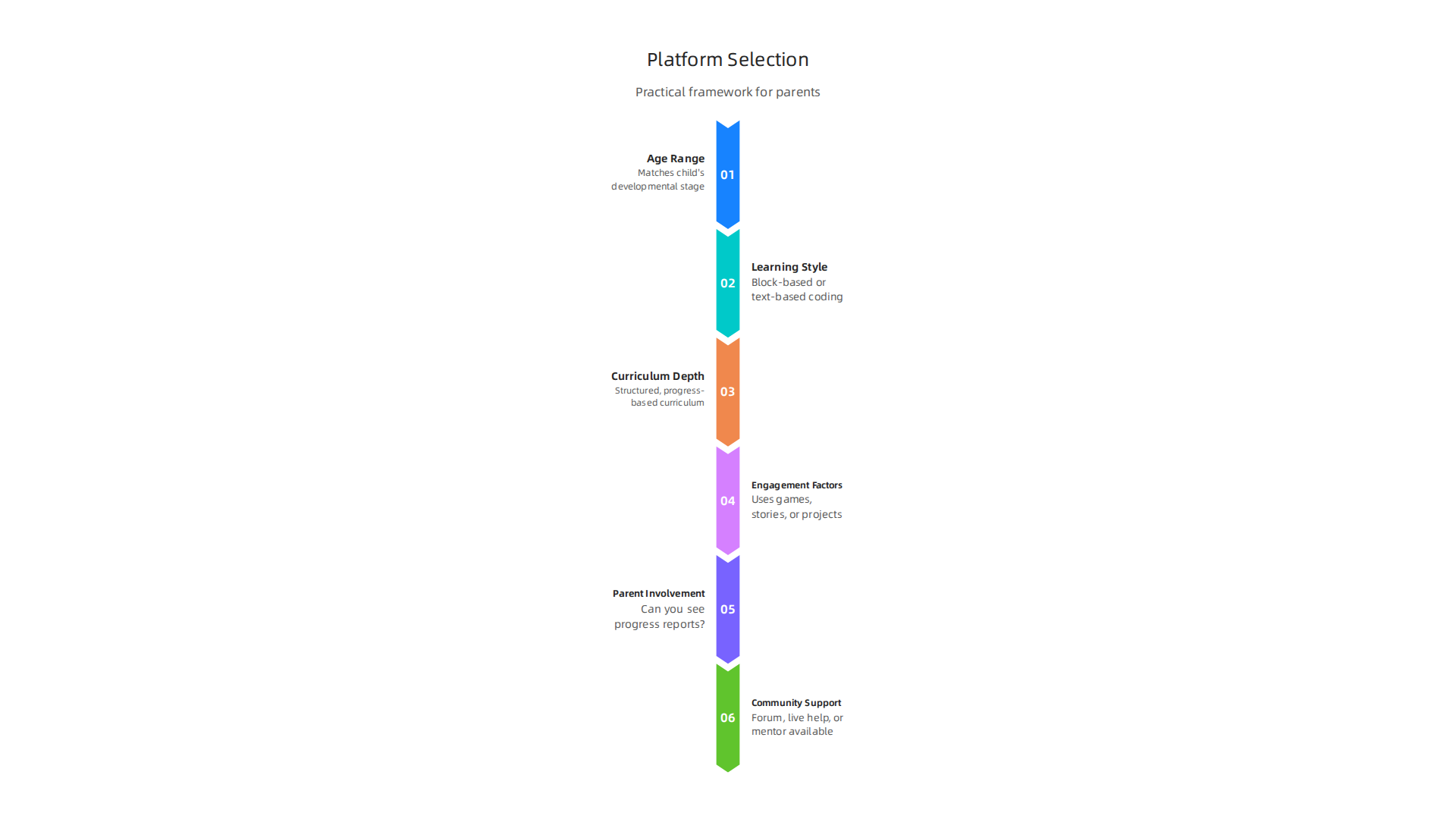
- Age range: Does the platform match your child’s developmental stage? Young kids (5 7) do best with visual, drag and drop tools. Older kids and teens can handle typed code.
- Learning style: Block based (like Scratch) or text based (like Python)? Many platforms offer both, switching from blocks to text as the child grows.
- Curriculum depth: Look for a structured, progress based curriculum. According to a 2025 article from Best Brains, many programs claim to teach coding but do not follow a clear learning path. You want a sequence that builds skills step by step.
- Engagement: Does the program use games, stories, or projects? Kids learn faster when they are having fun.
- Parent involvement: Can you see progress reports? Do you need to sit with them, or can they work independently?
- Community and support: Is there a forum, live help, or mentor? This matters especially when AI tutors are still imperfect.
The Complete Guide to Kids Coding Classes in 2026 from Breakout Mentors offers a great overview of popular platforms and what they offer.
Another helpful resource is the comparison site Top10codingcourses.com, which lets you stack different kids coding courses side by side.
To make things concrete, here is a quick comparison of some well known options:
| Platform | Best For | Coding Style | Cost | AI Support |
|---|---|---|---|---|
| Scratch Jr. | Ages 5 7 | Block based (simple) | Free | No AI |
| CodeSpark | Ages 5 9 | Block based (puzzle) | Paid | Built in hints |
| Kodable | Ages 4 10 | Block based to text | Paid | Yes, basic |
| Code Ninjas | Ages 7 14 | Block then text | Paid, per session | Optional |
| Create & Learn | Ages 8+ | Text (Python, Java, AI) | Paid | AI tutor |
The Stack Overflow blog reviewed three apps (Scratch Jr., CodeSpark, and Kodable) and found that each works well for different ages and goals. The key is to match the tool to your child’s readiness.
Once you pick a platform, help your child build real understanding, not just follow steps. A great next step is this science-backed framework for deep comprehension. It shows how to move beyond surface learning to truly grok code.
Remember, the best platform is the one your child will actually use. Most offer free trials. Test a few, sit with them, and see which one sparks their curiosity. That is the real secret.
For clear daily updates on coding education and AI trends in 2026, get free updates from The Deep View Newsletter. It helps you stay informed so you can make smart choices for your young developer.
Overcoming Common Challenges in Code Education
Let’s be honest. Learning to code is hard. Even with a great platform like Code Ninjas or Scratch, kids hit a wall. Syntax errors feel personal. Abstract concepts like loops or conditionals just do not click at first. This frustration is public enemy number one in computer science education. Many give up right before they would have had a breakthrough.
So how do we push past this? Research consistently points to one powerful tool: game-based learning. A 2026 review of studies on game-based learning in programming education found it significantly boosts engagement and learning outcomes. Another study, published by the NIH, showed that game-based learning has a "moderate to large effect on cognitive, social, emotional, motivation, and engagement outcomes." Why? Because games lower the stakes. Failing in a game means trying a new strategy, not getting a bad grade. This builds resilience, a core trait for any future entry level software developer. Platforms that make coding feel like a puzzle or an adventure turn the abstract into something concrete and the frustrating into something fun.
The second big challenge is the lack of consistent practice and feedback. Coding alone in a room is a great way to burn out. This is where peer collaboration comes in. When students work together, they talk through problems, explain concepts to each other, and learn that everyone struggles sometimes. Group projects, pair programming, or even a simple forum where they can ask questions turns coding from a solitary grind into a shared journey. This mirrors the real software developer apprenticeship model, where juniors learn directly from seniors. A study in the eLearning Industry found that gamification enhances engagement and retention in learning environments, especially when combined with social interaction.
The best platforms in 2026 use a mix of game-based lessons, structured challenges, and community support to fight frustration and dropout. If you are guiding a young coder, look for these elements.
Want to stay ahead of the latest tools and strategies shaping how kids learn to code in 2026? Get clear daily updates from The Deep View Newsletter. It breaks down complex trends so you can make the smartest choices for your young developer.
Expert Tips for Parents and Mentors
You want to help, but you are not sure where to start. That is totally normal. The best thing you can do is step back and let your child lead the way.
Let interest guide the path. Instead of forcing a strict curriculum, let your young coder explore what excites them. Does your child love Minecraft? That is a perfect entry point into coding mods. Are they obsessed with storytelling? Try tools that build interactive narratives. The global market for online coding for kids is growing fast because smart platforms now focus on what kids actually want to make. When coding connects to a real passion, motivation comes naturally. You do not need to be a tech expert. Just ask questions like "What would you build if you could code anything?"
Pair coding with creative projects. This is where the magic happens. Building a simple animation, designing a level in a game, or creating a chatbot makes abstract concepts concrete. A 2026 guide to best coding courses for kids highlights that project-based learning keeps kids engaged far longer than isolated exercises. The same principle applies to AI. Platforms like Code.org let kids experiment with AI in hands-on ways. When they see their code come to life as a moving character or a responsive quiz, that is when the lightbulb turns on.
Find community beyond the screen. Learning to code alone at home gets lonely fast. Local coding clubs, library programs, and summer camps offer something online platforms cannot: real-time collaboration and peer encouragement.

These spaces mirror the software developer apprenticeship model where beginners learn by working alongside others. In 2026, many communities also host "hackathons" for kids. These events teach teamwork, problem-solving, and the thrill of finishing a project together. That shared experience builds confidence that no solo tutorial can match.
The best mentorship is simple. Provide encouragement, find the right tools, and then get out of the way. Let your child tinker, fail, try again, and discover the joy of creating something new.
Want more straightforward guidance on the tools and trends shaping how kids learn tech skills in 2026? Get Free Updates from The Deep View Newsletter. It cuts through the noise so you can focus on what really moves the needle for your young coder.
The Future of Code Ninjas and Beyond
Remember when coding for kids meant just dragging blocks on a screen? Those days are fading fast. Programs like Code Ninjas are evolving to match what the tech world actually looks like in 2026. And the changes are exciting.
AI, VR, and real-world projects are taking over. The old model of learning isolated commands is giving way to immersive experiences. Kids today can build simple AI chatbots, explore virtual reality worlds, and create apps that solve real problems. A 2026 guide to kids coding classes shows that the best programs now blend computer science education with hands-on projects that feel like play. Even entry level software developer skills are being taught through game design and interactive storytelling. The days of boring syntax drills are over.
From youth programs to careers. The big shift in 2026 is the growing connection between after-school coding programs and actual industry pathways. More Code Ninjas-style centers are partnering with tech companies to offer internships and mentorships. This creates a direct bridge from learning to a software developer apprenticeship. When young coders see that their weekend project could lead to a real job, motivation skyrockets. Understanding the science-backed framework for deep comprehension can help both parents and students make the most of these opportunities.
The access problem still needs solving. Not every family can afford a premium coding program. Many free or low-cost online learning platforms exist, like Scratch Jr., Codespark, and Kodable. A review from experienced parents highlights these free apps as a solid starting point. But the best outcomes often come from structured, progress-based curriculums. When choosing any program, look for one that builds skills step by step rather than jumping around. Democratizing access means making high-quality, structured learning affordable and available to all kids, regardless of background.
The future of Code Ninjas and similar programs is bright. They are moving beyond simple coding drills into a world of AI, creativity, and real career connections. The challenge now is to make sure every child can join the ride.
Want to stay ahead of these trends and learn what tools are actually working for young coders? Subscribe Free to The Deep View Newsletter for simple, daily updates on AI and tech education.
Success Stories: Real‑World Impact of Code Education
And when kids actually get structured coding lessons, the results can surprise even the most skeptical parents. The global online coding for kids market is expected to grow from $6.5 billion in 2025 to $32.2 billion by 2035, according to industry reports. That kind of growth doesn’t happen without real, proven outcomes.
Take a 7‑year‑old in a Code Ninjas program who built her first simple game after just eight weeks. Her parents noticed not just the new game but a boost in confidence at school. Stories like hers are everywhere. From free curricula like Code.org to structured after‑school centers, kids as young as 7 are creating games, basic apps, and even simple websites. These aren’t just cute projects. They represent something bigger: a gateway to understanding how technology actually works.
The long‑term benefits go far beyond code. When a child learns to debug a program or design a character’s movement, they pick up problem‑solving skills that carry into math, science, and reading. Teachers report that students who go through structured computer science education often show improved academic confidence. And many start asking about careers in science and technology. That early spark can lead directly to an interest in becoming an entry level software developer one day.
Measuring success takes both stories and numbers. Sure, hearing about a 9‑year‑old building a chatbot is inspiring. But to know if a program truly works, you need hard data too. How many projects did each child complete? Did they move up in difficulty levels? Programs that track completion rates and skill progression give parents clearer answers. One way to make sense of these metrics is to use a science‑backed framework for deep comprehension that helps both teachers and students understand what real mastery looks like.
The bottom line: code education works when it’s structured, progressive, and full of real projects. And the best part? You can see the impact in a child’s eyes when their code finally runs without errors.
Want more stories like these, plus daily updates on what’s actually working in tech education? Subscribe Free to The Deep View Newsletter for simple, practical insights on AI and coding for kids.
Summary
This article guides parents and mentors through the crowded world of kids’ coding education in 2026, showing what actually builds lasting skills instead of just filling time. It explains why game-based learning works, how AI tutors can accelerate progress (and where they fall short), and what to look for when choosing a platform for different ages and goals. The piece offers a simple, evidence-informed framework—age fit, curriculum depth, engagement, and community—to vet options like Code Ninjas, Scratch, and newer AI-enabled tools. It addresses common challenges such as frustration and isolation, and gives practical mentoring tips to keep kids motivated with real projects. Finally, it looks ahead to how after‑school programs are connecting to apprenticeships and careers, and shows how to measure real learning through tracked progress and meaningful projects. After reading, you’ll know how to pick a platform, use AI wisely, support your child, and map coding play into future opportunities.