
Choosing AI Companies: A Technical Guide for Smart Partner Selection in 2026
· 22 min read

It’s 2026, and if you work with technology, you know that artificial intelligence is everywhere. Everyone seems to have a list of the "top 10 AI companies." But for technical teams, these lists can be more confusing than helpful. Why? Because what makes a company "top" often depends on who is asking and what they need.

There’s a huge amount of information out there about different AI companies and their products. This can lead to information overload, making it hard to tell what’s really good from what’s just popular. Many of these lists don’t dig deep into what technical buyers need to know, like how well a generative AI platform actually works, or if a massive AI solution will fit with your existing tools. They often skip important details about security, how easy it is to use, or if the company truly understands your industry needs. This means a generic list of the top 10 AI companies rarely helps you pick the right partner for your specific project.
This guide is different. We know that picking the right AI partner is a big deal for technical teams. You need more than just names; you need real insights. That’s why we’ll show you a clear, step-by-step way to look at AI companies. Our method helps you cut through the noise to find the best fit for your team, whether you’re looking for a nextgen coding company or just better tools for your software development. It’s about using solid facts and a smart approach to make good choices for your business.
Instead of just giving you a list, we will help you learn how to choose. We’ll explore things like important technical details, how well a company’s solution fits your business goals, and how they handle data and security. Many experts agree that using a structured way to evaluate AI vendors is key. For example, some frameworks suggest scoring vendors based on things like their technology, risks, and how ready they are to work with you [1]. This helps you compare different AI providers fairly.
Staying up to date with the fast pace of AI news can be a challenge. If you want clear, daily updates on AI and technology, consider signing up for The AI Newsletter Worth Reading.
Later in this article, we’ll look closely at different kinds of AI providers and the roles they play in today’s tech world, helping you understand how to find the right partners, tools, and team roles for your projects. You can also explore our detailed guide on top AI companies: a 2026 guide to partners, tools, and team roles.
The idea of "top 10 AI companies" is really interesting, but we’ve seen why those simple lists aren’t helpful. What makes an AI company "top" changes a lot depending on what your team actually needs. For technical teams, "top" isn’t about popularity; it’s about fit and function. It’s about how well a company’s tools, like their generative AI platforms, solve your specific problems.
To truly figure out which AI company is best for you, we need to look at them in a smarter way. We should use clear ways to judge them, not just guesses. Experts often suggest using a scorecard system to make fair comparisons, like the structured approach detailed in the AI Vendor Evaluation Framework for 2026: A 30-Point Enterprise Scorecard.
This helps you see beyond the hype.
Here are the main things to look at when you want to rank AI companies:
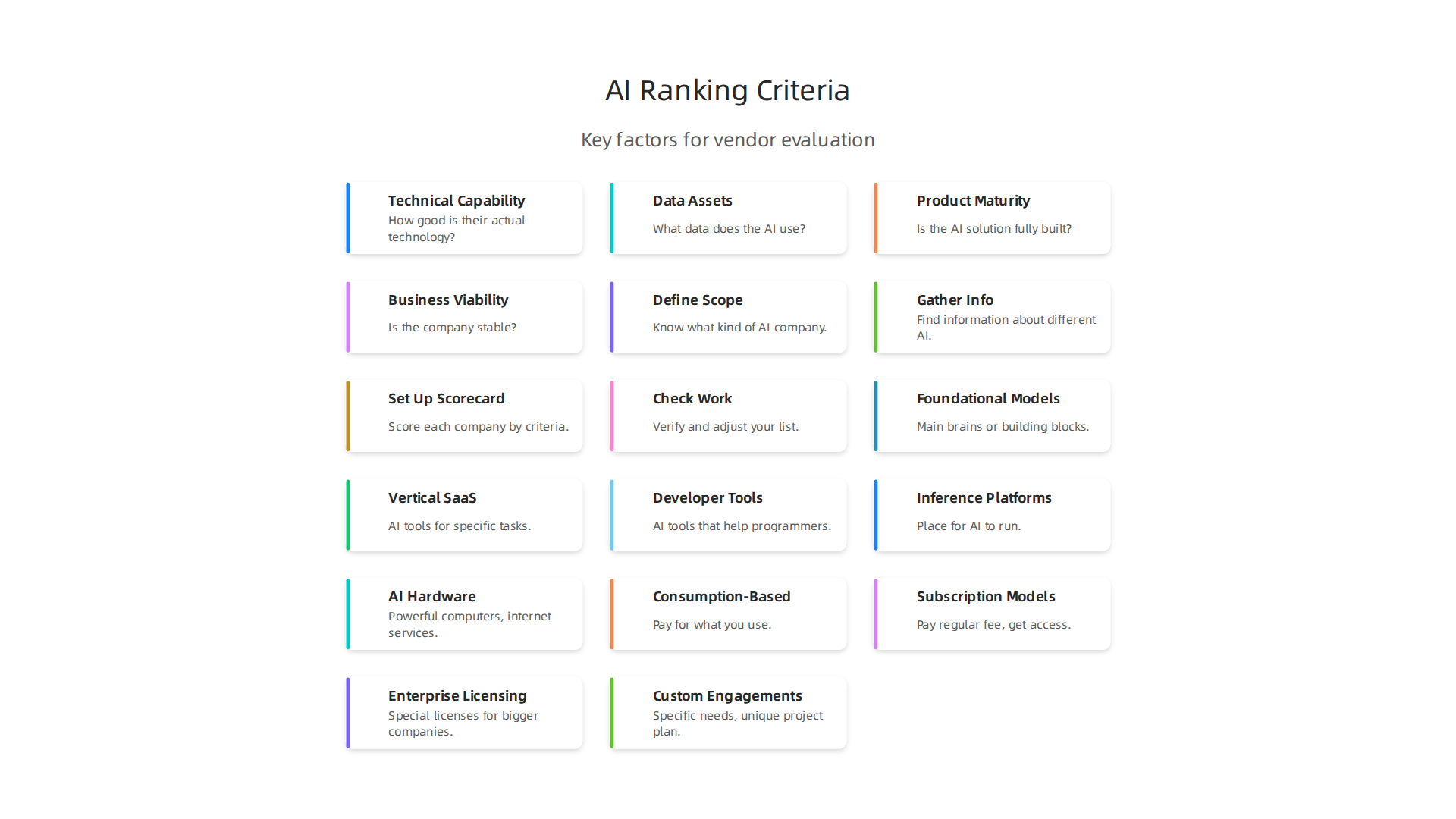
- Technical Capability: How good is their actual technology? Can it do what they say? This means looking at how their AI models work, how well they perform, and if they can handle more work as your needs grow. If you’re looking for a nextgen coding company, you’ll want their tech to be super strong and innovative.
- Data Assets and Practices: What data does the AI use? How do they keep it safe? Do they follow rules about privacy? This is super important because AI often uses a lot of information. Making sure your data is secure and used correctly is key, as highlighted in any good AI Vendor Evaluation Checklist. Learning about AI ethics for software teams can also help you understand these important practices.
- Product Maturity: Is the AI solution fully built and ready to go? Has it been used by many others? Or is it still new and might have some issues? A mature product means fewer surprises for your team.
- Business Viability and Support: Is the company stable? Will they be around for a long time to help you? Do they offer good customer support? Can they grow with your business? This is very important for big projects that need a massive AI solution.
Changing What Matters: Weighting Your Choices
The cool part about this way of thinking is that you can change what you care about most. Not every project needs the same "top" company.
- For a small test (Proof of Concept or POC): You might care more about how quickly you can start and if the basic tech works well for your idea. You might give more points to technical capability and speed of setup. You’re trying to prove an idea, not build a whole new system yet.
- For a big company-wide launch (Enterprise Rollout): Here, you need a different kind of "top." You’ll put more importance on things like security, how well the AI fits with your other tools, long-term support, and how stable the company is. Think about how a company like a well-established Minneapolis software company would evaluate a new vendor for a large project; they’d focus on strong, reliable partners. This kind of project needs a company that can truly be a long-term partner and handle complex needs. For example, experts suggest giving more weight to privacy, model management, and cross-platform consistency for enterprise solutions, as outlined in the Vendor Evaluation Framework for Enterprise Mobile and On-Device AI.
By thinking about these different points and deciding which ones matter most to your project, you can find the truly "top" AI company that fits your unique needs. This way, you’re not just picking from a list; you’re making a smart business choice.
Instead of just taking someone else’s list, you can make your own reliable "top 10 AI companies" list. This way, you pick companies that truly fit what you need, not just popular ones.

It’s like building your own map instead of following someone else’s.
Here is a simple way to build your own list:
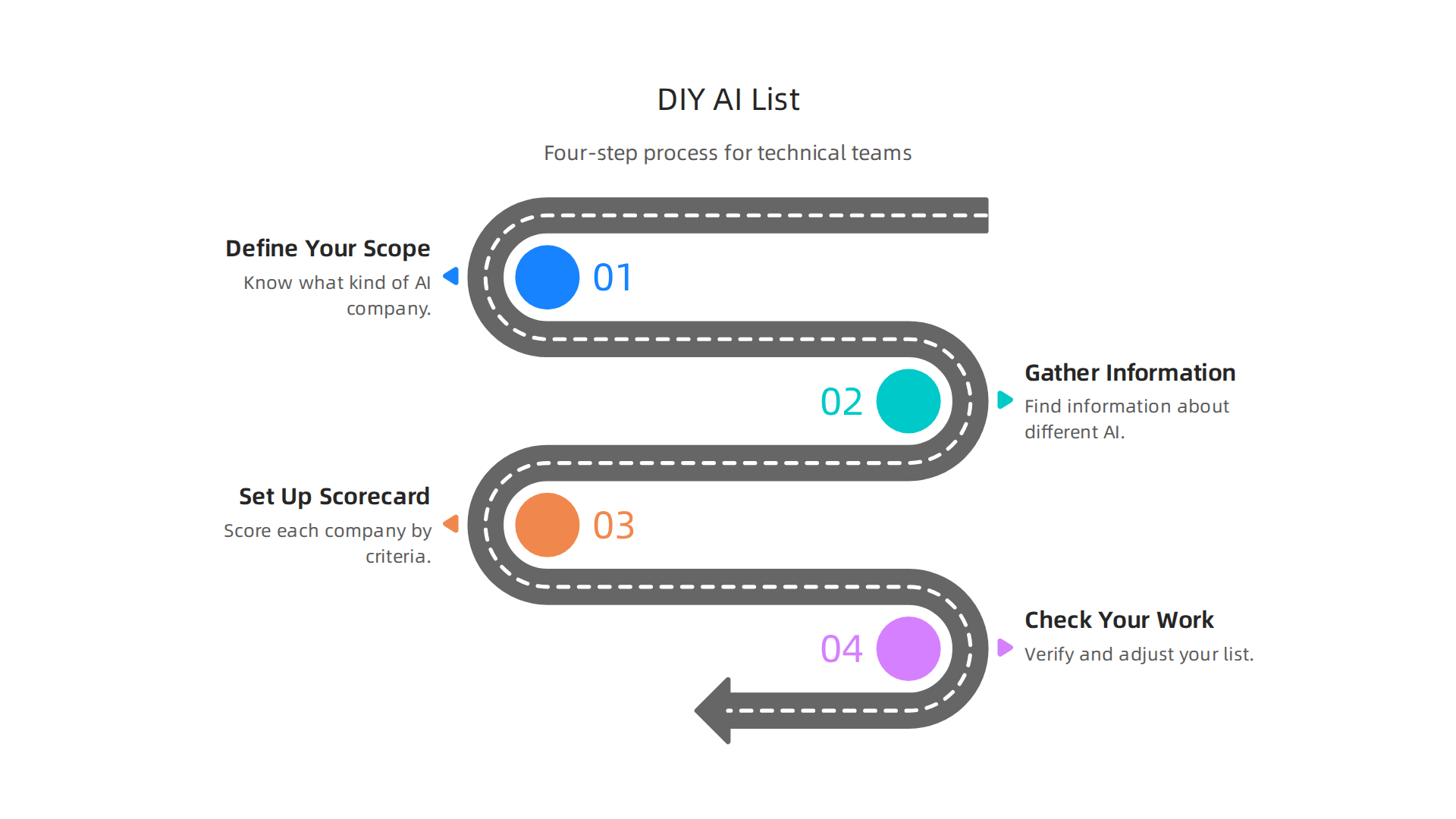
1. Know What You Need (Define Your Scope)
First, think about what kind of AI company you are looking for.
- What problem are you trying to solve? Are you trying to make your coding faster? Do you need a big solution for a whole company?
- What kind of AI tools do you need? Are you looking for generative AI platforms to create new content or a nextgen coding company to help developers?
- What is your budget and timeline? Some projects are small tests, while others are massive AI projects for big businesses.
Knowing your goals helps you only look at companies that are a good match.
2. Gather Your Information (Data Sources)
Next, you need to find information about different AI companies. Don’t just trust one source. Look at a few.
- Industry Reports: Big groups like CB Insights AI 100 2026 or the Forbes AI 50 List 2026 often share lists with their reasons for picking companies.

- Tech Reviews: Check out what other developers and companies say about different AI tools. Sometimes, specialized sites like TLDL’s AI Company Rankings 2026 offer deep dives into many AI companies.
- Company Websites: Look at their case studies, how their products work, and what customers say.
- Expert Opinions: Sometimes you can find good insights from people who really know the AI field, like in the AI Leaderboard 2026 for comparing AI models.
When you’re gathering information, make sure to look for details about the company’s technical abilities, how they handle data, how mature their products are, and how stable their business is.
3. Set Up Your Scorecard (Scoring Rubric)
Remember those four important things we talked about earlier? Technical Capability, Data Assets and Practices, Product Maturity, and Business Viability. Now you’ll use them to score each company.
- Make a simple scorecard: Give each of these areas a score, like 1 to 5.
- Add your own important points: If something specific matters a lot to you (like customer support or how easy it is to use), add that to your scorecard too.
- Weight your scores: This is the most important part. Some things will matter more to you than others.
For example, if you’re a small team building a quick demo, you might give more points to how easy a generative AI platform is to use and how quickly you can start. But if you’re a large Minneapolis software company looking for a massive AI solution to run your whole business, you’d give more points to security, long-term support, and how well the AI works with your other systems. This changes who makes your "top" list dramatically.
4. Check Your Work (Verification and Adjustment)
After you score all the companies, look at your list.
- Does it make sense? Do the top companies really seem like the best fit for your needs?
- Read reviews again: See if what you found matches what others say.
- Talk to others: If possible, get opinions from people on your team.
You might need to adjust your scores or even look for new companies if your first list doesn’t feel right. The goal is to feel confident in your choices. This structured approach helps you go beyond basic "top 10 AI companies" lists and find a true partner for your specific goals.
To stay updated on the fast-changing world of AI and make better choices, you’ll want reliable, daily insights.
The AI Newsletter Worth Reading offers clear daily AI updates from The Deep View Newsletter.
Market Segments: Where Leading AI Companies Stand Out
The world of Artificial Intelligence (AI) is huge, and not all AI companies do the same things. When you are looking for a company, it helps to know which part of the AI market they belong to. This helps you understand why some companies might be great for one need but not another. Actually, the idea of a "top 10 ai companies" list changes a lot depending on what you’re looking for, because different companies shine in different areas. The global AI market is always growing and changing, as noted in the Global Artificial Intelligence Market Report.
Let’s break down the main parts of the AI world:
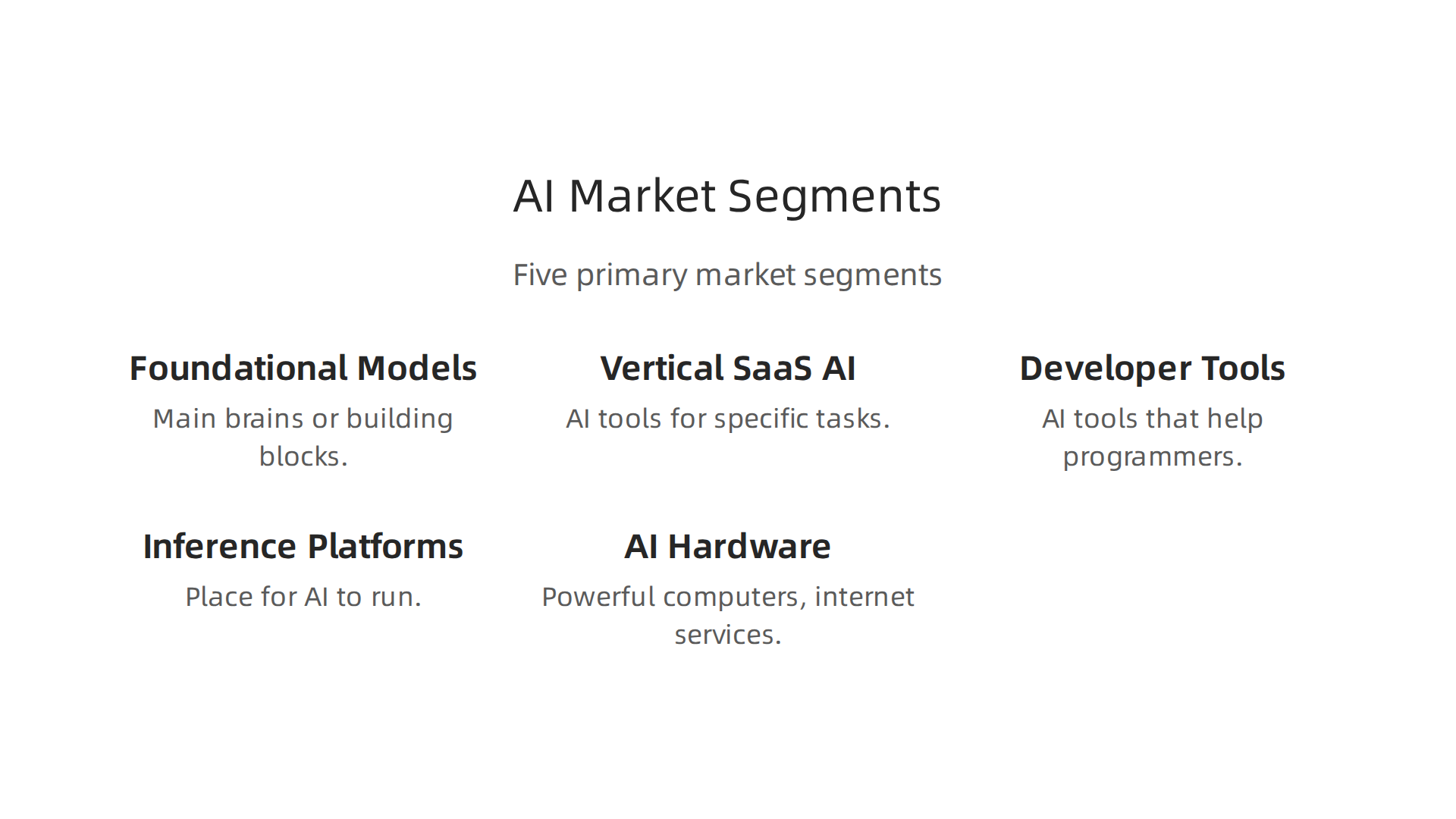
- Foundational Models (or Base AI): Think of these as the main brains or building blocks of AI. They are big AI systems that can do many different things. Large language models (LLMs) are a good example. These companies create the basic technology that other companies then use to build their own AI tools. The 2026 AI Index Report by Stanford HAI often talks about the strong technical performance of these foundational models.
- Vertical SaaS AI (AI for Specific Jobs): "SaaS" means "Software as a Service." These companies make AI tools for very specific tasks or industries. For example, there’s AI just for healthcare, or AI that helps with marketing, or AI for banking. These tools are made to solve problems in one area really well. If you are looking for top SaaS companies that use AI, you’d look here.
- Developer Tools & NextGen Coding Companies: These companies build AI tools that help other computer programmers and developers. They might offer services for AI software development or new ways to write code faster and better. A nextgen coding company focuses on making the work of building software easier for others.
- Inference Platforms: Once an AI model is built, it needs a place to run and do its job. Inference platforms provide these services. They make sure the AI can work quickly and efficiently for many users.
- AI Hardware and Cloud Services: This segment is about the powerful computers and internet services that make AI possible. AI needs a lot of computing power. Companies here provide the special chips and vast cloud networks. The Market Share Of Ai shows that big cloud providers and hardware makers hold much of the influence in this area.
So, when you think about "top 10 ai companies," it’s not just one list. A company known for amazing generative AI platforms that create new content might be a top choice for a creative agency. But for a Minneapolis software company needing a massive AI solution to run their business, they would need a company strong in foundational models or enterprise-specific AI. Your specific needs will always shape your idea of who the "top" companies are.
Finding the right AI partner goes beyond just knowing what kind of AI they offer. To truly pick from the top 10 ai companies, you need to look closely at how mature they are.

This means checking their technical abilities, their products, and how they do business. Think of it like looking under the hood of a car to see how well it’s built and how reliable the company that made it is. Experts note that companies need to evaluate AI vendors very carefully in 2026.
Important Technical Signals
When you check out an AI company’s technical side, you want to see if their AI works well and is dependable.
- Model Benchmarks: This is like a report card for their AI models. It shows how well the AI performs on different tasks. You want to see strong scores, especially for tasks related to what you need. Checking technical performance is key. For example, if you’re looking for generative AI platforms that create new content, you’d want to see how good their AI is at generating text or images.
- Reproducibility: Can the AI always get the same good results every time, or does it sometimes act strangely? Consistent results mean the AI is stable and well-made.
- Documentation: Good companies have clear instructions. Their guides should be easy to understand, showing you how to use their AI tools step by step. This is super important for developers using new systems.
- SDK Quality: An SDK (Software Development Kit) is a set of tools that developers use to build their own software with the AI. A high-quality SDK makes it simple for your team to connect to their AI, making development smoother.
A company’s overall AI readiness assessment often looks at these technical points to ensure the AI can actually deliver on its promises.
Key Business Signals
Beyond the tech, how a company operates tells you a lot about whether they’re a good long-term partner.
- Partnerships: Who else do they work with? If they have strong partners, it can show they are trusted in the industry. It also means they might offer more complete solutions.
- Customer References: What do other customers say about them? Getting feedback from businesses similar to yours can give you a real-world picture of their service and product quality. You can learn how companies evaluate AI vendors based on real outcomes.
- Licensing Flexibility: How easy is it to get and use their software legally? You want clear terms that fit your business model, whether you need a massive AI solution for many users or something smaller.
- SLAs (Service Level Agreements): These are promises about how quickly they will fix problems or keep their service running. Good SLAs give you peace of mind that you’ll get support when you need it. Plus, looking into things like AI ethics for software teams is increasingly important for business signals, showing a company’s commitment to responsible AI.
By looking at both the technical side and the business side, you can make a much smarter choice. This helps you find AI companies that are not just good today but will also be strong partners in the future.
Get clear daily AI updates and stay ahead of the curve with The AI Newsletter Worth Reading.
Once you’ve carefully picked from the many top 10 AI companies, the next big step is to bring their AI services into your existing setup. This part is all about how your developers can actually use the AI. It involves connecting different parts of your system to the AI vendor’s tools.
Practical Ways to Connect AI Vendors
Think about how you’ll make the new AI talk to your old systems. Here are some smart ways that developers are using in 2026:
- SDKs and API Contracts: An SDK is like a ready-made toolbox. It helps your developers use the AI’s features without having to build everything from scratch. API contracts are like clear rules for how your software and the AI software will communicate. Good contracts make sure they understand each other perfectly, which is especially important for complex generative AI platforms that create new content.
- Data Pipelines: For AI to work well, it needs good data. Data pipelines are like special paths that move your information to and from the AI. They make sure the AI gets the right data to learn from and that your systems get the AI’s results back. It’s important to have a solid data strategy for 2026 when setting these up.
- Testing: Just like any other software, AI needs to be tested. You need to check if the AI works correctly when connected to your systems. This means running tests to see if it gives the right answers and doesn’t cause new problems. This is a key part of making sure AI readiness is actually working for you. Many companies are still developing in this area, as shown in the AI Readiness, KPIs & Adoption Data from 121 Teams report from 2026.
- CI/CD for Models: CI/CD stands for Continuous Integration and Continuous Delivery. It’s a way to keep your software always updated and running smoothly. For AI models, this means having a system that automatically updates the AI when new versions or changes are ready. This helps your team quickly deploy new features or fixes from your AI partners. You can learn more about making your code reliable with practices like how to manage line break code for flawless cross-platform software.
Things to Watch Out For
Connecting third-party AI models to your systems can have some tricky parts. Here are pitfalls to avoid:
- Not Planning for Change: AI technology moves fast. What works today might not be the best solution tomorrow. Make sure your setup can be easily changed or updated as your AI vendor improves their models. Planning for flexibility from the start saves headaches later.
- Poor Data Quality: If the data you feed the AI is bad, the AI’s answers will be bad too. This is often called "garbage in, garbage out." Always make sure your data is clean and correct before sending it through the pipelines. You might need strong AI readiness assessments to evaluate your data foundations.
- Security Concerns: When you connect your systems to an outside AI, you’re opening a door. You must make sure that this door is very secure. Protect your data and your users’ privacy. This includes thinking about things like prompt injection, where someone tries to trick the AI, and other security risks. In 2026, companies need to consider AI governance vendor reports to ensure best practices.
By thinking through these practical steps and avoiding common mistakes, your team, whether a small nextgen coding company or a larger firm, can smoothly integrate AI vendors. This helps you get the most out of your AI tools and keep your development workflows efficient.
After your team knows how to connect to new AI tools, the next step is to understand how to buy and pay for these services. This means looking at how different top 10 AI companies charge money and what you should look for in their contracts. It’s like shopping for a new car; you need to know the price and what the warranty covers.
How Companies Charge for AI Services
In 2026, AI is a big and growing market. The way companies pay for AI depends on what they need. Here are the main ways AI vendors charge:
- Consumption-Based Pricing: This is like paying for electricity. You only pay for what you use. If you use a lot of AI processing or send a lot of data, you pay more. If you use less, you pay less. This can be good for small projects or when you’re just starting out with a generative AI platform.
- Subscription Models: With this, you pay a regular fee, usually monthly or yearly. In return, you get access to certain AI features or a set amount of usage. It’s predictable, which helps with budgeting. Many businesses use this for ongoing needs.
- Enterprise Licensing: For bigger companies that need a lot of AI power, especially with massive AI systems, vendors might offer special licenses. These are often custom deals that let a company use the AI across many departments or for very large tasks. These agreements can be complex, fitting specific needs like those of large minneapolis software companies or global firms.
- Custom Engagements: Sometimes, a company needs something very specific that no standard package covers. In these cases, they might work directly with an AI vendor to create a custom solution. This often involves a unique project plan and pricing.
The global AI market is expanding quickly, with strong growth expected in 2026, according to the Global Artificial Intelligence Market Report. This means more options for businesses, but also a need to carefully review costs.
Key Things to Look for in AI Contracts
When you choose an AI vendor, the contract is very important. It sets the rules for your relationship. Don’t just sign without reading. Here are important things to check:
- Data Ownership: Who owns the data you feed into the AI? Who owns the results the AI creates? You want to make sure your company keeps ownership of its own data. This is a big deal for privacy and future use.
- Model Updates: AI models get better over time. How will the vendor update their AI? Will you automatically get the newest versions, or will there be extra costs? Understanding this helps you stay current without unexpected fees. The 2026 AI Index Report highlights how fast AI is changing, making updates crucial.
- Security: How will the AI vendor protect your data? What security measures do they have in place? This is super important to keep your information safe from bad actors. Good security rules in the contract protect your business. You might want to look at how to build AI ethics for software teams into your own practices as well.
- Liability: What happens if the AI makes a mistake that causes problems for your business? Who is responsible? The contract should clearly say who is liable if something goes wrong.
Making smart choices about procurement, contracts, and pricing models will help your company, whether it’s a small startup or a nextgen coding company, get the best value and protection when working with AI vendors.
Ready for more insights on AI and other tech topics?
The AI Newsletter Worth Reading
Get clear daily AI updates from The Deep View Newsletter.
Choosing the right AI vendor is not just about price and features. It’s also about making sure you avoid big risks, follow all the rules, and use AI in a fair way.

After looking at contract details like data ownership and security, it’s time to think about the bigger picture: how AI affects society and what laws you need to follow. This is especially true when picking from the many top 10 AI companies out there today.
Regulatory Angles, Data Governance, and Model Auditability
In 2026, many countries and states have new rules for AI. You need to know these rules when picking an AI partner. For example, the EU AI Act is a major set of rules in Europe.
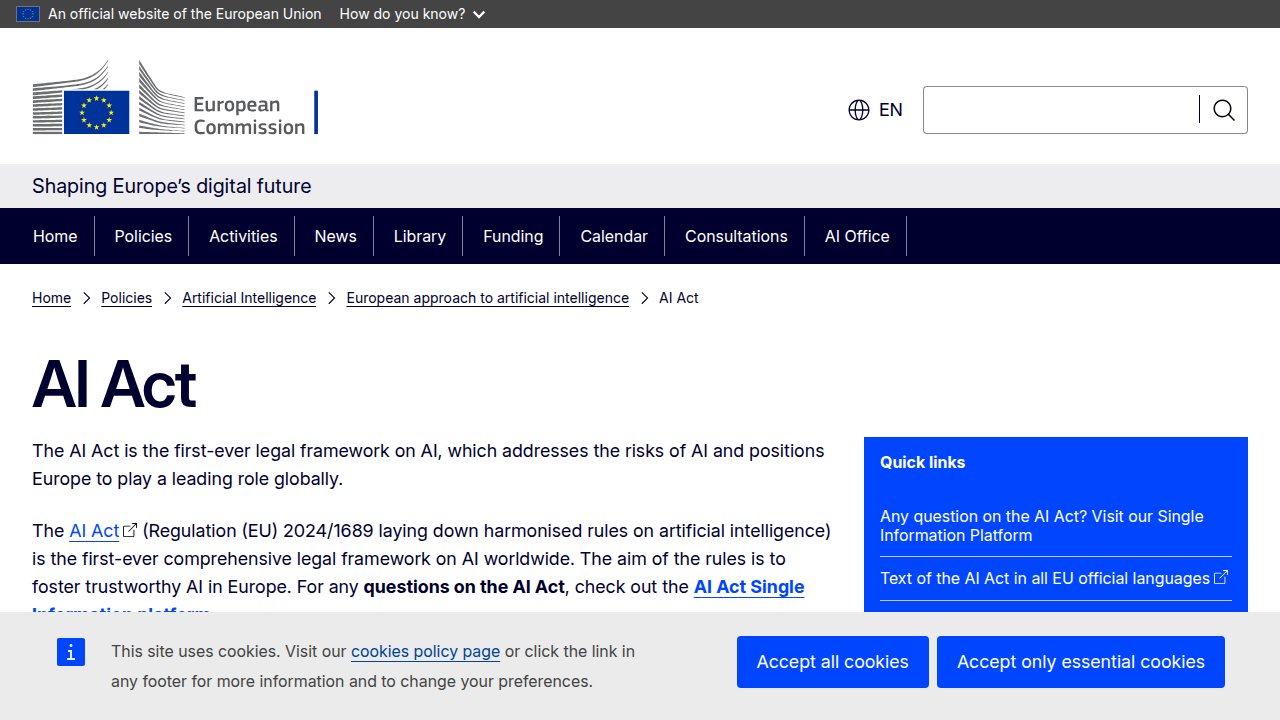
It has strict requirements for AI systems, especially those that are high-risk. These rules started applying in stages, with many main parts fully active by August 2026. Different US states also have their own AI laws, creating a mix of rules that companies need to follow, as explained in a guide to AI regulatory compliance in 2026.
When you use AI, you must know how it uses data. This is called data governance. It’s important to understand:
- Where does the AI get its data?
- How is that data kept safe?
- Can you see how the AI makes decisions? This is called model auditability. It means you can check the AI’s logic to make sure it’s working as expected and not doing anything risky.
Big companies, like even local minneapolis software companies that use massive AI systems, need clear ways to check and understand how their AI models work. Frameworks like the NIST AI Risk Management Framework help companies manage these risks and ensure their AI is trustworthy. You might even want to explore tools to select the most accurate AI detector to help with checking AI outputs.
Ethical Concerns and How to Validate Vendor Practices
Beyond the law, there are ethical concerns. This means thinking about what is fair and right when using AI. For example, does the AI show bias against certain groups of people? Is it used in a way that respects privacy? When choosing a vendor for your generative AI platforms, you must ask how they handle these ethical questions.
You should look for vendors that:
- Have clear policies on ethical AI use.
- Are open about how their AI models are trained and what data they use.
- Can show you how they check their AI for fairness and bias.
Validating vendor practices means going beyond their promises. It’s about asking for proof. You want to make sure the AI you use from a vendor, whether for a startup or a nextgen coding company, helps your business without causing harm or breaking trust. This requires a careful look at their technology and their company culture.
Summary
This article explains why generic