
Mobile App Development Trends 2026 Reshape How Teams Build Software
· 18 min read
Introduction: Why the App Ecosystem Matters More Than Ever
The world of mobile apps is moving faster than ever. In 2026, the global mobile app market is valued at over $200 billion, and experts expect it to grow to around $600 billion by 2033. That is huge growth, and it changes how developers and product teams think about building software.
New technologies like AI, cross-platform tools, and real-time collaboration features are reshaping what users expect from an app. People want smart, fast, and helpful experiences. They want apps that learn from them and adapt. At the same time, developers face a flood of information. It can be tough to know which apps and features actually make a difference.
This is where having a clear guide helps. In this article, we cut through the noise and focus on the most impactful tools and trends shaping software development right now.

We look at what is working, what is growing, and what you should care about in 2026.
For example, Google Play Store app downloads are expected to hit around 143 billion by the end of 2026, according to mobile app development statistics for 2026.
That is a huge number of people downloading and trying new apps. This demand pushes developers to build better, faster, and smarter software.
If you want to stay ahead, understanding the latest mobile app development trends for 2026 is a great place to start.
The ecosystem is not slowing down, and the best time to learn is now.
And if you want to keep up with daily shifts in tech and AI, you might enjoy The AI Newsletter Worth Reading.
It delivers clear, daily updates on the innovations that matter most to developers and product teams.
The State of the App Ecosystem in 2026
The app ecosystem in 2026 is not just big. It is massive. And it keeps getting bigger.
Experts say the global mobile app market is worth about $206.6 billion this year, and it could reach $616.4 billion by 2033, according to Mobile Applications Market Size & Growth Analysis, 2033. That growth is powered by more smartphones, faster 5G networks, and smarter software.
But here is what is changing.
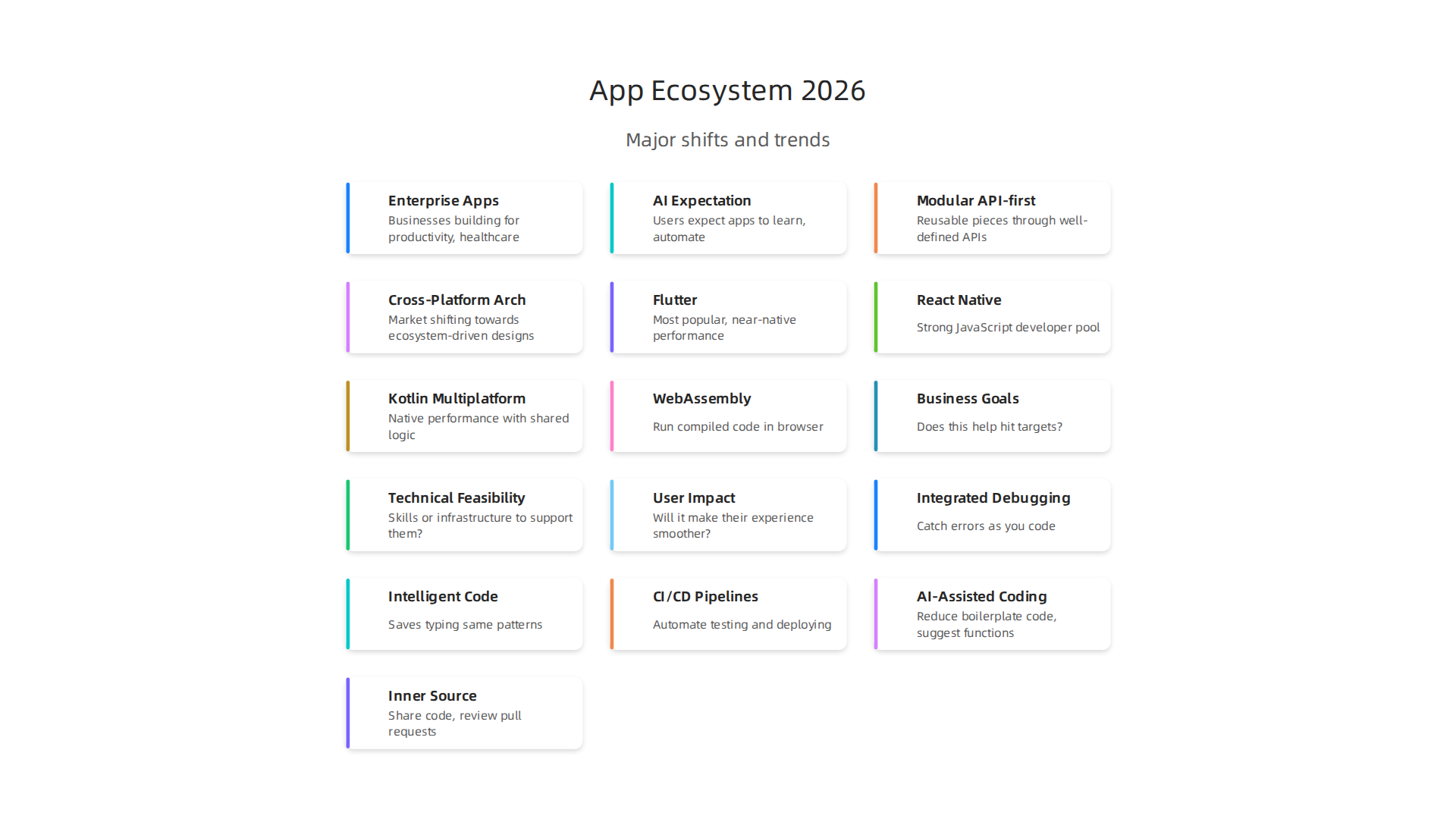
In the past, consumer apps like games and social media drove most of the revenue. Now, enterprise apps are taking the lead. Businesses are building apps for productivity, healthcare, finance, and supply chain management. The Mobile Apps Professional Market Size, Trends, 2026-2033 Forecast shows that enterprise productivity apps are one of the fastest-growing segments in the market.
Another big shift is artificial intelligence. Just a few years ago, AI was a nice-to-have feature. In 2026, it is a baseline expectation. Users expect apps to learn from their behavior, suggest next steps, and automate boring tasks. In fact, 84% of developers are now using or planning to use AI tools in their work, based on app development statistics for 2026. If your app does not use AI, it already feels outdated to many users.
Developers are also changing how they build apps. Instead of building everything from scratch, teams are moving toward modular, API-first designs. This means they use small, reusable pieces of software that connect through well-defined APIs. This approach makes it easier to update features, fix bugs, and scale. The Mobile Application Market Size, Share & Forecast 2036 confirms that the market is shifting toward cross-platform and ecosystem-driven architectures.
If you are planning your next project, it helps to understand these trends. For a deeper look at what actually works when building a new app, check out this guide on startup app development trends for 2026. It covers real strategies that founders and product teams use to succeed in this fast-moving market.
Rise of AI-Powered Features
That trend is not slowing down. In 2026, AI-powered features are the new normal for almost every app. You find them in code editors, customer support chatbots, photo editors, and even fitness trackers.
Embedded AI agents are everywhere. According to the AI Agent Adoption 2026 Enterprise Data Points from Digital Applied, 80% of enterprise applications shipped or updated in Q1 2026 now embed at least one AI agent. That is up from 33% just two years ago. These agents can do anything from answering customer questions to writing code automatically.
Natural language processing and generative AI lead the way. Among all AI capabilities, these two are the most adopted. The AI Adoption Statistics Q1 2026 show that 88% of organizations now use AI in at least one business function. Generative AI specifically is used by 71% of organizations. Common uses include content generation, customer support automation, and personalization.
But AI also raises real concerns. Teams love the speed and cost savings, but data privacy and algorithmic bias worry many decision-makers. And for good reason. A model trained on biased data can produce unfair results. Builders must test their AI features carefully and keep humans in the loop.
If you want to stay up to date on how AI is reshaping software, check out how AI is the new standard for developers in 2026. It explains what developers need to know to thrive in this AI-first world.
And if you want clear daily updates on AI trends straight to your inbox, subscribe to The AI Newsletter Worth Reading. It is a fast way to stay informed without the noise.
Cross-Platform Development Tools
Building an app that works on both iOS and Android used to mean writing two separate codebases. That was slow, expensive, and hard to maintain. In 2026, that is no longer the case. Cross-platform development tools let you write one set of code and deploy it to multiple platforms. And the options keep getting better.
Flutter, React Native, and Kotlin Multiplatform lead the pack. According to the Top Cross-Platform App Development Frameworks in 2026, Flutter has become the most popular cross-platform framework, with 9.4% of engineers using it. It delivers near-native performance and a consistent user interface across platforms. React Native follows closely, with 8.4% adoption, and is a strong choice for teams that already know JavaScript. Kotlin Multiplatform lets you share business logic while writing native UI code, which is great for complex apps like fintech or healthcare tools.
Developer experience and performance set the winners apart. It is not just about writing code once. Teams need tools that are easy to learn, fast to compile, and capable of handling real-world demands. The 5 Best Cross Platform Frameworks for App Dev in 2026 notes that Flutter now commands about 46% market share among mobile developers. That success comes from smooth animations, a rich widget library, and growing support for web and desktop. React Native benefits from a massive JavaScript developer pool and strong community support. Kotlin Multiplatform offers true native performance with shared logic, making it a smart pick for teams that need both speed and code reuse. For a deeper look at where mobile development is heading, check out the mobile app development trends for 2026 article on this site.
WebAssembly is opening new doors. Traditionally, cross-platform tools ran on mobile or desktop. But WebAssembly lets you run compiled code in the browser at near-native speed. Frameworks like Uno Platform and .NET MAUI now support WebAssembly targets. That means you can write your app once and ship it as a web app, a mobile app, and a desktop app all from the same codebase. The Kotlin Multiplatform documentation also highlights how modern frameworks are embracing new platforms like embedded systems and browsers.
This flexibility is changing what is possible for software applications.
Must-Have Features for Modern Software Applications
Modern software applications need more than just good code. They need the right mix of capabilities. In 2026, users expect apps and features that work together seamlessly. If your app feels outdated or clunky, people will delete it and find a better alternative.
Real-time collaboration is now a basic expectation. Whether you are editing a shared document, managing a team task list, or playing an online game, instant updates are standard. Users have grown used to seeing changes appear the moment someone else makes them. Apps that lack this feel broken.
Intelligent personalization keeps people engaged. Users want apps that learn their preferences and adapt over time. According to the Mobile App Development Statistics 2026, 44% of mobile apps now use AI personalization to deliver tailored content. That could be a shopping app that suggests products based on past purchases or a news app that hides topics you never read.
Strong security is non-negotiable. Data breaches are common, and users are wary. Every software application must include encryption, clear privacy controls, and easy authentication like fingerprint or face unlock. Without these, trust disappears fast.
Offline-first features are quickly becoming a priority. Internet connections are not always reliable. Apps that let users keep working offline and sync data later stand out. Progressive web apps (PWAs) make this especially easy. They load fast, work without a connection, and take up less storage space on phones.
But you cannot build everything at once. Teams must decide which features truly move the needle. That is where prioritization frameworks help. They let you rank ideas by user value, effort, and business impact. For a deeper look at how successful teams pick the right capabilities, check out our guide on startup app development trends for 2026.
To keep up with shifting user needs and the latest tools in the programming world, it helps to follow reliable sources. If you want clear, daily updates on AI and app trends, you might enjoy The AI Newsletter Worth Reading. It covers the changes that shape how you build great software applications.
Real-Time Collaboration Capabilities
Have you ever been on a video call where someone says "hold on, let me share my screen" just to show a document? In 2026, that workflow feels ancient. Users now expect to open the same file, see who else is viewing it, and type at the same time. No delays. No confusion.
Real-time collaboration has moved from a "nice to have" to a core requirement for every modern software application.

Think about how you use Google Docs or Figma. When a colleague highlights a section, you see their cursor move in real time. You know exactly who changed what and when. That is the standard users now demand from every app they touch.
The technology behind this magic is simpler than you might think. Two main approaches power seamless real-time editing. WebSockets keep a constant open connection between the user’s device and the server. When someone types, the change is pushed instantly to everyone else. Conflict-free Replicated Data Types (CRDTs) solve a harder problem. They let multiple people edit the exact same piece of text without overwriting each other’s work. These technologies make real-time collaboration reliable even on slow networks.
Presence indicators are another hidden but essential piece. Seeing green dots next to team members or knowing someone is typing builds trust. When you know another person is actively working in the same doc, you feel more connected and less likely to make conflicting edits.
The benefits go beyond convenience. Teams finish projects faster when they can discuss changes right inside the app instead of switching to email or chat. Integrated communication like in-app comments or quick video calls eliminates context switching. Good software development frameworks actually make it easier for developers to build these collaborative features because they provide shared tools and version control. As the top 15 software development frameworks in 2026 highlight, well-designed frameworks give teams a common set of procedures that simplify collaboration across the board.
But real-time collaboration comes with real challenges. Conflict resolution is the biggest one. What happens when two people delete the same paragraph at the exact same millisecond? The system must decide whose change wins without losing data. Scaling is another hurdle. Supporting hundreds of simultaneous editors without lag requires careful server architecture and smart data syncing strategies.
The bottom line is simple. If you are building new apps and features in 2026, real-time collaboration is not optional. Users will try your app once. If they cannot work together smoothly, they will leave and find one that lets them. For a deeper look at how these expectations are shaping the industry, check out our guide on mobile app development trends 2026. It covers how AI and super apps are pushing collaboration even further.
Intelligent Personalization Engines
Have you ever opened an app and felt like it already knew what you needed? Maybe the homepage showed your favorite categories first. Or the music playlist matched your mood without you searching. That feeling is not magic. It is intelligent personalization at work.
In 2026, smart personalization engines use AI to study your behavior in real time. Every tap, scroll, and pause teaches the system about your preferences. Then it adjusts the experience instantly. These engines power three main things: recommendation systems, dynamic content, and adaptive interfaces.
Recommendation systems suggest what to watch, buy, or read next. Think about how streaming services always seem to know your next favorite show. Dynamic content changes the text, images, or layout based on who is viewing it. An ecommerce site might show different banners to a repeat buyer versus a first-time visitor. Adaptive interfaces rearrange buttons, menus, or settings based on how you normally use the app. The result is an experience that feels custom made for you.
Businesses are investing heavily here. One report shows that personalized customer recommendations is the top AI use case in ecommerce, with 47% of companies focusing on it. When done right, personalization boosts engagement and sales. But it comes with a big responsibility.
Balancing personalization with privacy is the hardest part. Users love when an app "gets them," but they hate feeling watched. Good personalization engines anonymize data and let users control what gets collected. They ask for permission first. They also avoid being too pushy. Nobody wants an app that guesses everything wrong.
The best apps in 2026 get this balance right. They learn from your actions without crossing the line. For developers, understanding how to build ethical, effective personalization is a key skill. If you want to dive deeper into how AI is shaping modern development, check out our guide on how AI is becoming the new standard for developers in 2026. It covers how AI tools are being embedded into workflows to deliver smarter, more personal experiences.
The bottom line: Intelligent personalization engines turn generic apps into helpers that feel human. They analyze your patterns, adapt the interface, and serve up what you actually need. When built with privacy in mind, these engines keep users coming back. To stay ahead of these fast changes, get clear daily AI updates from the The Deep View Newsletter. It delivers the top AI news straight to your inbox every day.
Evaluating New Apps and Features: A Framework for Teams
As intelligent personalization engines become standard in 2026, your team is likely drowning in new apps and features to consider. Every week brings fresh software applications promising to boost efficiency or delight users. Without a clear plan, it is easy to waste time on tools that do not fit your actual needs.
A structured evaluation framework helps you avoid that trap. The goal is to cut through the noise and choose the right apps and features quickly.

Here is a simple three-part framework that works for most teams.
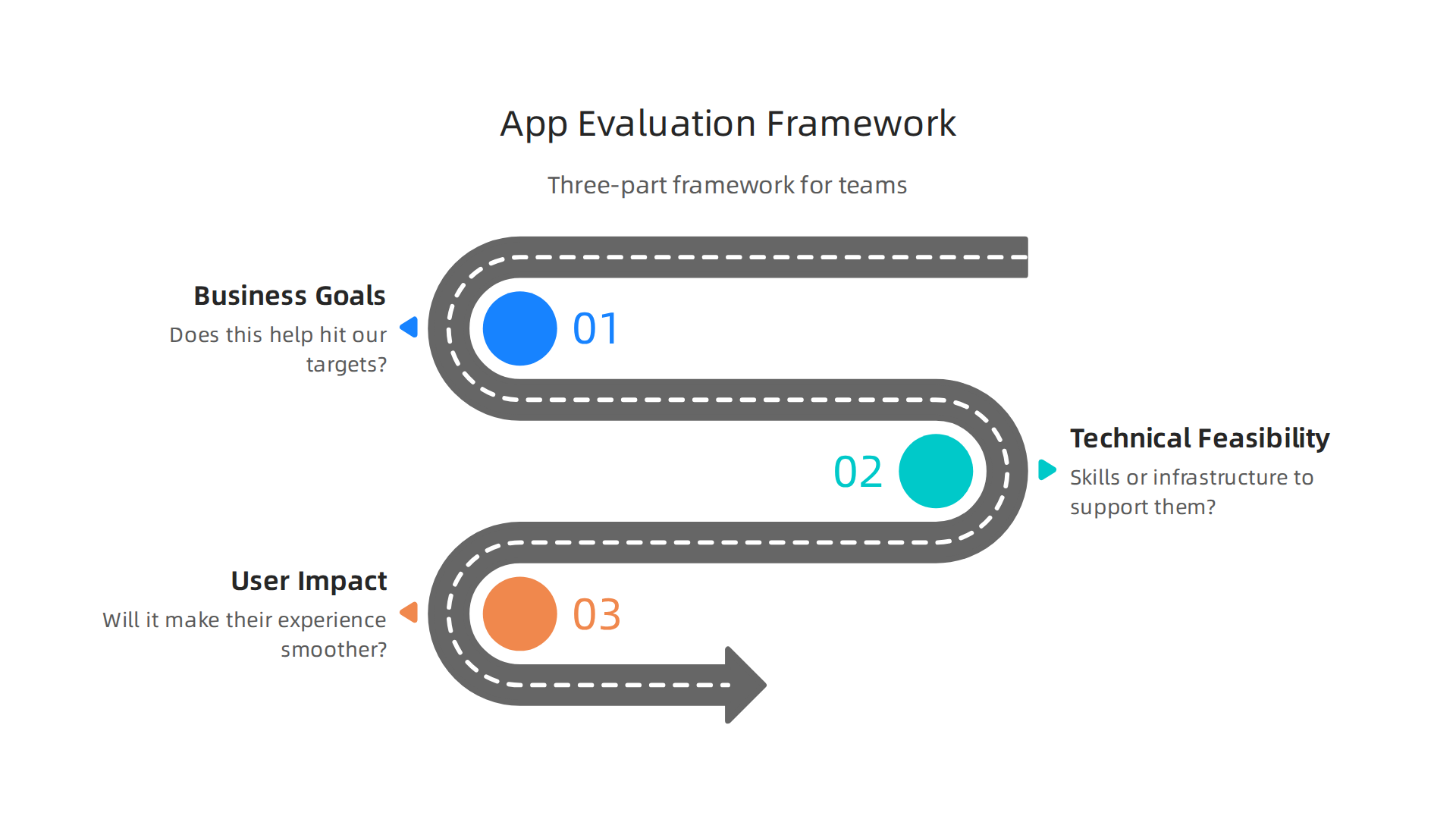
1. Check Alignment With Business Goals
Before you even think about a google play store app download or a new feature, ask one question: Does this help us hit our targets? Maybe your goal is to reduce churn by 10% this quarter. If the proposed app or feature does not connect to that goal, it is probably not worth your time. Write down the specific metric it should move before you evaluate anything else.
2. Assess Technical Feasibility
Even the most exciting apps and features fail if your team lacks the skills or infrastructure to support them. Look at the programming requirements. Do you have the right developers? Is the software applications stack compatible? How much effort will it take to integrate? Load testing and security checks matter here too. A quick feasibility scan saves your team from painful surprises later.
3. Measure User Impact
Finally, look at what the change will mean for your customers. Will it make their experience smoother? Will it solve a real pain point? User feedback, surveys, and data from your support team can help you score this. Features that delight users while also serving business goals are the ones you want to move forward with.
A modern feature prioritization matrix helps you compare options across these criteria quickly. Many teams use RICE scoring or a simple value vs. effort grid to rank their choices. The key is to get input from all stakeholders early. Involve people from development, product, and operations from the start. That way everyone buys in before the work begins.
If you want to dig deeper into how teams are structuring their evaluation process for new tools, check out our guide on mobile app development trends 2026. It covers how teams are adapting their workflows to keep up with rapid changes in apps and features.
The bottom line: Stop guessing. Use a simple framework that weighs business goals, technical feasibility, and user impact. Get everyone on the same page early. Your team will spend less time on bad ideas and more time building what actually matters.
The Developer Experience Revolution: Features That Boost Productivity
But once you pick the right apps and features using that framework, your work is not done. The next big question is how to make your developers faster and happier every single day. That is where developer experience features come in. In 2026, teams that invest in the right tools see huge gains in speed and quality.
Think about integrated debugging tools. They catch errors as you code, not after you run the whole program. Intelligent code completion, like the kind found in modern software applications, saves you from typing the same patterns over and over. And CI/CD pipelines automate the boring parts of testing and deploying. Together, these apps and features turn hours of manual work into seconds of automated action.
AI-assisted coding tools are changing the game even more. They reduce boilerplate code so you can focus on the hard problems. For example, GitHub Copilot is now a standard tool used by over 73% of professional developers according to the latest surveys. It suggests entire functions and even helps with tests. If you want to see how other teams are stacking their tools, check out the complete list of top developer productivity tools in 2026 from the DEV Community. It breaks down what actually works.
Another shift in 2026 is the rise of inner source practices. Teams borrow the open source way of working inside their own company. They share code, review each other’s pull requests, and improve shared documentation. This reduces duplication and makes onboarding faster. Good documentation features in your tools are not a nice-to-have anymore. They are critical for keeping everyone aligned.
When you pair these improvements with solid programming practices, your whole team moves faster. The best part? Many of these features are already built into common software applications you might already use.
To stay on top of every new tool and trend in developer productivity, you need a reliable source of daily updates. That is why many engineering teams subscribe to The AI Newsletter Worth Reading. It gives you clear, actionable AI updates every day so you never miss what matters.
Summary
This article explains how the mobile app ecosystem has rapidly evolved by 2026 and what product teams must know to build winning software. It covers market scale and growth drivers, the shift from consumer to enterprise apps, and why AI is now a baseline expectation rather than a luxury. The piece walks through leading cross-platform frameworks, must-have features like real-time collaboration and offline-first behavior, and how intelligent personalization engines work while highlighting privacy tradeoffs. It gives a simple three-part evaluation framework—align with business goals, check technical feasibility, and measure user impact—so teams can choose the right apps and features faster. The article also outlines developer-experience improvements (AI-assisted coding, CI/CD, inner source) that speed delivery and quality. Readers will finish knowing which trends to prioritize, how to evaluate new tools practically, and which capabilities most influence retention and productivity.