
Mobile App Development Trends 2026 AI Super Apps and Privacy First
· 19 min read
Introduction: The Mobile Revolution Continues
If you’ve used your phone today, you’ve already seen the revolution. Apps don’t just open anymore. They predict what you need. They talk to you. They work without the internet. The mobile world in 2026 is faster and smarter than ever before.
New technology like artificial intelligence, super-fast 5G, and modern development tools are making it possible to build a true game changer app. Think about creative tools like the Procreate app. It changed how artists draw on a tablet. Now imagine AI drawing alongside you or AR placing your art in the real room. That same shift is happening everywhere. In iot product development, apps now talk to smart devices in real time. For managing a cloud client, apps handle heavy data processing right on your phone instead of waiting on a server.
For developers and product teams, the challenge is real. There are too many trends to follow.

Which ones actually matter? Which ones will help you build apps people love and keep using? According to a recent report on Top 10 Mobile App Development Trends in 2026, artificial intelligence is redefining what users expect from mobile applications.
Developers looking to adopt AI can learn more about AI as the new standard for developers in 2026.
This article will cover the most impactful mobile and app development trends defining 2026. We’ll explore AI-native applications that learn from your behavior. We’ll look at super apps that combine messaging, payments, and shopping in one place. We’ll also discuss low-code platforms that let non-developers build apps quickly. And we’ll touch on privacy-first design that builds user trust. Our goal is to help you decide where to focus your energy and budget.
Want to stay ahead of every new trend? The pace of change is only getting faster. Sign up for The AI Newsletter Worth Reading for daily updates that keep you informed.
Let’s dive in.
AI-Native Apps and Intelligent Experiences
Let’s talk about the biggest shift in 2026: AI is no longer just an add-on. It’s the foundation. Apps today are built around machine learning from day one. That’s what makes a true game changer app.
Think about the Procreate app. It started as a drawing tool. Now imagine if it could predict your next brush stroke or generate a background based on your sketch. That’s the direction we’re heading. AI makes apps proactive instead of reactive. They learn your habits. They adapt in real time.
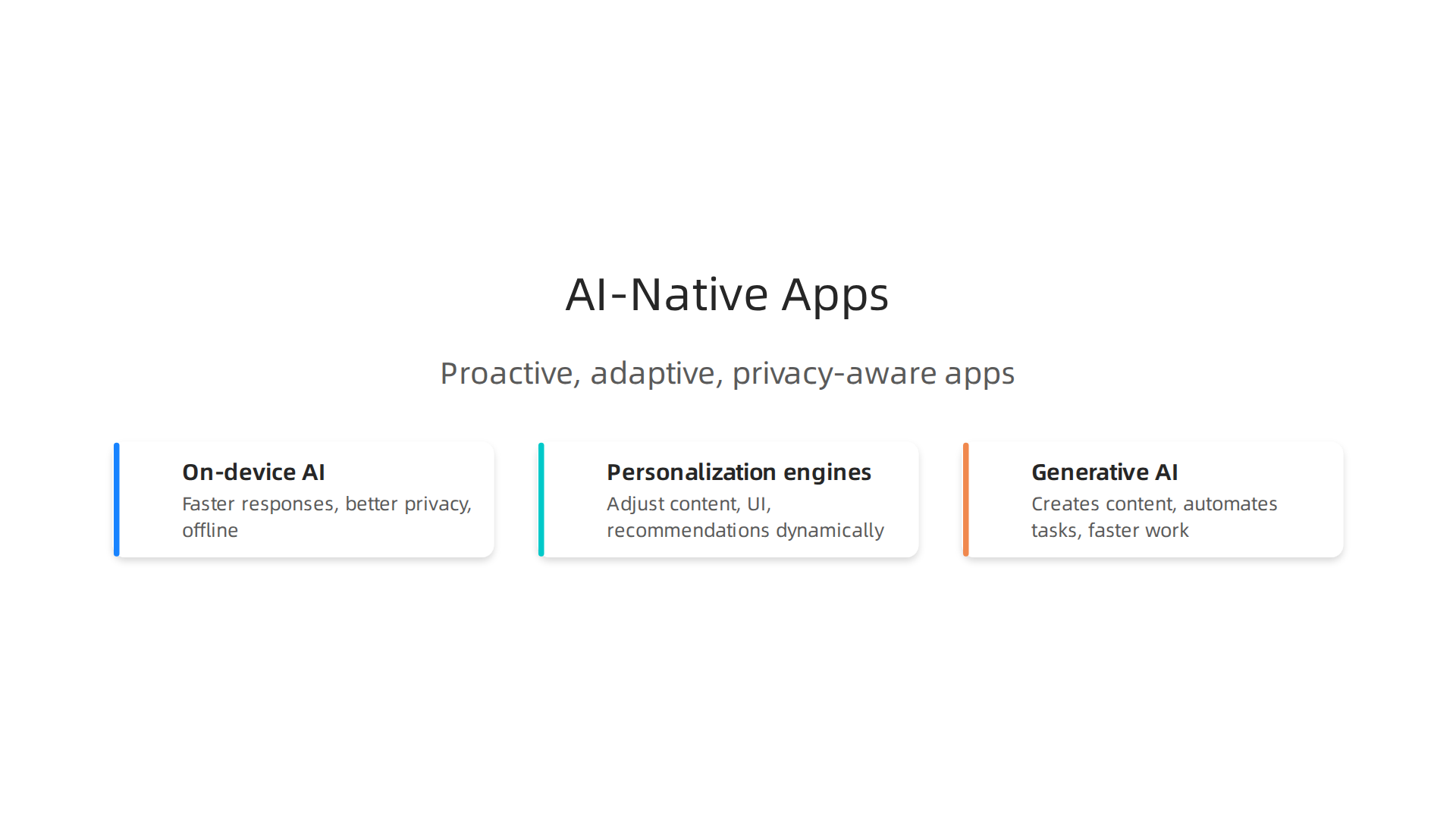
On-device AI is a big part of this. Your phone processes data locally, not in the cloud. That means faster responses, better privacy, and offline capability. For iot product development, this is huge. Smart devices can react instantly without waiting for a server. And for anyone managing a cloud client, on-device AI handles heavy tasks locally, reducing latency.
One report explains how Mobile App Trends in 2026 show that AI-native applications are now the standard.

Personalization engines adjust content, UI flows, and recommendations dynamically. Users expect predictive search and automated help as baseline features.
Generative AI is also embedded into productivity and entertainment apps. It creates content, automates tasks, and helps you finish work faster. This is changing how people use their phones every single day.
Super apps take this even further. They combine messaging, payments, shopping, and other services in one place. AI powers the personalization across all those features. That’s what makes a super app feel like a game changer app that users never want to leave.
If you’re building or planning an app this year, focus on AI from the start. Don’t tack it on later. For a deeper look at what’s working right now, check out these startup app development trends that show how teams are applying these ideas in the real world.
Cross-Platform Frameworks: The New Baseline
So you want to build a game changer app in 2026. The first big question is always: native or cross-platform? For most teams today, the answer is clear. Cross-platform frameworks like Flutter, React Native, and Kotlin Multiplatform now power over 40 percent of new mobile apps.
That’s not a fringe choice anymore. It’s the default starting point for startups, MVPs, and even some enterprise projects.
Why the shift? Performance gaps between cross-platform and native have shrunk dramatically. A few years ago you had to choose between cost savings and smooth animations. Now Flutter delivers near-native speed with its own rendering engine. React Native gives you direct access to native components through its bridge architecture. And Kotlin Multiplatform lets you share business logic while keeping fully native UI for each platform. For most use cases, users can’t tell the difference.
The real advantage in 2026 is how these frameworks embrace AI. Smart tooling like AI-powered code completion, automated UI generation, and predictive debugging are now baked into the development workflow. Frameworks integrate directly with on-device machine learning models, making it easier to add intelligent features without writing everything from scratch. This is where the idea of an AI-native app meets practical engineering.
React Native stays popular because of its massive JavaScript ecosystem. Flutter commands roughly 46 percent developer market share in 2026. Kotlin Multiplatform is growing fast in enterprises that need shared logic without sacrificing native performance. Each framework has strengths, but they all share one thing: they let you ship faster and iterate quicker. That speed matters when you’re trying to beat competitors to market.
If you’re still worried about going cross-platform, consider how major production apps from Meta, Microsoft, Shopify, and Google Pay rely on these same tools. The technology is proven.
Cross-platform development now comes with built-in AI integration as a standard feature. To stay current on these rapid shifts, check out The AI Newsletter Worth Reading for your daily AI update.
For a deeper dive into how AI is reshaping the developer’s daily workflow, our guide on AI as the new standard for developers in 2026 covers the tools and practices that actually work.
Super Apps and the All-in-One Model
Now let’s talk about one of the boldest trends in 2026: the super app. This is not just an app with extra features. A super app is a single platform where you can message friends, pay bills, order food, book a ride, shop, and manage your finances all in one place. No switching between apps. No multiple logins. It’s the ultimate convenience play.
The model has already exploded in Asia. WeChat, Alipay, Grab, and Gojek have shown that if you nail the core daily service first, users will stay for everything else. In 2026, Western companies like Uber and Revolut are actively testing this approach. They want to turn their single-purpose apps into what experts call life operating systems. According to the latest analysis on super apps and the future of mobile ecosystems in 2026, these apps are now becoming global digital platforms that combine AI personalization, mini-app frameworks, and embedded finance.

But building a super app is not easy. You need a rock-solid foundation.
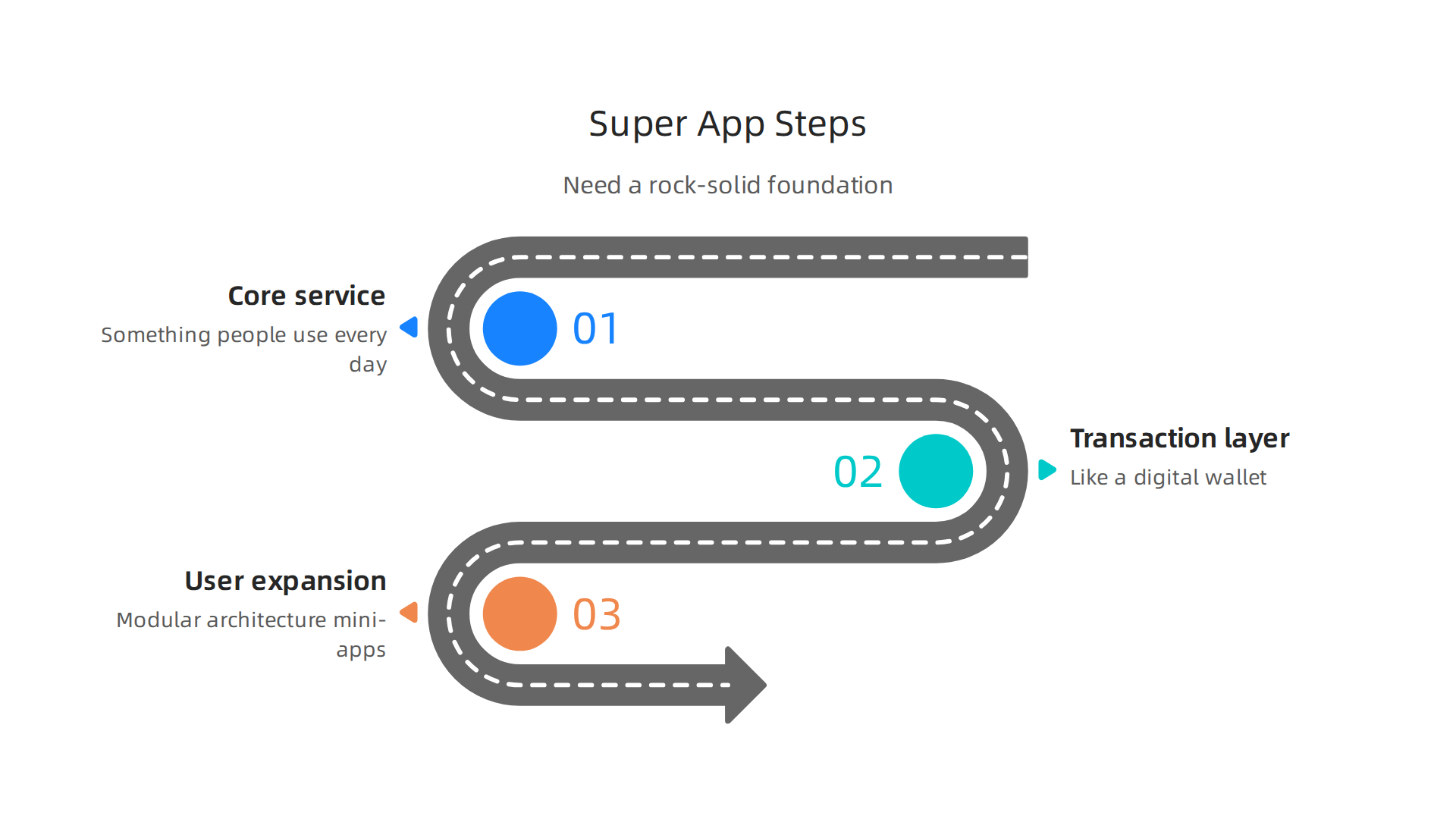
Think of it like this: your first feature must be something people use every day. That’s your anchor. Then you add a transaction layer like a digital wallet. From there, you expand based on what users actually do. The key is modular architecture mini-apps that third parties can build inside your ecosystem without forcing users to leave.
For developers, this means choosing the right stack from day one. If you are planning to build a game changer app that could grow into a super app, you need a team that understands this complex architecture. Our guide on startup app development trends 2026 walks through what actually works when you are starting from scratch.
There is a big trade-off though. Super apps collect enormous amounts of user data across services. This lets them offer hyper-personalized recommendations, but it also raises serious privacy concerns. In 2026, users are more aware than ever about how their data is used. Any super app that wants to win trust must be transparent about data handling and give users real control. Blockchain-based payment systems and on-device AI are two ways developers are tackling this challenge.
So here is the real opportunity. If you can combine the convenience of an all-in-one experience with strong privacy protections, you have a shot at building something truly sticky. Users want one trusted place for their digital life. The question is whether you can deliver it without crossing lines.
Privacy-First Development as a Competitive Advantage
Privacy used to be an afterthought in app development. You shipped a product, then worried about compliance later. That approach does not work in 2026. Privacy is now a direct competitive advantage, especially if you want to build a game changer app.
Regulations keep tightening worldwide. The GDPR in Europe, CCPA in California, and India’s DPDP Act all set strict rules on how you collect, store, and use user data. Fines are massive, but the bigger risk is losing trust. Users in 2026 have learned to read app permissions and privacy labels before hitting download. If your app asks for more data than it needs, they will skip it.
This is where on-device processing becomes a secret weapon. Instead of sending user data to the cloud for every action, you process as much as possible right on the user’s phone or tablet. On-device AI handles recommendations, voice commands, even image recognition without ever touching a server. According to the latest breakdown of mobile app development trends in 2026, on-device AI offers enhanced privacy protection while also speeding up response times. That is a win-win.
Another best practice is differential privacy. This technique adds a small amount of noise to user data before it ever leaves the device. The data is still useful for big-picture analytics, but no individual can be identified. Apple and Google already use it. If you are building a game changer app, you should too.
Transparency also matters more than ever. Apple’s privacy nutrition labels show exactly what data your app collects and why. Google Play now requires similar disclosures. These labels influence download decisions directly. A clear, minimal label is a signal that you respect your users.
If you are developing across platforms, remember that privacy also affects IoT product development. Smart devices in homes collect constant streams of data. Designing for privacy from the hardware up is not just ethical; it is expected. Similarly, deciding when to use a cloud client versus local processing is a core architectural choice that impacts both performance and trust.
To stay on top of these fast-moving trends, consider subscribing to a daily briefing like The AI Newsletter Worth Reading. It delivers clear updates on AI, privacy, and tech so you never miss what matters.
Building a game changer app in 2026 means treating privacy as a feature, not a burden.
The teams that get this right will earn the most valuable currency of all: user trust.
5G and Edge Computing: Enabling Real-Time Mobile Experiences
Have you ever used an app that felt sluggish? You tap, and there is a tiny delay. That lag ruins the experience. In 2026, users expect instant responses. The combination of 5G and edge computing makes that possible. If you are building a game changer app, this is the architecture you need to understand.

5G is not just faster downloads. The real magic is ultra low latency. That means the time between your tap and the app’s reaction drops to nearly zero. By 2026, 5G coverage has expanded far beyond major cities. It now reaches suburbs, industrial parks, and even rural areas. This opens the door for app features that were impossible before. Think cloud gaming where you play high quality games streamed directly to your phone. Think augmented reality navigation that overlays directions on the real world in real time. Think real time collaboration where two people edit a 3D model together from different locations.
But 5G alone is not enough. That is where edge computing comes in. Instead of sending every piece of data to a distant cloud server, edge computing processes data on local servers or even on the device itself. This cuts out the round trip to the cloud. The result is near instantaneous feedback. According to a recent press release on mobile app performance with edge computing and 5G, this combination is driving next gen user experiences in 2026.
Edge computing also matters for iot product development. Smart devices in homes and factories generate huge amounts of data. Processing that data locally reduces bandwidth costs and speeds up response times. Instead of waiting for a cloud command, a smart lock can react in milliseconds.
If you are deciding between a cloud client and local processing, edge computing gives you the best of both. You keep sensitive data local while still connecting to the cloud for heavy analytics when needed.
To build a game changer app in 2026, you need to design for 5G and edge from day one. Your app can then handle heavy media, real time interactions, and immersive experiences without breaking a sweat. For more on how startups are approaching app development this year, check out this guide on startup app development trends 2026. It covers the strategies that actually work for building your next app.
AR, VR, and Spatial Computing: The Next Frontier
You have heard about virtual reality and augmented reality for years. But let us be honest: until recently, many experiences felt clunky. The headsets were big, the content was limited, and the lag gave you motion sickness. That is changing fast in 2026. With 5G and edge computing powering real time interactions, augmented reality and virtual reality are finally delivering on their promise.
Devices like the Apple Vision Pro and Meta Quest 3 have reset expectations. Users now want digital content that sits naturally in the real world. They want to reach out and interact with holograms. They want to try on clothes without stepping into a store. This shift is huge for anyone building a game changer app.
Spatial computing is the term you will hear a lot this year. It blends digital objects with your physical surroundings. Instead of staring at a screen, you see information floating in the room. Your phone becomes a window into an overlaid digital layer. For example, you point your phone at a piece of furniture and see how it would look in your living room. That is spatial computing in action.
Enterprise use is growing fast too. Companies now use AR for training new workers. A mechanic can see step by step instructions overlaid on an engine. Retailers let customers see how a new sofa fits in their actual space. Remote assistance has become smoother. A technician in one country can guide a colleague on site using live AR markers. All of this was possible before, but latency made it frustrating. Now, with 5G and edge, the response is instant.
If you are thinking about building immersive experiences, you need to plan for these new workflows. According to a recent industry overview on mobile app trends including spatial computing and immersive experiences, spatial computing and AR/VR are now “must-consider” buckets for 2026 apps. The report highlights use cases like remote collaboration with 3D overlays and real time product try ons.
What does this mean for your game changer app? You do not need to build a full VR headset experience. Even simple AR features can set your app apart. Think of a real estate app that lets users walk through a virtual open house. Think of a fitness app that projects your running route onto the actual street. The technology is ready. The infrastructure is ready. Now it is about creative execution.
As you explore building for spatial computing and immersive interfaces, it helps to stay on top of the broader technology shifts that make it all possible. Staying informed about AI and edge developments can sharpen your strategy. One way to do that is by subscribing to a daily newsletter that cuts through the noise. You can get clear daily AI updates by signing up for The AI Newsletter Worth Reading. It covers the trends that affect how you build and market your next app.
For more guidance on building teams that can execute these cutting edge features, check out this guide on how to hire a full stack developer in 2026. The right talent makes all the difference when you are pushing into new territory like spatial computing.
Low-Code/No-Code: Accelerating Mobile App Delivery
You do not need to be a professional coder to build a game changer app in 2026.

Low-code and no-code platforms have changed the rules. With drag and drop builders, visual workflows, and pre-built templates, almost anyone can create a fully functional mobile app.
Think of a small business owner who wants a customer loyalty app. Before, they would need to hire a developer, wait weeks, and spend thousands. Now, they can open a platform like Adalo, Glide, or Bubble and build it in a weekend. That is real power.
Enterprise teams are also jumping in. IT departments use low-code tools to deliver internal tools faster. Instead of waiting months for a full development cycle, they can prototype in days. This speed is a huge advantage in fast moving markets.
What makes low-code even better in 2026 is the integration with AI copilots. Many platforms now include an AI assistant that helps you design screens, connect data, and debug logic. You type what you want, and the copilot builds the basic structure. This slashes the learning curve. Even someone with no coding experience can start creating right away.
If you are working on a game changer app for a niche like iot product development, low-code can help you launch a minimum viable product (MVP) quickly. You can test your idea with real users before investing in a full custom build.
According to a detailed guide on cross-platform app development pros and cons in 2026, low-code and no-code platforms are part of the reason why cross-platform adoption is booming. The report notes that over 40% of new apps now use frameworks that speed up delivery, including visual builders.
Of course, low-code has limits. For highly complex or performance-sensitive apps, you will still need custom code. But for many use cases, it is the fastest path to market.
If you want to learn more about choosing the right approach for your next project, check out this resource on startup app development trends in 2026. It covers what actually works when building a new app today.
The message is clear: you do not have to be a developer to turn your idea into a real product. Low-code and no-code let you focus on what matters: solving a real problem for your users.
Blockchain and Decentralized Apps: Beyond Crypto
Low-code tools let you build fast. But what if your app needs trust and transparency without a central authority? That is where blockchain and decentralized apps (dApps) come in. In 2026, blockchain is no longer just about cryptocurrency. It is becoming a core technology for mobile apps that handle identity, payments, and data sharing.
Blockchain allows trustless transactions. This means two parties can exchange value or information without needing a middleman.

For mobile apps, this opens up features like decentralized identity. Instead of logging in with a password stored on a company server, you can use a self-sovereign identity stored on the blockchain. You control your own data.
dApps are moving beyond finance into real industries. Supply chains now use blockchain to track products from factory to store. Healthcare apps store medical records on-chain so patients can share them securely with any doctor. Social media platforms are experimenting with decentralized networks where users own their content and followers. These are not experiments anymore. They are real products.
According to a report on blockchain DApp development trends in 2026, industries like banking, logistics, and insurance are actively deploying decentralized solutions. The same report notes that enterprise adoption is now outpacing early-stage startups in many areas.
If you are building a game changer app that needs to operate without central control, blockchain might be the foundation you need. For example, a supply chain app combined with iot product development could use blockchain to create an unchangeable record of every step a product takes. Or a cloud client app could store encrypted user data across a decentralized network rather than on a single server.
That said, there are still barriers. Scalability remains a challenge. Public blockchains can be slow and expensive for high-volume mobile apps. User experience is also a hurdle. Many dApps still require users to manage wallets, sign transactions, or understand gas fees. For mass adoption, these friction points need to disappear.
The technology is evolving fast. Layer-2 networks and account abstraction are making dApps faster and easier to use. But for now, you need to weigh the benefits of decentralization against the added complexity.
If you want expert help bringing your blockchain idea to life, you can read this guide on how to hire a full stack developer in 2026. And to stay informed on how AI and blockchain are converging this year, The AI Newsletter Worth Reading delivers daily updates straight to your inbox.
Summary
This article maps the most impactful mobile app trends shaping 2026 and gives practical guidance for building a standout product. It explains why AI-native design is now foundational, how cross‑platform frameworks speed delivery, and what it takes to grow into a super app while protecting user trust. You’ll learn why on‑device AI, differential privacy, 5G plus edge computing, and spatial AR/VR are changing user expectations, when low‑code is the fastest route to an MVP, and where blockchain makes sense despite UX and scalability tradeoffs. The piece helps product teams prioritize investments, choose architectures (cloud vs local), and staff the right talent to turn trend awareness into deliverable features users actually want.