
Open Future AI Is the New Standard for Developers in 2026
· 21 min read

Introduction
A few years ago, cutting-edge AI lived behind closed doors. Only a handful of big companies held the keys to the most powerful models. That world is gone. In 2026, the AI landscape is shifting hard toward open, collaborative frameworks. Developers, startups, and even solo builders now have access to tools and models that were once locked inside corporate vaults.

This movement is often called open future ai, and it is changing how we build software.
Understanding open future ai matters more than ever. Whether you are experimenting with personal AI assistants, exploring lightweight architectures like Lightchain AI or Spark AI, or following the latest in technology development, the shift from closed to open systems affects every choice you make. Open models let you inspect the code, fine-tune the weights, and deploy on your own infrastructure. That freedom speeds up innovation and lowers costs.
This article walks through the evolution of open AI, the trends driving it in 2026, the challenges that come with openness, and how you can integrate these tools into your own projects. Along the way, you will see how the transition from proprietary giants to community-driven development is reshaping the entire software industry.
To understand how we got here, it helps to look at the key milestones. The history of OpenAI on Wikipedia shows how the organization started as a nonprofit with a mission to democratize AI and later evolved into a central player in both closed and open movements.
For developers who want to put these ideas into practice today, one great place to start is AI coding assistants in 2026. These tools make it easier than ever to experiment with open models and speed up your daily workflow.
Staying ahead in this fast-changing field means staying informed. The AI Newsletter Worth Reading delivers clear daily updates so you never miss a breakthrough in open future ai and the broader AI ecosystem.

Open Future AI: A New Paradigm
The old model of AI development was simple: a few companies built giant, secret models and sold access to them. That model is breaking apart. In 2026, the open future ai paradigm flips that script. Instead of locked black boxes, we see transparent models that anyone can inspect, modify, and run on their own hardware. This shift is redefining the competitive landscape. Small teams and solo developers now compete with big labs because they can build on top of shared foundations.
Open collaboration accelerates research in a way that closed systems never could. When a researcher in Japan improves a model weight, a developer in Brazil benefits instantly. The AI timeline from 2020 to 2026 shows how fast this ecosystem grew once key building blocks became public.
Key projects like Meta’s Llama and Google’s Gemma have become the pillars of this movement. They prove that openness does not mean lower quality. These models rival proprietary options in performance while giving developers full control over deployment and customization. For practical hands-on experience with open models, the GLM coding plan offers a clear entry point for building AI-assisted workflows today.
From Proprietary to Open: A Timeline
To understand how we got here, it helps to look at the key milestones that pushed AI from closed labs into open hands.
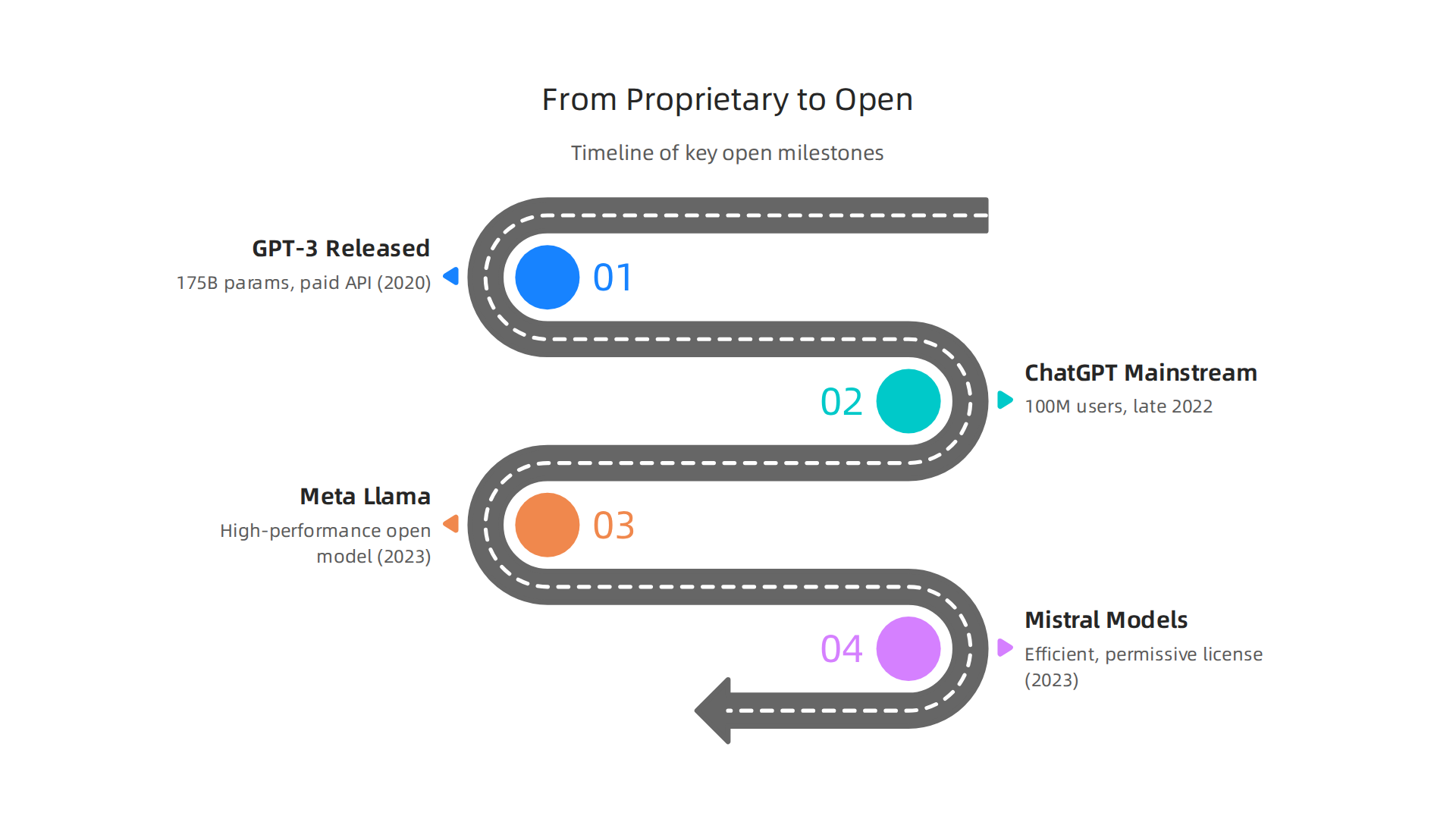
In 2020, OpenAI released GPT-3, a 175-billion-parameter model that showed what large language models could do. But it was only accessible through a paid API. That changed quickly. By late 2022, ChatGPT made generative AI mainstream, reaching 100 million users in two months.
Then came the shift toward openness. In 2023, Meta released Llama, one of the first high-performance open models. Mistral followed with efficient, permissively licensed models that anyone could download and fine‑tune. These releases proved that open models could compete with proprietary ones. The AI timeline from 2020 to 2025 shows how fast this transition happened, with community contributions driving rapid improvements in benchmarks and safety testing.
Open collaboration now fuels technology development faster than any single company could manage. When a researcher improves a model weight, the whole ecosystem benefits. This kind of shared progress is exactly why strategic research and development for software innovation matters today.
Want to stay ahead of every shift in AI? The AI Newsletter Worth Reading delivers clear daily updates on open models, personal AI tools, and the trends shaping 2026.
Key Projects Driving Open AI
Several open model projects are leading the charge in 2026.
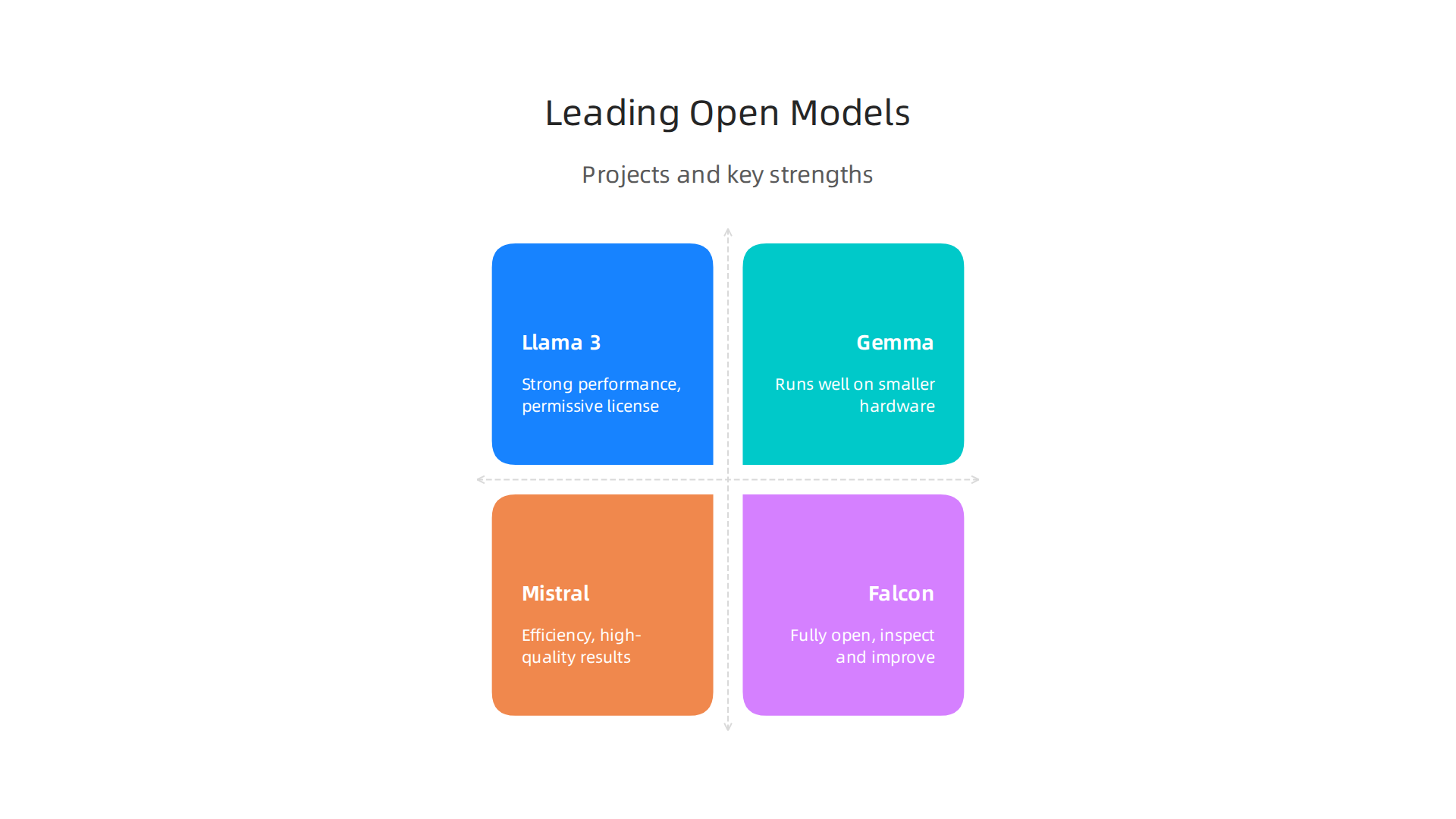
Llama 3 from Meta offers strong performance and a permissive license, making it a top choice for developers who want to customize models for their own needs. Gemma from Google gives researchers a lightweight option that runs well on smaller hardware. Mistral focuses on efficiency, delivering high-quality results with fewer computing resources. And Falcon from the Technology Innovation Institute provides a fully open model that anyone can inspect and improve.
Each project brings unique strengths. Llama 3 shines in community support, while Gemma excels in accessibility. Mistral leads in speed, and Falcon offers transparency. These differences matter because they let teams pick the right tool for each job.
But the real power comes from cross-project collaboration. Researchers share techniques across these models, which speeds up the technology development process for everyone. This kind of shared progress is exactly what makes the open future AI so exciting. If you want to see how these tools work in practice, check out our guide on AI coding assistants in 2026. The rapid evolution of these projects is one of the key milestones in AI history.
Current Trends Shaping Open AI Development
These projects set the stage for the next wave of innovation. In 2026, several trends are shaping the open future AI landscape. Agentic AI is a huge focus — systems that can plan, use tools, and complete long running tasks on their own. Reasoning models are also getting better at breaking down complex problems step by step. Multimodal abilities let these models understand text, images, audio, and video together.
Open source frameworks for building AI agents are gaining major traction. Popular options like LangGraph, CrewAI, and AutoGen help developers create multi-agent systems without vendor lock-in. Leaders like LangChain report that most teams now use multiple models across their projects, and the best open source frameworks for building AI agents in 2026 are enabling rapid experimentation.
Community driven fine tuning is also becoming standard. Developers take base models and specialize them for niche tasks — from healthcare to logistics — using public datasets and shared benchmarks.

This collaboration drives faster technology development for everyone.
To stay on top of these fast moving trends, subscribe to The AI Newsletter Worth Reading for clear daily updates.
Large Language Models and Open Access
The rise of open LLMs is a core part of this open future ai movement. In just the last year, the number of high quality open source language models has exploded. You now have dozens of capable models you can download, inspect, and run yourself without paying per API call.
Here is the thing: the performance gap has nearly closed. Leading open LLMs now match or come close to proprietary models like GPT-4o on many standard benchmarks. Open models from groups like Meta, Mistral, and Alibaba have proven you do not need a billion dollar budget to build something powerful.
This shift lowers the bar for everyone. Startups can experiment with a local model before committing to a paid API. Researchers can fine tune a base model on their own data without sharing sensitive information. Even hobbyists can spin up a personal ai assistant on their laptop.
The result is faster technology development across the entire field. Because so many teams now use multiple models in production, the ecosystem is far healthier than it was a few years ago. According to the popular State of Agent Engineering report from LangChain, model diversity is now the norm rather than the exception.
If this is your first time diving into open models, you might appreciate a practical roadmap for beginners using AI to learn the basics. The best part is you can start right now with nothing more than a laptop and curiosity.
AI Agent Frameworks Go Open Source
The shift to open LLMs opens the door to something even bigger: open source AI agent frameworks. These toolkits help you build smart programs that can plan, use tools, and work together. They are a key part of the open future ai movement.
Frameworks like LangChain, AutoGen, and CrewAI let you create multi-agent systems where several AI workers handle different parts of a complex task.

This is not a niche idea anymore. Gartner’s AI agent adoption forecast shows that 40% of enterprise applications will feature task-specific AI agents by the end of 2026, up from less than 5% in 2025.
Because these frameworks are open source, you can look under the hood. You can customize how agents behave, swap in any LLM you prefer, and avoid vendor lock in. That transparency is critical for serious technology development projects. If you are new to building with AI, you might also explore AI coding assistants in 2026 to see how similar open approaches apply to everyday coding.
Agentic workflows are becoming the standard way to automate research, data processing, and customer support. To keep up with these fast-moving trends, consider The AI Newsletter Worth Reading for daily AI updates straight to your inbox.
Overcoming Technical Hurdles in Open AI
Building an open future ai is exciting, but it comes with real challenges. Scalability can trip up even the best teams.

Open models often need huge amounts of data and computing power to train and run well. That puts a strain on budgets and infrastructure.
Data quality is another big hurdle. If the information you feed an AI agent is messy or incomplete, the results will be too. To deal with this, open source communities are pooling resources to build domain-specific datasets and benchmarks. These help agents learn reliably for fields like healthcare and finance.
Compute efficiency also matters. Running large models requires careful management of GPU memory and network speed. Many teams now turn to open source frameworks that help monitor and optimize these resources. You can learn more about these strategies in our guide on Anthropic AI for developers and how it helps manage complex coding tasks.
The good news? New techniques and community collaboration are steadily lowering these barriers. For a deeper look at infrastructure hurdles, check out the State of Agent Engineering report from LangChain, which covers GPU utilization and scaling behavior. The path to a truly open future ai gets smoother every month.
Scalability and Compute Efficiency
Training a truly open future ai model takes a massive amount of computational power. GPT-3, for example, required roughly $560,000 worth of compute for a single training run on A100 cards, according to a breakdown from Navigating the High Cost of AI Compute. That kind of cost can shut out smaller teams and hobbyists.
The good news is that smart engineering can dramatically reduce these requirements. Two techniques lead the way:
- Model quantization shrinks the numbers used in calculations, making models smaller and faster without losing much accuracy.
- Pruning removes unimportant connections inside a neural network, cutting down the work needed for each prediction.
On top of that, distributed training lets developers split the workload across many GPUs at once. When you combine these tricks, you can cut GPU needs by up to 93 percent, as shown in a study on the resource cost of AI. With these efficiency gains, building an open future ai becomes far more practical.
If you are exploring how to pick the right infrastructure for your AI projects, check out our guide on how to evaluate quantum computing companies for your software stack. It covers the tradeoffs between different hardware options.
Staying on top of these fast-changing strategies is hard. For clear daily AI updates that cut through the noise, subscribe to The AI Newsletter Worth Reading.
Data Quality and Model Robustness
Building an open future ai that works for everyone depends on more than raw compute power. The data you feed the model matters just as much.
Open models trained on vast internet data can easily pick up biases, errors, and inaccuracies from the source material. If the training data is messy, the model will be too. That is why curating high quality training data is a must for any team serious about creating a trustworthy personal AI or a tool like Lightchain AI or Spark AI. Clean data leads to more reliable outputs.
Two techniques help improve robustness:
- Data augmentation creates new training examples by slightly changing existing ones. This helps the model handle real world variety.
- Adversarial training exposes the model to tricky inputs designed to fool it. The model learns to stand up to those attacks and becomes more resilient.
Together, these methods reduce the risk of harmful bias and improve reliability. Investing in solid technology development for data curation and model testing is not optional. It is essential. For a deeper look at how to drive software innovation through careful planning, check out our guide on strategic research and development for AI data quality.
The Open Source Movement’s Role in AI
Clean data and robust models are part of the picture. But building an open future ai that truly serves everyone requires something bigger: community.
The open source movement has brought developers from all over the world together to build and improve AI models collaboratively. When many eyes review the code, data, and outputs, flaws get spotted and fixed faster. This crowd-powered approach directly improves model accuracy, safety, and usability.
Open source licensing also shapes how quickly new technology spreads. Permissive licenses let startups, researchers, and even large companies use, modify, and distribute AI tools without heavy legal costs. That lowers the barrier to entry for small teams who want to build a personal AI or contribute to projects like Lightchain AI or Spark AI.
Training frontier models is incredibly expensive. For example, research on navigating the high cost of AI compute estimates that a single GPT-3 training run can cost between $500,000 and $4.6 million. Open source helps spread that cost across many contributors and prevents the need for every team to start from scratch.
For developers who want to put these community-driven models to work, our deep dive on AI coding assistants in 2026 shows how open source AI is changing the way we build software.
The vision is clear: shared progress, wider access, and faster innovation. To keep up with the latest shifts in open AI, software development, and more, subscribe to The AI Newsletter Worth Reading for daily updates you can actually use.
Community-Driven Model Development
Open source licenses make code and data accessible. But the real magic of an open future ai happens when people build together on shared platforms.
Take Hugging Face. This platform has become a central hub where developers from different teams, companies, and countries collaborate on model fine-tuning and sharing. Instead of each person training a model from scratch, they start from an existing base and adjust it for their own use case. That saves massive amounts of compute and time.
Community-led projects also allow for rapid iteration. A developer posts a model, others test it, report issues, and suggest fixes. Within days, the model improves in ways that a single team might have taken weeks to achieve. The Understanding FLOPs-per-token estimates from OpenAI’s scaling laws discussion on Hugging Face shows how community members break down complex topics and share practical insights.
Crowdsourced benchmarks add another layer of transparency. When many people evaluate a model using the same tests, you get a clearer picture of its real-world performance. This openness helps everyone make better decisions about which model to use or contribute to.
For teams that want to participate in this collaborative model development, adopting strategic research and development practices can help them maximize the value of community contributions.
Licensing and Commercial Viability
Community building is powerful, but for an open future ai to truly succeed, the license behind each model really matters. The license decides who can use the model, for what purpose, and under what conditions.
Different open source licenses come with different commercial implications. Apache 2.0 and MIT are the most common permissive licenses. They let you use, modify, and sell products built on the model with very few restrictions. The Rainbow License, on the other hand, adds rules that limit harmful use and may require companies to contribute back. This can affect how easily you can deploy the model inside a commercial product.
Startups often lean toward permissive licenses. Why? Because they want the widest adoption possible. If a model is easy to integrate without legal headaches, more developers will try it. That lowers the barrier for building commercial applications. But you also need to think about regulatory requirements. For example, the EU AI Act now demands categorization and oversight for high-risk AI systems, as covered in the AI ethics and policy issues of 2026.
For teams building commercial applications on open models, understanding startup app development trends in 2026 can help align licensing strategy with product goals.
To stay sharp on the latest legal and commercial shifts in AI, subscribe to The AI Newsletter Worth Reading for daily updates.
Ethics, Safety, and Governance in Open AI
Open AI models offer incredible flexibility, but they also come with real risks. Bias in training data, misuse of capabilities, and lack of accountability are not just theoretical problems.

As more developers build on open models, these issues demand attention. Even OpenAI’s own CEO has flagged key ethical and security concerns around AI systems, including mental health risks and governance gaps.
Governance frameworks are still playing catch up. In 2026, the EU AI Act requires risk categorization and oversight for high-risk systems, but many other regions lack clear rules. That means your team needs to build responsible practices directly into your development pipeline. Regular audits, bias checks, and transparency measures should be part of everyday work, not afterthoughts.
For developers looking to integrate responsible practices into their workflow, exploring AI coding assistants that solve the trust problem can be a practical starting point. The goal is to build open future AI systems that are not only powerful but also trustworthy.
Bias Mitigation and Fairness
A big part of building trustworthy open future AI systems is tackling bias. Open models learn from huge datasets scraped from the internet. Those datasets contain real world prejudices around race, gender, and culture. So the models pick them up too. That can lead to unfair or harmful outputs, especially when used in hiring, lending, or healthcare.
The good news is that the technology development community is fighting back. Techniques like fairness aware training and debiasing are becoming standard practice. Teams now bake fairness checks directly into their training pipelines. Community audits and red teaming sessions help catch hidden biases before models go live. Regular testing with diverse groups reveals blind spots that automated checks might miss.
According to a review of major 2025 ethics issues, algorithmic discrimination remained a significant challenge, but audits and fairness tools are improving. Staying on top of these evolving practices is key for any developer building with AI.
If you want to build bias mitigation into your workflow, check out this guide on strategic research and development for ethical AI. It offers a practical starting point for teams serious about fairness.
And to keep learning about the latest in responsible AI and technology development, subscribe to The AI Newsletter Worth Reading for clear daily updates straight to your inbox.
Regulatory Landscape and Compliance
Bias mitigation is only one piece of the puzzle. Governments around the world are now creating laws that directly affect how open future AI systems get built and used. That means staying on top of regulations is just as important as making your model fair.
In 2026, the EU AI Act is fully in force. It requires organizations to sort their AI systems by risk level, run oversight plans, and publish transparency information. High-risk systems used in hiring, credit, or public services face strict checks. The US has also moved forward with Executive Orders and updated national policy frameworks. Other countries like Brazil and India are drafting their own rules. The key idea is that compliance is no longer optional.
For developers working on open future AI, this means building with compliance in mind from day one. You need to document your training data, test for bias, and set up human oversight. If you want a deeper look at what’s changing, check out this overview of the Top AI ethics and policy issues of 2025 and what to expect in 2026.
Staying informed about these rules helps you avoid legal trouble and build trust with users. For more practical tips on how to build trustworthy AI tools, take a look at this guide on AI coding assistants that build trust in 2026. It covers real world approaches to keeping your software ethical and compliant.
Integrating Open AI into Your Tech Stack
Once you understand the rules, the next step is putting open future AI tools to work in your own tech stack. Integrating open AI into your existing workflows takes careful thought. You need to pick the right model and API based on what your app does, how fast it needs to respond, and what you can afford. Small personal AI projects might use a lightweight API, while larger systems often lean on platforms like lightchain AI or spark AI to handle scale.
The best approach is to start small. Run a simple test with a single API call before building out complex features. As you get comfortable, add more functionality step by step. Always plan for scaling from the beginning. OpenAI’s own team recommends following production best practices for scaling AI apps like using caching, load balancing, and monitoring to keep costs down and performance up.
To go deeper on building AI tools that fit your stack, check out this guide on understanding Forge Code for AI software development. And for daily updates on where technology development is heading, you can get clear daily AI updates from The AI Newsletter Worth Reading.
Choosing the Right Open Future AI Tools
With so many open future AI options available today, picking the right one for your project can feel overwhelming. Focus on a few key factors: model size, performance, license type, community support, and where you plan to deploy. For personal AI experiments, lightweight models may be enough. For larger systems, platforms like lightchain AI or spark AI can help you scale.
Three popular tools worth exploring are Hugging Face Transformers, vLLM, and Ollama. Hugging Face gives you access to thousands of pre-trained models. vLLM focuses on fast inference. Ollama makes it easy to run models locally. Each serves a different need.
Before committing to any tool, run a small proof-of-concept. Test it with your real data and see how it performs. Many developers share their experiences, like in this discussion on choosing an AI tech stack. Also check out AI coding assistants in 2026 for more ideas on integrating AI into your workflow.
By evaluating tools early, you save time and avoid picking a tool that does not fit your needs.
Workflow Optimization with AI APIs
Once you have chosen your open future AI tools, the next step is using AI APIs to speed up your daily work. AI APIs can automate code generation, testing, and documentation. This saves you hours each week.
But to get the most out of them, you need to optimize how you make API calls. For example, you can use caching to avoid repeated requests and batching to group prompts together. Lowering your max tokens setting also cuts latency and cost. Following production best practices for AI APIs helps you scale without breaking your budget.
You can also plug AI APIs into your CI/CD pipeline. That way, every time you push code, AI runs tests or generates summaries automatically. Tools like Anthropic AI for developers show how this works in practice.
Technology development moves fast, and AI updates come daily. To stay ahead, get clear daily updates from The Deep View Newsletter. It covers the latest AI trends and tools to keep your workflow sharp.
Summary
This article explains the rise of an